This week at a glance
The week’s market story was resilience. On November 13 the FAA halted flights nationwide for more than four hours after a newly installed router flooded its legacy network, and the agency paused further installs of Juniper routers. It landed in a week that also saw outages at Microsoft, Workday and JPMorgan Chase, none of them linked to an attack. Forrester’s response was that network transformation itself must be engineered for failure, and Uptime Institute figures put configuration and change failures behind 41% of network-related outages. For buyers, the question moved from “is the network up?” to “do we know what our next change will do?”, and CIOs were told to bring that case to the board as exposure and cost, not as a request for more budget.
The supply side answered with control as the selling point. HPE said customers, not HPE, decide where its Marvis agents may act alone, after calling itself the first fully autonomous provider in May. Microsoft described more than 100 agents working on Azure’s network, each with its own identity and a human manager, and said they handled more than 30,000 cases in a year. Itential used AutoCon 6 to release an open-source library of agent skills, which treats operational know-how as something to be shared rather than locked inside one platform. The community’s own survey showed the opportunity: the gap between teams that want troubleshooting automated and those that have done it reached 52.9 points, and 46% of automating teams have no formal way to measure results.
Distribution is changing too. DXC built Cisco’s agentic tools into its managed operations platform, Cisco told partners that agents could double their service margins, and Westcon-Comstor launched an AI governance alliance with Extreme and Check Point. LogicMonitor folded its AI into every package with a single credit pool, and Kentik and Infoblox connected their assistants to each other. For a vendor competing in enterprise NetOps, the week set out the terms: buyers want proof that changes are safe, autonomy they control, and outcomes they can measure, and more of them will buy it through a services partner.
On our watch list
- The FAA’s root-cause findings and the length of the router pause. The FAA has not said how long the Juniper install pause will last, and Forrester notes the cause is reported but not confirmed. A finding that points to change control rather than equipment would make pre-change verification a standard question in large network migrations, in government and beyond.
- Congressional follow-up on the outage week. Senate committee members have already cited installation figures for the FAA programme (3,648 devices planned, 69 operational). Hearings or a formal review would keep outage risk in front of boards into the first quarter, when many network budgets are set.
- Microsoft’s post-incident report on its Microsoft 365 outage. Last week Microsoft traced the outage to a network change; the full review will show whether a second hyperscaler-scale incident reinforces the change-risk story buyers are hearing.
- Whether HPE discloses how many customers turned on fully autonomous fixes. HPE declined to give Asia Pacific numbers or say how far Marvis works with other vendors’ equipment. A disclosed adoption figure would show how much autonomy buyers actually grant when the choice is theirs.
- Contributions to Itential’s open-source agent skills. The library launched with 40 capabilities and 153 vendor-specific references. Outside contributions, or other vendors adopting the same skills format, would signal that operational know-how is becoming a shared layer rather than a platform differentiator.
- A primary release of the 2026 State of Network Automation survey. The survey’s numbers have so far reached the market through one practitioner blog. If the Network Automation Forum publishes the full data, the 52.9-point troubleshooting gap and the ROI-measurement gap become citable benchmarks for every vendor pitch.
- Named customers for DXC and Cisco’s agentic operations work. DXC cites a pilot that cut incident resolution from one to two hours to five to seven minutes, but no named customer. Reference accounts, and expansion beyond Meraki Wi-Fi incidents, would show whether systems integrators become a main route to market for agentic network operations.
- How MSP contracts shift from tickets to fixed fees. Tech Data warned that ticket-based managed services lose revenue as incidents fall. Watch renewal terms at the large MSPs and distributors over the next two quarters; fixed-fee contracts reward tools that prevent incidents rather than count them.
- LogicMonitor’s year-end package migration. Current LogicMonitor packages expire at the end of 2026. Customer response to bundled AI with a single credit pool will be an early read on whether buyers accept AI priced as consumption inside a platform fee.
- Microsoft’s agent figures beyond its own network. Microsoft’s 100-plus agents and 30,000 cases are its own claims about its own estate. Watch whether Azure turns that operating model into customer-facing network operations services, which would put a hyperscaler directly into the enterprise NetOps conversation.
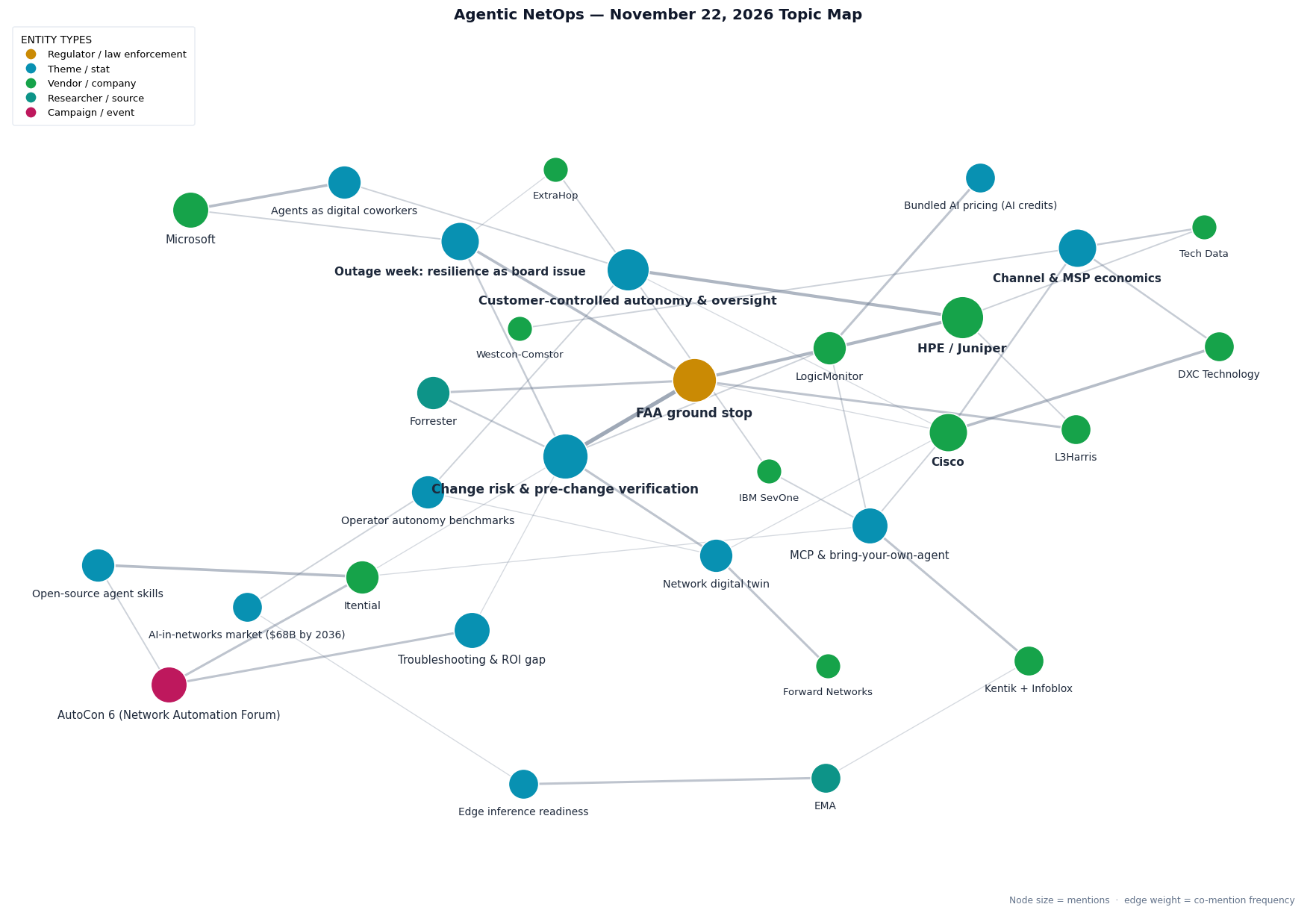
Entities and connections across this week’s 24 tracked stories. Node size reflects how often an entity appears; line weight reflects how often two appear together.
View interactive topic map →
Article index
The resilience case: a week of outages
The FAA ground stop and a cluster of other outages turned network change risk into a board-level topic. Analysts and CIOs framed the response as engineering for failure and making the cost of exposure visible.
AutoCon 6 and the direct field
The network automation community met in Tucson. Itential released open-source agent skills, and practitioner coverage of the event set out the troubleshooting gap, the measurement gap and why large organisations stall.
Incumbents and hyperscalers set the terms
Microsoft described running its own network with agents, and HPE repositioned autonomy as something the customer switches on.
Services and channel
A systems integrator, Cisco’s partner organisation and a large distributor all packaged agentic operations for delivery through partners.
Packaging, pricing and interoperability
LogicMonitor bundled its AI into every tier and added configuration management; Kentik and Infoblox let their assistants call each other.
Market sizing & analyst view
EMA measured how unready enterprise networks are for AI at the edge, and a syndicated forecast put the AI-in-networks market at $68 billion by 2036.
Operator benchmarks
Telecom operators are further along on certified autonomy. These rows are benchmarks for the enterprise market, not the lead.
Foundational: new approaches
Vendor explainers on the approaches buyers are weighing: digital twins as the safety layer for agents, wire data, staged agentic NOC models, and customer advisory input on agent governance.
Detailed write-ups
1. The FAA ground stop makes change risk a board-level issue
Network World · Forrester · InformationWeek · November 17–19, 2026
On November 13 the FAA halted departures across the US for more than four hours. According to the FAA, traffic flooded its legacy copper network at about 1,000 connection attempts every four to five seconds, and the instability spread to 17 of 22 air route traffic control centres. The agency traced the traffic to two sites where L3Harris, the programme contractor, had deployed new routers, and it paused further installation of Juniper routers without saying for how long. Senate committee members, citing L3Harris, said 3,648 Juniper devices are planned, with 400 installed and 69 operational. HPE, which owns Juniper, said its equipment “was working as configured,” while Transportation Department leadership pointed to ageing Cisco servers. Forrester notes that the investigation is ongoing and that there is no public evidence of a cyberattack.
The analysts drew the market lesson quickly. Network World cited Uptime Institute figures that configuration and change-management failures cause 41% of network-related outages. Forrester’s Andre Kindness and colleagues said the failure came during a migration from legacy copper to IP, and argued that “network transformation itself must be engineered for failure”: model dependencies, set go/no-go thresholds, rehearse rollback, limit blast radius, migrate in small steps, restrict contractor access to approved work windows, and measure resilience in business terms. InformationWeek set the FAA event inside a wider week that also hit Microsoft, Workday and JPMorgan Chase, with no link between them, and quoted research from Origina that vendor-driven upgrades take about 28% of enterprise software budgets and pull experienced engineers off other work. NetBrain CEO Bernadette Nixon was quoted in both trade pieces; former CIO Lisa Palmer put the CIO case as “Deferred maintenance isn’t savings. It’s a loan.”
For the enterprise NetOps market this is the clearest demand signal in months. A public, nationally visible outage tied to a single change during a migration gives every board a reason to ask how its own changes are tested, and gives CIOs a way to frame the spend as reduced exposure rather than more headcount. It also puts suppliers and contractors inside the risk picture, which widens the buyer from the network team to programme owners and procurement. Vendors that can show, with evidence, what a change will do before it is made are now answering a question boards are asking directly.
Sources: Network World (FAA halts router installs as experts question how one change grounded the nation) · Forrester (The FAA Ground Stop Shows Why Network Transformation Must Be Engineered For Failure) · InformationWeek (Can CIOs turn a week of outages into a business advantage?)
2. AutoCon 6: Itential open-sources agent skills as the automation gap widens
Futuriom · Network Doodles · November 17–21, 2026
Itential used AutoCon 6 in Tucson, the Network Automation Forum’s event, to release Agent Skills: an open-source library, under the Apache 2.0 licence, of reusable operational procedures for agents. It launched with 40 operational capabilities and 153 vendor-specific references, covering tasks from certificate management to incident resolution and network changes, and invites outside contributions. The skills work in Itential’s own FlowAI agent platform or any agent platform that supports the open Agent Skills format. It follows Itential’s open-source MCP server in 2025 and FlowAI’s general availability in July, which Gartner listed among five “coolest vendor innovations” in agentic AI for enterprise networking. Co-founder and CTO Chris Wade framed the move as “making operational expertise available to agents.”
The community’s own data shows why the timing matters. The 2026 State of Network Automation Survey, presented at the event and reported by practitioner David Henderson, found that 66.3% of its 344 automating respondents say troubleshooting should be automated but only 13.4% have done it, a 52.9-point gap that has widened every year since 2023. Some 46% of automating teams have no formal way to measure results, and teams with a dedicated automation engineer were far more likely to validate in production and measure outcomes. Two talks put the obstacles in executive terms: Salesforce’s Anna Claiborne argued that large organisations stall because governance and risk controls work exactly as designed, and US Signal’s Sean Mahoney said that when agents can build software quickly, verification, not building, becomes the bottleneck.
The market reading is twofold. Itential is betting that operational procedures become a shared, open layer and that value moves to the platform that runs and governs them, which pressures vendors whose differentiation is a proprietary library of workflows. And the survey describes a buyer who wants troubleshooting automated, has not got there, and cannot yet prove the return. Vendors that close the troubleshooting gap and hand buyers a measured outcome are selling to the largest unmet need the community has documented.
Sources: Futuriom (Itential Launches Open-Source Skills for Agentic NetOps) · Network Doodles (Where Do You Start Automating Network Troubleshooting? Your Alerts) · Network Doodles (Everything Is Working Exactly as Designed. That’s the Problem. (AutoCon 6, Part 6)) · Network Doodles (Wouldn’t It Be Cool If…: From CLI to Agentic Delivery (AutoCon 6, Part 8))
3. Microsoft says more than 100 agents now help run Azure’s network
Network World · November 20, 2026
Microsoft gave Network World an unusually concrete account of agents running a production network. It operates about 1.6 million network-attached devices, and more than 100 AI agents work on that network as what Microsoft calls “digital coworkers”, each with its own identity and a human manager. Over the past year, Microsoft says, the agents handled more than 30,000 cases and cut the backlog by about three-quarters. In one example, an agent that specialises in fibre cuts located a break near Jakarta to within a metre about 20 minutes after it happened, arranged repair windows with a local partner crew, brought in Microsoft engineers when the crew ran late, and checked the link from both ends before closing the ticket.
Azure’s networking leaders framed the network as an operations problem rather than a build problem. “The problem is not about how to set up this network. It’s how you operate it,” said Narayan Annamalai, vice president of product management. Corporate vice president Igor Sakhnov said the network is “becoming the intelligent control for the agentic world.” Microsoft also said its multicloud interconnect service is generally available for AWS and in preview for Google Cloud. All the figures are Microsoft’s own.
This is the hyperscaler version of the operating model enterprise vendors are selling: agents with named identities, human managers, defined escalation to people, and verification before a case closes. It sets a reference point for what enterprise buyers will expect, and it is a sign that Microsoft sees network operations as part of its agent story. Enterprise NetOps vendors should expect buyers to ask why their own NOC cannot work the way Microsoft says Azure does, and should be ready to show the multi-vendor, on-premises estates where hyperscaler tooling does not reach.
Sources: Network World (What’s next for Azure networking?)
4. HPE repositions autonomy as something the customer switches on
Tech Wire Asia · November 19, 2026
HPE told Tech Wire Asia that its Marvis AI fixes network problems without approval only where a customer has enabled it, set for a whole organisation or site by site; elsewhere it recommends a fix for an administrator. The framing is a shift in tone: in May HPE called itself the “first and only provider of fully autonomous, agentic AIOps networking.” HPE described its guardrails, including verifying each fix, limiting retries before escalating with a log, and reopening issues that recur, but declined to say how many Asia Pacific customers have turned on fully autonomous fixes or how far Marvis works with other vendors’ equipment. “Autonomous capability does not mean that every action is enabled by default,” said Mark Ablett, HPE Networking’s vice president for Asia Pacific and Japan.
The article’s wider evidence suggests buyers are not ready to hand over control. ISACA’s 2026 AI Pulse Poll of more than 3,400 professionals found that only 36% say humans approve most AI-generated actions before they run, and 56% did not know how quickly their organisation could halt an AI system after an incident. Distributor Tech Data warned that managed service providers paid per ticket could lose revenue as incidents fall, while fixed-fee contracts would benefit, and could not say who carries liability when an automated change causes an outage.
HPE’s move matters because it is the largest networking incumbent now selling autonomy as customer-controlled permission rather than a headline claim, which aligns with what buyers in this week’s outage coverage want. The unanswered questions, adoption numbers, multi-vendor reach and liability, are exactly where independent vendors can compete: buyers running mixed estates need the same per-site control across equipment HPE will not speak for.
Sources: Tech Wire Asia (HPE says customers set the limits on autonomous networking)
5. Services firms and distributors package agentic operations for the channel
DXC Technology · Cisco Blogs · IT Brief UK · November 17–19, 2026
DXC Technology is building Cisco’s AgenticOps tools into DXC OASIS, its platform that combines human operators with agents, starting with Wi-Fi performance incidents in Cisco Meraki environments. Actions run under human oversight, and DXC says a pilot of its broader agentic work cut incident resolution from one to two hours to five to seven minutes. The partners want a repeatable model they can extend to other Cisco technologies. “Enterprise teams don’t need more alerts. They need faster paths to resolution,” said Dan Gray, president of DXC’s global infrastructure services.
Cisco’s partner organisation made the economic case directly. A Cisco partner blog described a “crew” of four agents that watch security advisories, check whether a customer’s live network is actually exposed, draft a fix with a rollback plan, and test it on a virtual copy of the network before an engineer approves it. Cisco claims partners can lift gross service margins from 25% to more than 50%. In Europe, distributor Westcon-Comstor launched an AI governance alliance pairing Check Point’s security controls with Extreme Networks’ platform, with a free test lab for partners, on the back of half-year gross sales up 21% to $3.37 billion.
The route to market for agentic network operations is widening beyond direct enterprise sales. Systems integrators and MSPs are being offered higher margins to deliver it, and incumbents are using that channel to embed their own agents in customer operations. For an independent vendor, partners that run multi-vendor estates are both a competitive threat, when they standardise on an incumbent’s tools, and an opportunity, when they need one layer that works across all of a customer’s equipment.
Sources: DXC Technology (DXC Collaborates with Cisco to Turn AI-Powered Network Insights into Action with DXC OASIS) · Cisco Blogs (The Power of AgenticOps: How a Crew of 4 Specialized AI Agents Can Supercharge Your Managed Services) · IT Brief UK (Westcon-Comstor launches AI governance alliance for partners)
6. Pricing shifts: LogicMonitor bundles its AI, Kentik and Infoblox connect assistants
LogicMonitor · Futurum · Kentik · November 16–20, 2026
LogicMonitor changed how it sells AI. Its Edwin AI and digital experience products, previously add-ons, are now in every package across three tiers, and all AI use, from diagnostics and fixes to agent usage and outside access through MCP, draws on a single pool of AI credits that grows with the tier. Current packages remain on sale until the end of 2026, and existing Edwin AI customers are offered the higher tiers at a lower price than their current combination. A Futurum note, written by its AI research service rather than an analyst, added that LogicMonitor’s new LM Config brings configuration-change tracking into its monitoring platform across major network and security vendors, and cited Futurum survey data that 49.2% of organisations plan to deploy agentic AI in IT operations within 18 months.
Separately, Kentik and Infoblox connected their AI assistants so each can query the other, using MCP, with each user’s permissions carried across both products. Kentik’s assistant labels answers that used Infoblox data.
Two pricing and product signals stand out. AI is becoming part of the platform fee, metered as consumption rather than sold as a separate product, which resets what buyers expect to pay for AI features across the category. And observability vendors are moving into configuration and change tracking, the ground network automation vendors hold, while assistants from different vendors are starting to call one another. Buyers will increasingly ask whether a vendor’s agent can work with the others already in the estate.
Sources: LogicMonitor (Enhanced LogicMonitor Platform Packages Make Autonomous IT The Standard) · Futurum (LM Config Closes the ITOps Visibility Gap for AI-Ready Infrastructure) · Kentik (AI Advisor can now reason with your Infoblox data!)
7. Market sizing: networks unready for AI at the edge, and a $68 billion forecast
EMA · Research and Markets · TelecomTV · TM Forum · GTT · November 17–19, 2026
EMA surveyed 319 IT professionals on running AI inference at the network edge. Only 43% expect their strategies to be completely successful, with executives more optimistic than the teams implementing them, and only 40% are fully confident their network can support the workloads. Most run a hybrid of edge sites and cloud, and nearly all are upgrading SD-WAN, DNS and address management, and certificate and identity systems. “Edge inference workloads will push enterprises to make significant upgrades and enhancements to network infrastructure,” said EMA’s Shamus McGillicuddy.
A syndicated Research and Markets report sized the “AI in networks” market at $10.9 billion in 2025, rising to $68.4 billion by 2036, an 18.2% annual growth rate. Telecom operators remain the largest buyers, but the report projects enterprises as the fastest-growing customer group and enterprise campus networks as the fastest-growing domain, with fault management and root-cause analysis the largest application. On the operator side, TM Forum said nearly 40% of service providers now have ambitious autonomous-network targets, up from 25% a year earlier, and that Level 4 autonomy certifications rose from 15 to 53. GTT, an award winner, described a target of cutting network incident response from hours to about six minutes after what its CIO called “a deliberate slowdown” to get data and governance ready.
The numbers point the same way: AI is adding load and complexity to enterprise networks faster than teams feel ready for, and forecasters expect the enterprise share of AI-run network operations to grow fastest. The forecast is a promotional estimate and should be read as direction, not precision. The operator figures are a useful benchmark: carriers are certifying higher levels of autonomy, and enterprise buyers will hear those claims from the same vendors.
Sources: PR Newswire (EMA) (EMA Research Examines Enterprise Strategies for Supporting AI Inference at the Network Edge) · GlobeNewswire (AI in Networks Market Size, Share, Growth, and Industry Forecast 2026-2036: Market to Reach USD 68.35 Billion by 2036 as Autonomous Networks, Agentic AI and Energy Optimization Scale) · TelecomTV (Asia leads the way towards the autonomous, AI-native telco) · TM Forum Inform (TM Forum’s Innovation Awards 2026 demonstrate progress towards autonomy) · GTT (GTT Wins AI and Agentic AI Pioneer Award at The Fast Mode Awards 2026)
8. Foundational: how vendors frame safe autonomy
Forward Networks · ExtraHop · Sutherland · IBM Community · November 11–17, 2026
Four vendor pieces this week set out the approaches competing for the same buyer. Forward Networks argues that a network digital twin is the safety layer for agent-made changes, because most changes, including urgent security patches, are rarely tested before production: “For an AI agent, it is the only thing that makes autonomy survivable.” ExtraHop pitches wire data as the way to settle whether the network or the application is at fault, and describes three levels of human oversight, approving actions, supervising agents and setting policy, with read-only use first.
Sutherland, a services firm, describes an agentic NOC that moves through five stages from observing to operating autonomously, and claims one client cut average repair time by 40–60%. IBM’s SevOne customer advisory board recap reports that customers want agents but insist on the same access controls for agents as for people, and that IBM now lets customers connect their own agents through an MCP server.
Read together, these describe the category’s emerging consensus: start read-only, verify before acting, give agents identities and permissions, and let customers bring their own agents. Differentiation is moving to who can prove a change is safe across the whole network and show the outcome. All four are vendor-authored and the performance figures are their own.
Sources: Forward Networks (Adopt Autonomous Networking Safely with a Network Digital Twin) · ExtraHop (Agents for ITOps: How Agentic AI is Changing Network Operations) · Sutherland (Agentic NOC: From Operational Visibility to Business Resilience) · IBM Community (Inside the 2026 IBM SevOne Customer Advisory Board: AI, Streaming Telemetry & the road to Agentic NetOps)
Calls to action
- Use the FAA ground stop in buyer conversations now. Boards are asking how network changes are tested. Give sales teams a short, factual brief on the incident, the Uptime Institute figure that 41% of network outages come from configuration and change failures, and how your platform shows what a change will do before it is made.
- Turn the outage cost into an exposure model buyers can take to their board. CIOs are being told to present exposure and cost, not budget requests. Provide a simple template that estimates outage exposure from change volume and recovery time.
- Close the troubleshooting gap with a measured offer. The community survey shows a 52.9-point gap on troubleshooting automation and 46% of teams with no way to measure results. Package a read-only troubleshooting starting point with a before-and-after measurement built in.
- Prepare a position on Itential’s open-source agent skills. Decide whether to support the open Agent Skills format, contribute to it, or explain why your own procedures are safer, before customers ask.
- Make customer-controlled autonomy explicit in your product and pitch. HPE now sells autonomy as permission set per site. Show buyers the same control across multi-vendor estates, with evidence and audit for every action.
- Review your MSP and integrator programme. DXC, Cisco’s partner organisation and Westcon-Comstor are all packaging agentic operations for partners, and Cisco is promising partners 50%-plus margins. Give partners a margin case for running your platform across all of a customer’s equipment.
- Check your AI pricing against bundled-credit models. LogicMonitor now includes AI in every tier with a single credit pool. Make sure your packaging is easy to compare and that AI is not seen as an extra cost buyers can avoid.
|