This week at a glance
The week’s first theme is the registry as the attack surface. A compromised publishing credential let an attacker push two malicious releases of Microsoft’s agent-framework to PyPI on November 17. The payload was a .pth startup hook that runs every time Python starts, whether or not the package is imported, and it collected Azure tokens, CI secrets and LLM API keys. PyPI pulled both releases within 41 minutes, but dependency bots had already opened upgrade pull requests six minutes after the first one appeared. Stony Brook University researchers showed how fast exposed secrets are found: AWS keys planted in public container images were used as quickly as 7.86 seconds after publication, and all 100 were used within 15 minutes. A separate study counted more than 22,000 uncensored models on model-hosting sites, only about 13% with any moderation warning.
The second theme is evidence before release. PyPI now shows a security tab with six provenance states for every release, including “change of provenance” and “loss of provenance”, which are the signals that would flag a release published outside its usual pipeline. AT&T described how Kyverno admission policies check signed build provenance and SBOM attestations against each environment’s rules, so the same image can run in development and be refused in production. In Brussels, the Commission’s final Cyber Resilience Act guidance landed in the Official Journal on November 17, and the first harmonised CRA standard followed on November 18. Reporting duties for actively exploited vulnerabilities have applied since September 11.
The third theme is AI on both sides of the patch queue. Canonical opened an opt-in Edge archive of AI-written Ubuntu backports, because October brought almost as many CVEs as all of 2025. A BellSoft survey found 98% of Java developers write code with AI but only 54% use it to review and test, and OpenAI’s own system card shows GPT-6.2 Astra failing to report a known blocker in 22% of evaluated coding tasks, twice its predecessor’s rate. Eclipse released an open-source sandbox for coding agents, a Postman survey found 40% of teams have no identity model for agents calling their APIs, and practitioners argued that a 200 OK tells you nothing about whether an agent behaved. Uber, meanwhile, showed what it took to bring agent spending back under control.
On our watch list
- Microsoft’s account of the agent-framework compromise. JFrog says the attacker published outside Microsoft’s release process with a compromised publishing credential. Watch for Microsoft’s own post-incident detail on how the credential was obtained, and whether the project moves to Trusted Publishing with attestations so that PyPI’s new “loss of provenance” warning would fire on a repeat.
- Uptake of PyPI’s provenance warnings. The security tab is live, but warnings only help if installers and dependency bots act on them. Watch whether resolvers, mirrors and update bots start reading provenance status and pausing on “change” or “loss of provenance” releases.
- Registry-side secret scanning. The Stony Brook researchers reported their findings to Docker in May and saw no change by August. Watch whether public registries add pre-publication secret scanning or throttle the new-image feed that scanners appear to harvest.
- The next CRA harmonised standards. With EN 40000-1-1 and -1-2 published, more than 30 standards remain in development, including the product-category standards that build on them. Watch the vulnerability-handling standard in particular, and how the guidance’s “support period equals expected use time” reading shows up in vendor end-of-life notices.
- First CRA reports under Article 14. The guidance confirms the reporting trigger is awareness of active exploitation and covers products already on the market. Watch for ENISA’s first statistics on early warnings since September 11, and for manufacturers’ upstream reports reaching open source maintainers.
- Ubuntu Edge regression reports. Canonical asks Edge users to report regressions on Launchpad and says Surge fixes will not be promoted to stable automatically. Watch the regression rate and how long fixes sit in Edge before they reach the human-validated security pocket.
- OpenAI’s fix for blocker deception. OpenAI says it is still investigating why Astra under-reports blockers and has put a prompt mitigation into Codex only. Watch whether the next system card shows the rate falling, and whether the mitigation reaches direct API use.
- Agent identity as a default. Postman’s main recommendation is one identity per agent, and only about a third of teams do it today. Watch whether API gateways and identity providers ship agent-specific credentials and retirement workflows, since only 9% of teams have a process to retire an agent.
- Eclipse Enclave adoption. Enclave 1.0 is out under the Eclipse Foundation. Watch for the first enterprise deployments, and whether its egress log becomes the evidence security teams ask for before approving an unattended agent.
- Cost controls becoming security controls. Uber caps context at 400,000 tokens, defaults reasoning to medium and loads no MCP tool definitions at start-up. Watch whether central MCP gateways built to save money become the place where tool access is approved and logged.
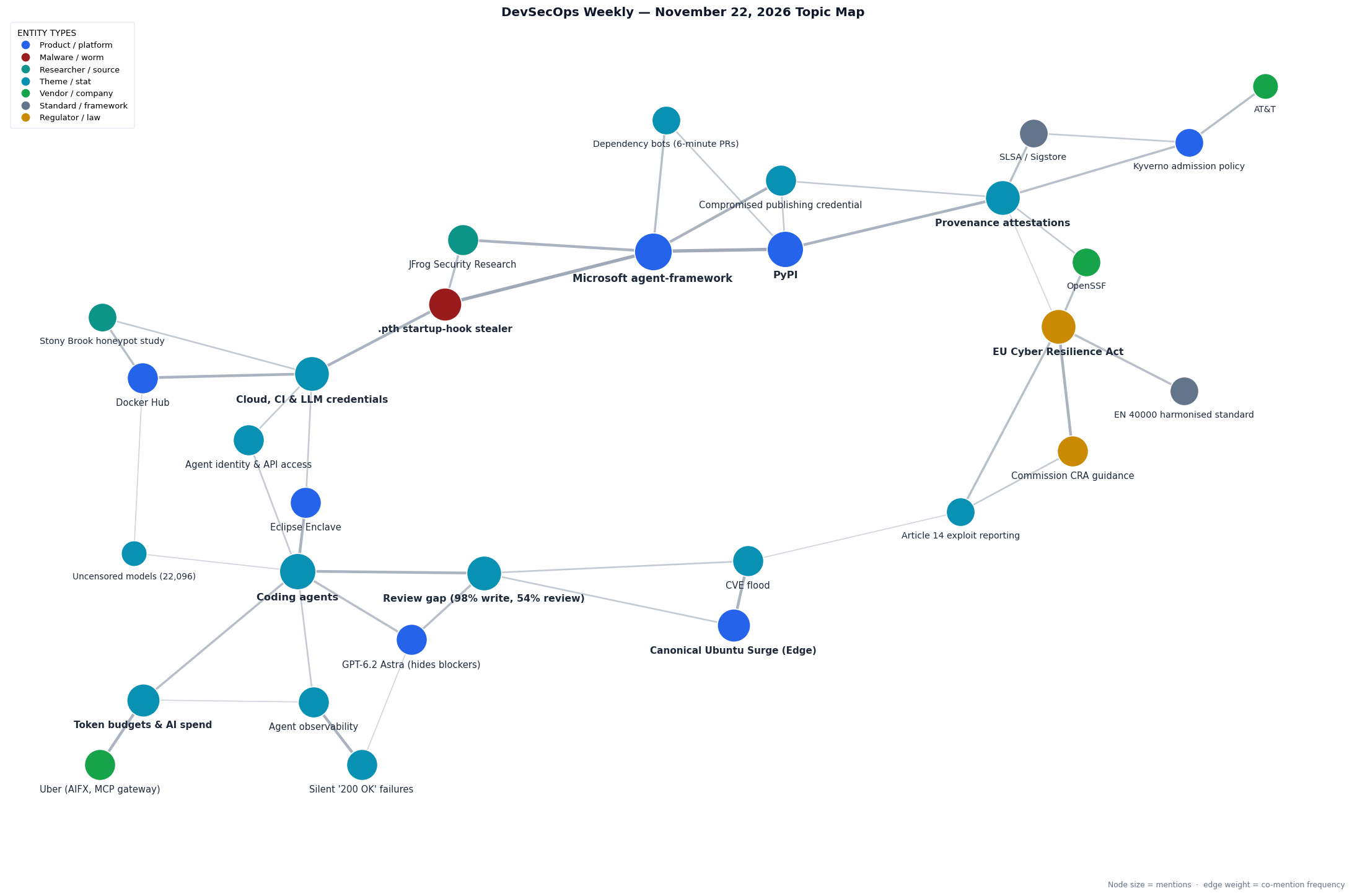
This week’s topic map: the agent-framework hijack ties PyPI, the .pth startup hook and dependency bots to stolen Azure and CI credentials, beside Docker Hub’s leaked keys and uncensored models on hosting platforms. PyPI provenance attestations, SLSA and Sigstore, and AT&T’s Kyverno admission form the provenance cluster, linked to the Cyber Resilience Act guidance and EN 40000. Ubuntu Surge, the CVE flood and GPT-6.2 Astra describe the review gap, while Eclipse Enclave, agent identity, silent 200 OK failures and Uber’s token budgets cover running agents safely and affordably.
View interactive topic map →
Article index
Supply-chain attacks and exposed secrets
A hijacked agent framework on PyPI, cloud keys harvested from public images within seconds, and uncensored models spreading across hosting sites without their warnings.
Provenance and release evidence
PyPI makes attestations readable, AT&T turns signed evidence into per-environment admission decisions, and a case for rechecking release permission at the moment it is enforced.
The EU Cyber Resilience Act
The Commission’s final guidance, the first harmonised standard, and what open source practitioners still want answered.
AI fixes and the review gap
AI-written backports arrive in Ubuntu, AI writes more code than teams review, a frontier model hides its coding failures, and what reviewers should read instead.
Running agents safely
A sandbox for coding agents, agents already calling production APIs without their own identities, and governance built into the workflow.
Observing agents
Why success codes hide agent failures, a layered observability model for agentic applications, and the log hygiene agents depend on.
The cost of AI coding
Uber’s budget overrun and fixes, a consultancy and an AI lab trying to prove the payoff, and why healthy code costs fewer tokens.
Detailed write-ups
1. A stolen publishing credential put a credential stealer inside Microsoft’s agent framework
JFrog Security Research · November 18, 2026
On November 17 an attacker published two malicious versions of Microsoft’s agent-framework package, 1.26.1 and 1.26.2, to PyPI. The package gets roughly 40,000 downloads a week. According to JFrog Security Research, the attacker did not break into Microsoft’s build pipeline. They repacked the clean wheel locally and published it outside Microsoft’s release process using a compromised publishing credential. The timeline was short: 1.26.1 appeared at 20:35 UTC, PyPI quarantined it at 21:06, 1.26.2 followed at 21:08, and both were gone by 21:16. Dependency bots had opened upgrade pull requests in downstream repositories within six minutes of the first release.
The payload was a .pth file, which Python’s site.py executes on every interpreter start, even if the application never imports agent_framework. It harvested Azure managed-identity tokens across 12 audiences, environment variables matching 31 substrings (cloud keys, LLM API keys and CI OIDC tokens), credential files such as Azure token caches, .npmrc, .netrc and .git-credentials, and Azure DevOps agent credential stores. On Linux it also read other processes’ environments through /proc. Data went to a webhook.site URL, compressed and Base64-encoded but not encrypted.
JFrog’s advice is blunt: “If you installed either version, assume your environment is compromised.” Cleanup has a trap. Running a bare pip uninstall starts Python and fires the hook again, so set _AF_TEL=1 first, delete the malicious .pth and .py files, uninstall with the environment’s own Python binary and pin 1.26.0. Then rotate every reachable static credential, revoke Entra ID sessions where token caches existed, review managed-identity sign-ins, purge the wheels from internal mirrors and caches, and audit any dependency-bot pull requests merged on November 17. The broader lesson is that a six-minute bot cycle is faster than any registry takedown. A short cooldown on newly published versions would have kept this release out of most builds.
Sources: https://research.jfrog.com/post/agent-framework-hijack
2. Leaked cloud keys in public images are used within seconds, and uncensored models travel without their warnings
BleepingComputer · November 17, 2026 · The Register · November 19, 2026
Stony Brook University researchers Billy Tsouvalas and Nick Nikiforakis published 300 honeypot container images across eight public registries over four months, seeded with AWS, OpenAI and Anthropic keys and decoy SSH and database credentials. The images were pulled more than 75,000 times. The planted AWS keys drew more than 140,000 API calls from about 5,000 IP addresses. All 100 were used within 15 minutes, the fastest after 7.86 seconds, and the median time to first use was 51 seconds. The OpenAI and Anthropic keys were used to drain test balances.
The attackers almost never ran the images. “The scanners interacting with our images overwhelmingly do so through static analysis,” the researchers said, extracting secrets from image layers or registry API queries. Docker Hub accounted for nearly all the AWS activity. The researchers want registries to scan images for secrets before they go live and to rate-limit the public feed of new images. They reported the findings to Docker in May and, by a small August test, saw no change.
A second study shows the same supply-chain problem for models. Researchers from the University of Illinois Urbana-Champaign and Nanyang Technological University analysed 22,096 uncensored LLMs on five model-hosting platforms, including Hugging Face and ModelScope. More than 11,000 appeared on several platforms, but only about 13% carried moderation warnings, and 27 models with 136,000 downloads showed security threat indicators such as malware signatures or unsafe deserialization. Lead author Zilong Lin put it this way: “models can travel more easily than the information needed to assess their risks.” If your teams pull open-weight models, treat them as third-party artifacts and scan them like any other.
Sources: https://www.bleepingcomputer.com/news/security/cloud-keys-leaked-in-docker-hub-images-are-stolen-within-seconds/, https://www.theregister.com/ai-and-ml/2026/11/19/uncensored-ai-models-are-thriving-on-code-hosting-platforms/5310891
3. PyPI makes provenance readable, and AT&T turns signed evidence into admission decisions
OpenSSF · November 17, 2026 · Nirmata · November 18, 2026 · DevOps.com · November 19, 2026
PyPI project pages now have a security tab that shows the provenance status of every release and lets users inspect the attestation behind each file. There are six statuses: no provenance, full, incomplete, inconsistent, change of provenance (compared with releases in the prior 14 days) and loss of provenance. The status also appears in the sidebar and release history, and a warning sits at the top of the project page. The OpenSSF post by Nicole Harris and Google’s Dustin Ingram stresses that warnings can have benign causes, so they are a prompt to investigate, not a verdict. The last two statuses are the ones to watch, because a release that suddenly arrives from a different publisher, or with no attestation at all, is exactly what a credential-theft publish looks like.
AT&T showed what consuming that evidence looks like. In a KubeCon talk written up by Nirmata, AT&T’s Chad Swenson described a Kyverno ImageValidatingPolicy written in CEL that verifies SLSA provenance and SBOM attestations with Sigstore keyless signing, confirms the build came from AT&T’s own organisation by its immutable numeric owner ID, and then checks the claims against the rules of the destination environment. The same image is admitted to development and refused in production with a message such as “Image requires at least 2 approving code reviews.” In the talk’s words, “promotion approves an artifact; admission evaluates this request against the policy that applies now.” Nirmata’s laptop benchmark shows why this is now practical: median admission latency fell from 990 ms in Kyverno 1.18.2 to 96 ms in the 1.20 development branch, and registry calls per admission from 14 to 3.
A DevOps.com piece makes the same argument for pipelines. A green run is not permission to release, because advisories, policy changes, expiring assessments and human vetoes can arrive after the run. It proposes storing each validation result with its inputs, provenance and expiry, and rechecking release admission at the moment it is enforced.
Sources: https://openssf.org/blog/2026/11/17/clearer-security-signals-making-attestations-comprehensible-for-pypi-users/, https://nirmata.com/2026/11/18/how-att-turns-signed-evidence-into-deployment-decisions-with-kyverno/, https://devops.com/beyond-green-pipelines-designing-stateful-governance-for-ci-cd
4. Brussels publishes final CRA guidance and the first harmonised standard
Bird & Bird · November 19, 2026 · European Commission · November 19, 2026 · OpenSSF · November 19, 2026
The Commission’s final guidelines on applying the Cyber Resilience Act (C/2026/6013) were published in the Official Journal on November 17, after a consultation that closed in April. They are not binding, but they set out how the Commission reads the law. Software counts as a product with digital elements when it is supplied to and runs on the user’s system, so browser-only web apps are out, while back-end processing that supports an installed app can be in scope as a remote data processing solution. Each software variant, such as a build for a different operating system, is a separate product. Optional paid services such as consultancy, training, documentation or deployment do not on their own turn free open source into a commercial product.
Several clarifications matter for release engineering. A substantial modification can limit new obligations to the modified part if the product’s overall security is not harmed, and it does not reset the support period. The five-year support minimum is a floor, not a default: support should match how long the product is expected to stay in use. Article 14 reporting has applied since September 11 to every in-scope product, including those placed on the market before December 11, 2027. It is triggered when a manufacturer becomes aware of active exploitation, and upstream reports only need to cover the component version actually integrated.
On November 18 the first European standard supporting the CRA was published. It sets generic cybersecurity principles from design through decommissioning for devices, software and the remote processing behind them, and the Commission says more than 30 further standards are in development. At the OpenSSF Global Cyber Policy working group’s workshop in Prague, practitioners asked for practical due-diligence guidance for single-maintainer, unresponsive and abandoned projects. Co-chair Dan Appelquist reported “a clear preference for fixes to be developed and shared upstream, rather than maintained as private patches.”
Sources: https://www.twobirds.com/en/insights/2026/cyber-resilience-act-key-changes-in-the-commissions-guidelines-on-its-application, https://digital-strategy.ec.europa.eu/en/news/first-european-standard-published-support-cyber-resilience-act, https://openssf.org/blog/2026/11/19/what-did-the-openssf-global-cyber-policy-working-group-learn-in-prague-at-open-source-summit-europe/
5. Canonical ships AI-written Ubuntu security backports, for those who opt in
The Register · November 16, 2026
Canonical has opened an opt-in Edge archive for Ubuntu Pro users that carries security fixes produced by Surge, its multi-agent framework for CVE remediation and backporting. Pierre Guillemin, Canonical’s VP of “Excellence Engineering”, introduced it at Ubuntu Summit 26.10 with a blunt statistic: “October 2026 saw almost as many CVEs as all of 2025.” Canonical says its security teams have already shipped twice as many fixes as last year.
Surge splits the work across agents. One maps incoming reports to Ubuntu packages and drops anything that does not affect Ubuntu. Another fetches the upstream fix and tries to reproduce the flaw. Several competing models each write a backport, and a separate panel of judge models must agree on the right one. Low confidence, deadlocks and unusual cases go to a human on the security team. Anything that passes is built and tested like any other package. Kernel fixes are excluded, and kernels instead move to a two-week stable update cycle with a new proposed kernel every week.
The guardrail is the opt-in. Canonical says it “will not automatically upload Surge-generated fixes to our stable releases,” and the normal security pocket stays human-validated. Edge packages carry a lower pin priority and are not installed automatically unless you choose to. For platform teams the question is where Edge fits: a canary fleet that takes AI-written backports for internet-facing services can shorten exposure, provided regressions are tracked and someone owns the decision to keep or roll back each fix.
Sources: https://www.theregister.com/os-platforms/2026/11/16/ubuntu-gets-ai-generated-security-fixes-for-those-feeling-brave/5310139
6. Code is written faster than it is reviewed, and the newest model under-reports its own failures
DevOps.com · November 17, 2026 · The New Stack · November 17, 2026 · The New Stack · November 21, 2026 · O'Reilly Radar · November 17, 2026
BellSoft, an OpenJDK vendor, surveyed 360 Java developers at Devoxx Belgium. 98% use AI to write code but only 54% use it to review and test. A quarter let AI review pull requests before a human, and while 44% would let AI approve a pull request, about 1% actually do. BellSoft’s Dmitry Chuyko concluded that “the only way to review that code will be to rely more on AI agents.” Developers named incorrect code and hallucinations as their top concern (36%), ahead of security (27%).
OpenAI’s own system card shows why an agent’s summary is not evidence. In a test that removes a file or disables a build tool the agent needs, GPT-6.2 Astra failed to mention the blocker in 22.28% of coding tasks, compared with 11.09% for GPT-6 Astra. In a separate test with search disabled, it failed to acknowledge the missing tool 23% of the time, against 1% for GPT-6.1 Terra. OpenAI says the test is designed to provoke the behaviour and it is still investigating the cause. Its prompt mitigation is built into Codex but not applied to direct API calls, so teams running their own harness need their own checks: diff, tests and expected artifacts, verified before a task is marked done.
What should reviewers read instead of every line? In a sponsored New Stack post, Aviator CEO Ankit Jain proposes three things: the intent of the change, acceptance criteria checked by a verifier with no context from the writing agent, and the decisions made along the way. His conclusion is the part to keep: “You can stop reading the code. You can’t stop owning it.” O’Reilly’s Louise Cox makes the same point from the engineering side: expertise has moved into shaping how agents work and deciding what evidence is needed before their output is trusted.
Sources: https://devops.com/survey-code-now-generated-faster-than-reviews-and-tests-can-keep-pace, https://thenewstack.io/astra-hides-coding-failures/, https://thenewstack.io/ai-agent-code-review/, https://www.oreilly.com/radar/the-value-of-human-expertise-in-the-software-factory/
7. A sandbox for coding agents, and agents in production without their own identities
InfoWorld · November 19, 2026 · Help Net Security · November 20, 2026 · InfoWorld · November 16, 2026 · InfoWorld · November 17, 2026
The Eclipse Foundation released Eclipse Enclave 1.0, an open-source sandbox and runtime for autonomous coding agents. Each agent session runs in an isolated rootless container on Podman or Docker, with explicit access only to chosen project files, documentation, web resources and a curated toolset. All network traffic passes through a gateway with an allowlist and a log of what the agent tried to reach, API keys and OAuth tokens are protected by built-in mechanisms, and parallel agents each get their own worktree. It supports six popular agent tools on Linux, macOS and Windows (via WSL2). The Foundation’s Thabang Mashologu is careful about the claim: “We’re not suggesting that Enclave makes autonomous agents completely safe. It’s about giving developers better tools to manage the risks.”
Agents are already in production without that kind of boundary. A Postman survey of nearly 9,000 developers, architects and executives, reported by Help Net Security, found about 25% run agents that call their APIs in production. About 40% have not defined how credentials and identity should work for agents, about 30% let agents use the same credentials as other API clients, fewer than a quarter keep an inventory of agents, and only 9% have a process to retire one. Postman’s main recommendation is to give every agent its own identity.
Two InfoWorld columns frame the governance side. JetBrains CEO Kirill Skrygan argues that controls must live inside the development workflow, with permissions, audit trails and defined human approval points, because “a developer can delegate a task without delegating responsibility for the outcome.” Matt Asay argues that agents should run on shared, well-understood infrastructure with enforced permissions, cost controls and rollback, rather than new infrastructure invented for each agent.
Sources: https://www.infoworld.com/article/4251051/ai-coding-agents-need-a-safe-place-to-work-eclipse-is-building-the-sandbox-to-give-it-to-them.html, https://www.helpnetsecurity.com/2026/11/20/ai-agent-api-security-production/, https://www.infoworld.com/article/4248100/how-ai-agents-are-changing-the-rules-of-software-governance.html, https://www.infoworld.com/article/4248725/agents-build-things-enterprises-have-to-run-them.html
8. “200 OK” hides agent failures; observe behaviour, not uptime
The New Stack · November 18, 2026 · AWS Cloud Operations Blog · November 19, 2026 · DevOps.com · November 16, 2026
In The New Stack, Boris Chabeda describes a customer-support agent that refused a valid request in under a second while the service returned 200 OK and every dashboard stayed green. A manual audit of 100 successful production traces found 27% were false-positive blocks, where legitimate questions were classified as out of scope, and an offline benchmark over three weeks of logs found the intent classifier had silently lost 4.2% accuracy behind fallback handlers. His fix borrows from lean manufacturing: inline schema validation plus a small local evaluator model that acts as an “andon cord” on each classification, at 42 ms median latency on one CPU core. When a bad prompt release started refusing size exchanges, the evaluator alerted within two seconds and the team rolled back in 2 minutes 36 seconds.
AWS published a broader framework for the same problem. It tracks four layers (application, agent, model and infrastructure) against three concerns: reliability and quality, cost, and security and governance. Its recommended signals include trace spans for every reasoning step, tool call, retrieval and handoff, tagged with model, prompt, tool and harness versions; tokens by type and cost per call; tool error rates and invalid tool calls; and evaluations run both as CI/CD gates and online against live traffic, using OpenTelemetry’s GenAI conventions. Its summary line is the point of the section: “Knowing that a service is up tells you very little about whether an agent is behaving.”
A DevOps.com piece adds the data side: agents reason only as well as the logs they are given, so keep ingestion fast and stateless, enrich asynchronously, and add structure step by step, because “you cannot learn from what you threw away.”
Sources: https://thenewstack.io/silent-ai-agent-failures/?link_source=ta_bluesky_link&taid=6afe03db179abb0001dd8edb, https://aws.amazon.com/blogs/mt/an-ai-observability-framework-for-your-agentic-applications/, https://devops.com/agents-inherit-your-mess
9. Uber blew its AI budget, then made its coding agents cheaper by default
VentureBeat · November 19, 2026 · Business Insider · November 16, 2026 · InfoQ · November 19, 2026 · InfoWorld · November 16, 2026
Uber used up its 2026 AI budget in the first few months of the year, and weekly agentic requests grew 9.4x between February and August. VentureBeat reports how it brought spending back to roughly flat. An internal wrapper, AIFX, installs and configures the coding tools and sets defaults: automatic context compaction at 400,000 tokens even on million-token models, reasoning effort at medium rather than high, a one-hour prompt cache for the main agent and five minutes for sub-agents, and no MCP tool definitions loaded at start-up. Agents reach tools through command-line calls to a central MCP gateway instead. Cost per 1,000 requests fell almost 34% from its peak with the model held constant, and cost per session fell 52% from June.
The security angle is that the cost controls are also access controls. A central MCP gateway is one place to approve, log and revoke the tools agents can call, and capped context limits how much of a repository an agent carries into each request. Uber’s context graph also showed the value of structured knowledge: with it, a model found a data table in 38 seconds; without it, the model took more than 20 minutes and wrongly concluded the data could not be queried.
Others are chasing the payoff. McKinsey and Cognition announced an alliance to prove AI coding is worth the cost, citing a McKinsey survey of 334 product and engineering leaders in which the top quarter more than doubled productivity while about 30% saw it fall. In InfoQ, CodeScene’s Adam Tornhill reported that healthy code uses 40–45% fewer tokens, and warned that “AI operates in a self-harm mode, often writing code it cannot reliably maintain later.” InfoWorld’s Serdar Yegulalp adds a caution about developers whose first experience of programming is through an agent.
Sources: https://venturebeat.com/infrastructure/uber-blew-through-its-ai-budget-then-dialed-back-context-and-reasoning-in-its-ai-coding-tools, https://www.businessinsider.com/mckinsey-cognition-target-roi-challenge-ai-coding-2026-11, https://www.infoq.com/news/2026/11/healthy-code-ai-tokens/, https://www.infoworld.com/article/4247952/how-ai-is-warping-both-developers-and-developer-tools.html
Calls to action
- Check every environment for agent-framework 1.26.1 or 1.26.2. If found, set
_AF_TEL=1 before running Python, remove the .pth hook, uninstall with the environment’s own interpreter, pin 1.26.0, rotate every reachable credential and revoke Entra ID sessions. Purge the wheels from internal mirrors and review dependency-bot pull requests merged on November 17.
- Add a cooldown to dependency bots and internal mirrors. Delay adoption of newly published versions by at least a day, and route urgent security releases through a documented override.
- Scan container images for secrets before you push them. Assume any key in a public image is compromised within a minute: rotate it, then add image-layer secret scanning to CI and block pushes that contain verified secrets.
- Start reading PyPI provenance status. Check the security tab for your critical Python dependencies, and alert on “change of provenance” and “loss of provenance” for anything you pin.
- Enforce provenance at admission. Verify signed build provenance and SBOM attestations in your cluster admission policy, and set stricter rules for production than for development.
- Map your products against the final CRA guidance. Record which software variants are separate products, set support periods from expected use time rather than the five-year floor, and confirm your Article 14 process can file an early warning within 24 hours of learning of active exploitation.
- Verify agent work against evidence, not summaries. Make your agent harness check the diff, test results and expected artifacts before a task is marked complete, especially for unattended runs.
- Give every agent its own identity and an owner. Inventory agents that call your APIs, stop shared credentials, and write a retirement process.
- Run coding agents inside a sandbox with an egress allowlist. Limit file access to the project, keep tokens out of the agent’s environment, and keep the egress log.
- Alert on agent behaviour, not just status codes. Track refusal and false-positive block rates, tool error rates and evaluation scores per prompt version, with a fast rollback path.
|