At a glance
This week’s brief converges on a single uncomfortable truth: the CISO mandate is expanding faster than the discipline can train, structure, and pay for it. Verizon’s 2026 DBIR — distilled across two of this issue’s reads — flips the script on initial access, with vulnerability exploitation overtaking credential abuse for the first time in nineteen years, third-party breaches up 60%, and shadow-AI use tripling. Boards now want those numbers in dollars, not CVE counts, and several pieces here lay out exactly how to make that translation.
A regulatory wave is the other dominant theme. The EU has hammered out a Digital Omnibus on the AI Act — deferring high-risk obligations to December 2027 while introducing fresh prohibitions — even as the GDPR enforcement template gets retooled for AI fines, the EU Cyber Resilience Act sharpens liability for AI-mediated failures, and India’s CERT imposes a 12-hour SLA to contain actively exploited internet-facing flaws. Sovereign regulators are moving from principle to deadline.
Inside the org chart, the seat itself is in flux. Only 11% of CISOs report to the CEO, 64% still sit under IT, and average tenure is 18 months to three years against a 5.2-year C-suite norm. Practitioners want incident-response veterans in the chair, the AI talent problem is shifting out of HR and into CIO/CISO direct ownership, and a fresh wave of agent identity, shadow-AI governance, and AI-security investment (Corgi doubling its valuation in three weeks) is reshaping what the role is actually for.
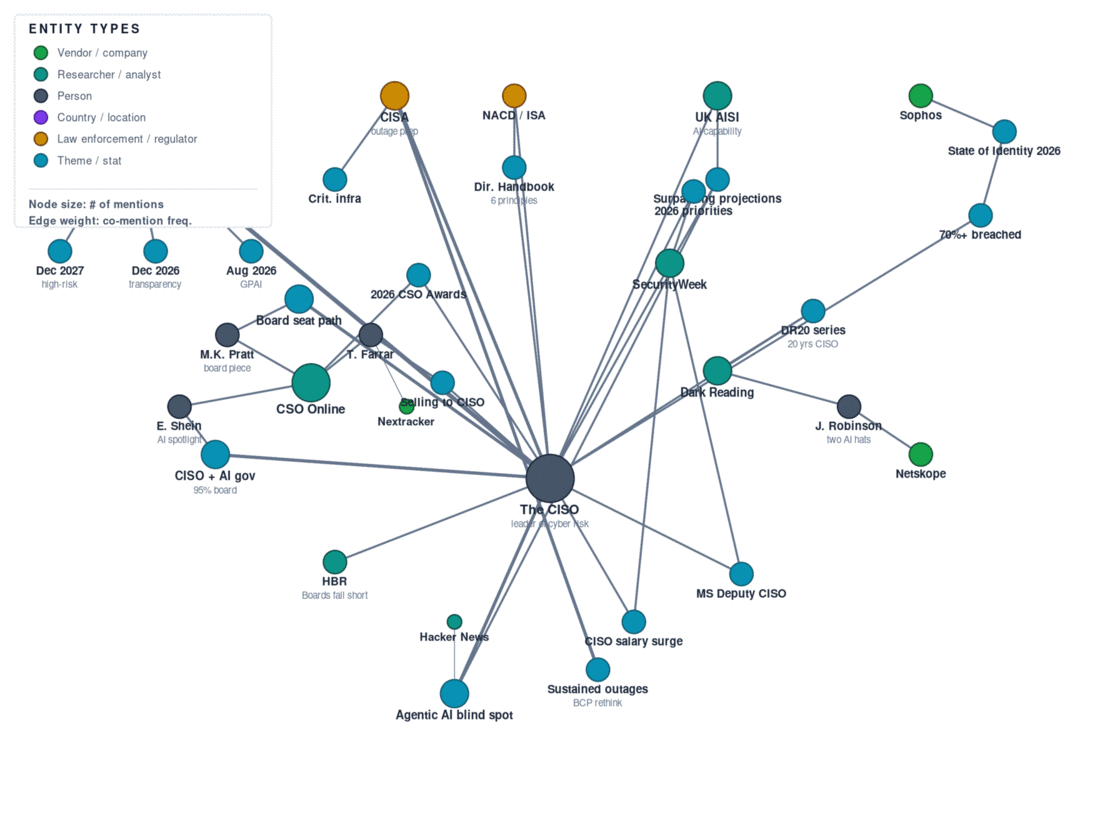
This week’s topic map — board reporting and risk quantification, the EU/India regulatory wave, AI governance and agent identity, and CISO role economics.
Article index
Cluster 1 — Board reporting & cyber risk quantification
Boards want financial exposure, not heatmaps. Verizon’s 2026 DBIR is the data backbone for that conversation, and a stark gap remains between stated ransomware resilience and actual recovery time.
- 1. Boards want cyber risk in dollars, not CVE counts — HelpNetSecurity
- 3. When ransomware hits, confidence doesn’t restore endpoints — HelpNetSecurity
- 4. Verizon DBIR 2026: Vulnerability exploitation overtakes credentials as top initial access — HelpNetSecurity
- 5. Verizon DBIR 2026 — 6 key takeaways for CISOs — TechTarget
- 15. Verizon DBIR 2026: Vulnerability exploits top initial access as patching coverage falls — SC World
Cluster 2 — Regulatory wave: EU AI Act / CRA / India CERT / GDPR
EU lawmakers softened AI Act timelines while sharpening enforcement teeth elsewhere; India’s CERT set a 12-hour containment SLA. CISOs and GCs should treat this as a single regulatory operating-model shift.
- 12. EU AI Act Update: Timeline Relief, Targeted Simplification, and New Prohibitions — Inside Privacy
- 17. Indian CERT urges firms to contain exploited internet-facing flaws within 12 hours — CSO Online
- 18. GDPR set the tone for regulatory action — and the AI fine pushback to come — CSO Online
- 19. “The AI did it” won’t save you when EU regulators come knocking — The New Stack
Cluster 3 — AI governance & shadow AI
Shadow-AI use tripled in the DBIR data; CISOs are publishing AI security frameworks as 2026 priority #1. Multi-agent delegation, Claw-style enterprise agents, and AI security readiness are the live governance fronts.
- 8. CISOs step into the AI spotlight — CSO Online
- 9. Coinflow CISO Malcolm Portelli on crypto payments security under AI pressure — HelpNetSecurity
- 10. Governing shadow AI without killing innovation — HelpNetSecurity
- 13. AI security readiness is now the No. 1 obstacle to adoption — The New Stack
- 14. Who Authorized That? The Delegation Problem in Multi-Agent AI — O’Reilly Radar
- 20. Claw-style AI agents are coming to the enterprise. Governance is still catching up. — The New Stack
- 21. The AI governance imperative you can’t afford to ignore — CSO Online
- 24. Corgi announces $106M raise at $2.6B valuation — TechCrunch
Cluster 4 — CISO role: reporting line, talent, succession
Where the CISO sits, how long they stay, and what kind of leader practitioners actually want to follow — all in motion this week. The talent problem is being repositioned from an HR program to a CIO/CISO direct mandate.
- 2. The CISO selling confidence in a breach-headline market (Englman, Span) — HelpNetSecurity
- 6. CISO shortage may reflect unrealistic job expectations — TechTarget
- 7. The endless CISO reporting line debate — CSO Online
- 11. CISO Succession Crisis Highlights How Turnover Amplifies Security Risks — DarkReading
- 16. What happens when security teams inherit identity — HelpNetSecurity
- 22. The AI talent problem CIOs cannot delegate to HR — CIO.com
- 23. Cybersecurity Staff Prefer CISOs With Real Attack Response Experience — Infosecurity Magazine
Detailed write-ups
1. Boards want cyber risk in dollars, not CVE counts
HelpNetSecurity · May 25, 2026
The board-reporting conversation has shifted decisively away from CVE volume and color-coded heatmaps. This HelpNetSecurity video makes the case that CISOs must translate technical risk into financial exposure — what a particular threat could cost the business in revenue, regulatory penalties, and reputational damage — and then prioritize spending where it actually protects business value. The piece is short, direct, and lands as a playbook for board day. Pair it with the Verizon DBIR coverage further down in this issue: the DBIR’s data on vulnerability exploitation and third-party breaches is exactly the kind of numerator a financial-exposure narrative needs to be anchored to.
Read the article
2. The CISO selling confidence in a breach-headline market (Englman, Span)
HelpNetSecurity · May 28, 2026
Span CISO Hrvoje Englman delivers a sharp peer-CISO interview on three problems that are absorbing leadership bandwidth across the industry. First: AI coding assistants are inheriting over-provisioned identities, quietly inflating the blast radius of any compromised workload. Second: the “talent gap” is more accurately a senior-practitioner shortage — there are juniors, just not enough people seasoned enough to lead. Third: defenses that depend on perfect human behavior are brittle by design, and CISOs should architect for the failure mode. A useful framing piece for any leader sketching their own 2026 strategy memo.
Read the article
3. When ransomware hits, confidence doesn’t restore endpoints
HelpNetSecurity · May 18, 2026
Absolute Security surveyed 750 US and UK CISOs and found a gap that boards should be asking about directly. Eighty-three percent feel confident their organization can recover from a ransomware attack. But of the respondents who actually suffered an attack, 55% took up to six days to recover, and 58% would consider paying the ransom. The mismatch between stated resilience and observed recovery time makes this an excellent boardroom conversation starter — a chance to ask “what does our last tabletop tell us about the six-day window?” rather than relying on a green RTO line in a slide deck.
Read the article
4. Verizon DBIR 2026: Vulnerability exploitation overtakes credentials as top initial access
HelpNetSecurity · May 20, 2026
For the first time in the 19-year history of the Data Breach Investigations Report, vulnerability exploitation (31%) has overtaken credential abuse (13%) as the top initial-access vector. Third-party breaches jumped 60% year-over-year to account for 48% of all breaches, and only 26% of CISA KEV items were fully remediated through 2025. The data is reshaping budget justification and third-party-risk narratives across the industry. Expect to see these three numbers in every board deck for the rest of the year — and to be asked, pointedly, where your organization sits against each one.
Read the article
5. Verizon DBIR 2026 — 6 key takeaways for CISOs
TechTarget · May 20, 2026
TechTarget’s CISO-targeted distillation of the 2026 DBIR is the version to forward to your board chair. The six takeaways: vulnerability exploitation leads, third-party breaches up 60%, ransomware involved in 48% of incidents, shadow-AI use roughly tripled to 45%, the first AI-executed state-sponsored attack is documented in the dataset, and patching coverage continues to drift downward. Each takeaway is paired with the kind of operational question a non-technical executive can engage with. If you only attach one DBIR write-up to your next board pack, this is the candidate.
Read the article
6. CISO shortage may reflect unrealistic job expectations
TechTarget · May 28, 2026
The headline number — 35,000 CISOs worldwide for 359 million businesses — looks like a screaming talent gap. TechTarget’s piece argues it is something else: a job-design failure. The modern CISO role bundles security operations, compliance, board reporting, regulator-facing accountability, third-party risk, and now AI governance into a single seat that no single human can reasonably fill. The article reframes the “shortage” as something boards and CHROs must own, by either splitting the role, defining a realistic charter, or paying for the deputy structure the job actually requires. A useful internal-conversation starter.
Read the article
7. The endless CISO reporting line debate
CSO Online · May 27, 2026
The IANS/Artico 2026 benchmark puts hard numbers on a long-running governance question: 64% of CISOs still report into IT, and only 11% report to the CEO. CSO Online uses the data as a launching pad to introduce the Chief Digital Risk Officer (CDRO) model — a reframing that some boards are quietly piloting to consolidate cyber, AI, privacy, and resilience risk under a single executive. Where the CISO sits is not an org-chart cosmetic. It drives authority, budget, and increasingly, disclosure accountability under SEC, NIS2, and DORA. A timely read alongside this issue’s succession and talent pieces.
Read the article
8. CISOs step into the AI spotlight
CSO Online · May 29, 2026
Thirty-one percent of top security leaders now report directly to the board, according to CSO Online’s reporting — a meaningful shift from the 11%-to-CEO figure tracked elsewhere — and the lever pulling that change is AI. CISOs are publishing internal AI security frameworks as their number-one 2026 priority, ahead of identity, third-party risk, or even ransomware readiness. The convergence of AI governance with elevated board reporting is defining the role this year, and the article reads as a useful snapshot of where peers are spending the political capital that came with the seat being upgraded.
Read the article
9. Coinflow CISO Malcolm Portelli on crypto payments security under AI pressure
HelpNetSecurity · May 27, 2026
Coinflow CISO Malcolm Portelli offers a sector-specific view from regulated payments — where AI is simultaneously reshaping fraud, identity verification workflows, and compliance pressure from multiple regulators at once. The interview is most useful for leaders in financial services, fintech, and any vertical where transaction-level decisions are being increasingly delegated to model-driven systems. Portelli is candid about the gap between governance ambition and the operational reality of running an AI-augmented control environment under crypto-specific regulatory scrutiny. A good peer-CISO read for anyone briefing a board committee on payments-related AI risk.
Read the article
10. Governing shadow AI without killing innovation
HelpNetSecurity · June 1, 2026
The single board-level governance question this quarter: how to close the shadow-AI gap without throttling the business. Audits are surfacing sensitive data flowing to unmanaged models, and agentic workflows operating with broad system access that no one chartered. This HelpNetSecurity video walks through pragmatic tactics — egress visibility, sanctioned-model gateways, model registries, and a lightweight intake process that creates a path to “yes.” The right pairing for the DBIR’s shadow-AI-tripled stat: the data justifies the program, this piece sketches what the program actually looks like in flight.
Read the article
11. CISO Succession Crisis Highlights How Turnover Amplifies Security Risks
DarkReading
The CISO tenure number is the one to put on the slide: 18 months to three years, against an average of 5.2 years for the rest of the C-suite. DarkReading argues that the resulting operational gaps — half-built programs, transition-period rituals, lapsed external relationships — are exactly the conditions attackers exploit. The piece makes succession planning a board-level governance obligation, not an HR backstop. Concrete recommendations include a designated deputy, a documented six-month playbook, and explicit board check-ins on bench depth. A natural companion to the role-definition and reporting-line debates elsewhere in this issue.
Read the article
12. EU AI Act Update: Timeline Relief, Targeted Simplification, and New Prohibitions
Inside Privacy (Covington) · May 29, 2026
The first substantive amendment to the EU AI Act since 2024 landed in late May as a provisional agreement on the Digital Omnibus on AI. The Covington summary is the cleanest read available: high-risk AI system (HRAIS) Annex III obligations are deferred from August 2026 to December 2027, general-purpose AI rules are simplified, and a new tranche of prohibitions targets non-consensual intimate AI imagery and AI-generated CSAM. The deferral buys breathing room for compliance teams; the new prohibitions tighten the floor. Required reading for anyone running an EU-facing AI inventory or model registry.
Read the article
13. AI security readiness is now the No. 1 obstacle to adoption
The New Stack
A Linux Foundation study now ranks AI security readiness above cost and talent as the leading barrier to enterprise AI adoption. That is a procurement signal — and a budget signal — that CISOs and CIOs can carry directly into investment-committee conversations. The New Stack’s read of the data argues that the readiness gap is concentrated in three areas: model and data lineage, runtime controls for agentic workflows, and assurance against prompt injection at the application layer. If AI adoption is being throttled by security gaps, the security budget that resolves the bottleneck is now a growth investment, not a cost.
Read the article
14. Who Authorized That? The Delegation Problem in Multi-Agent AI
O’Reilly Radar
One of the foundational governance frames CISOs must own this year: transitive authorization. When agent A asks agent B to take an action on behalf of human user C, the existing identity and authorization plumbing breaks down — accountability becomes diffuse, audit trails fracture, and least-privilege fails silently. O’Reilly’s piece walks through the conceptual problem with admirable clarity and outlines the design primitives required to fix it (capability tokens, scoped delegation, end-to-end chain-of-custody for agent actions). As multi-agent systems spread into enterprise workflows, this framing belongs in your architecture review.
Read the article
15. Verizon DBIR 2026: Vulnerability exploits top initial access as patching coverage falls
SC World
SC World’s DBIR write-up is complementary to the HelpNetSecurity and TechTarget coverage elsewhere in this issue — and it surfaces a structural driver worth pulling out: patching coverage is falling, and the gap is what is making vulnerability exploitation the new top initial-access vector. The operational-hygiene framing is useful for any leader looking to convert DBIR data into a renewed argument for vulnerability-management investment, patch-management automation, and the kind of executive sponsorship that gets emergency patches deployed on weekends instead of in next month’s change window.
Read the article
16. What happens when security teams inherit identity
HelpNetSecurity · May 26, 2026
Semperis’s Eric Woodruff walks through a quiet but consequential org-design shift: identity teams are increasingly folding into security under regulatory pressure (NIS2, DORA, SEC). The interview is honest about the skills and tooling gap that creates — identity practitioners and security practitioners think differently about lifecycle, joiner-mover-leaver, and privileged access — and lays out a pragmatic integration playbook. Useful for CISOs who already have identity in their portfolio, and even more useful for those who are about to inherit it. Pair with the agent-identity coverage elsewhere in this issue; the two questions are converging.
Read the article
17. Indian CERT urges firms to contain exploited internet-facing flaws within 12 hours
CSO Online · May 27, 2026
CERT-In’s new directive sets a 12-hour containment SLA on actively exploited internet-facing vulnerabilities, citing AI-accelerated exploitation timelines. The directive is striking on its own terms — most jurisdictions have not committed to a number this aggressive — but the broader signal matters more: sovereign regulators are moving from principle-based guidance to enforceable, time-boxed deadlines. Expect other jurisdictions to consider similar models, especially given the DBIR’s data on patching coverage. CISOs operating in or selling into India should treat this as an immediate operational question. Everyone else should treat it as a leading indicator.
Read the article
18. GDPR set the tone for regulatory action — and the AI fine pushback to come
CSO Online
CSO Online makes a sharp argument: the GDPR enforcement template — extraterritorial reach, percentage-of-global-revenue fines, lead-supervisory-authority mechanics — is exactly the template the EU AI Act will use, and industry pushback is intensifying around proportionality and the cross-border discovery burden. The piece is a regulatory enforcement strategy preview for CISOs and general counsel preparing for the AI fine regime that the Digital Omnibus reshaping (article 12 above) does not soften. Read alongside this week’s CRA primer for a full picture of how EU AI enforcement will land in practice.
Read the article
19. “The AI did it” won’t save you when EU regulators come knocking
The New Stack
The EU Cyber Resilience Act is the third leg of the EU regulatory stool — alongside the AI Act and GDPR — and this New Stack explainer is the clearest primer available for product and security leaders. The CRA allocates liability for AI-mediated security failures and imposes product-cybersecurity obligations across the supply chain. “The AI did it” is not a defense; product manufacturers and importers carry concrete duties around vulnerability handling, security updates, and disclosure timelines. CISOs whose remit touches software shipped into the EU should map their portfolio against CRA obligations now, while there is still meaningful timeline cushion.
Read the article
20. Claw-style AI agents are coming to the enterprise. Governance is still catching up.
The New Stack
Automation Anywhere’s EnterpriseClaw alliance is the headline, but the broader story is the proliferation of Claw-style agents across enterprise workflows — agents that can read screens, click buttons, and execute end-to-end business processes with privileges that legacy RPA tools never had. The New Stack frames the governance gap candidly: identity, audit, secrets handling, and rollback are not yet first-class capabilities in this stack. The strategic question for CISOs evaluating multi-vendor agent deployments is whether to standardize early or stay deliberately heterogeneous while the category settles.
Read the article
21. The AI governance imperative you can’t afford to ignore
CSO Online
The how-to companion to this issue’s EU AI Act and Cyber Resilience Act pieces. CSO Online walks through the operational architecture of an enterprise AI governance program: committee structure (who owns, who advises, who decides), risk taxonomies that hold up under audit, a model registry that is more than a spreadsheet, and the ongoing assurance cadence that distinguishes a real program from a policy memo. The piece is pragmatic about resourcing — most organizations are running this with a fraction of what they need — and offers a credible 90-day starting plan for teams that need to ship a defensible v1.
Read the article
22. The AI talent problem CIOs cannot delegate to HR
CIO.com
CIO.com argues that AI fluency is now a leadership competency, not a training program — and that outsourcing the problem to HR-run upskilling tracks is reproducing the exact gap CIOs and CISOs say is slowing them down. The piece is an org-design lens on the talent crisis that runs through this whole issue: if your AI capability gap shows up in technology decisions (which models, which guardrails, which agent platforms), then the gap has to be closed inside CIO/CISO leadership first. Useful framing for the talent-and-tenure conversations the rest of the bulletin keeps coming back to.
Read the article
23. Cybersecurity Staff Prefer CISOs With Real Attack Response Experience
Infosecurity Magazine
An ISC2 study presented at Infosecurity Europe found practitioners overwhelmingly prefer working under CISOs with hands-on incident-response experience, not pure-governance or compliance backgrounds. The signal cuts directly against the trend of elevating GRC-flavored profiles into the seat — and arrives just as boards are debating whether to split the role (see article 6) or hold the line on a single accountable executive. For boards thinking about hiring or succession, this is data worth quoting. For CISOs reflecting on bench depth, it is a hint about which deputies will inspire the room they need to lead.
Read the article
24. Corgi announces $106M raise at $2.6B valuation — double what it was worth 3 weeks ago
TechCrunch · May 28, 2026
AI security firm Corgi closed a $106M round at a $2.6B valuation — roughly double what it was worth three weeks earlier, when it closed a $160M Series B. The pace and price are themselves the story: capital is still flowing aggressively into AI-security defenders, and the multiples have not cooled. CISOs justifying spend against the AI threat landscape can cite this as one more data point that the defensive market is repricing in real time. The flip side: vendor consolidation pressure is mounting, and the long-term winners in the category are still being decided.
Read the article
On our watch list
- The next Verizon DBIR slice. Expect deeper third-party-breach decomposition (where the 60% jump actually originated) and sector cuts that will reshape how peer comparisons land in board decks.
- EU CRA enforcement signals. First public actions and guidance under the Cyber Resilience Act will set expectations for vulnerability handling, disclosure timelines, and product cybersecurity duties across the EU supply chain.
- Board AI committee adoption. Watching how quickly Fortune 500 boards spin up dedicated AI risk committees (or fold AI risk into existing audit/risk committees), and whether CISOs land standing seats or remain on call.
- CISO succession data. A handful of public-company filings and benchmark studies due this summer will give the first hard numbers on whether boards are actually building bench depth — or just churning faster.
|