At a glance
The TanStack postmortem closes the May 11 chapter with the most useful artifact yet: a maintainer-side breakdown of the chained GitHub Actions weaknesses that let attackers publish 84 malicious versions without ever stealing an npm credential. Read it alongside this week's three fresh registry incidents — Microsoft's typosquat burst, the 33-package dependency-confusion campaign, and the durabletask PyPI compromise — and the pattern is unmistakable: registry trust is the active front, and the controls that would close it (provenance, scope reservation, namespace lockdown) remain unevenly adopted.
Platform vendors are moving on the surrounding controls. GitLab 19.0 ships per-job secrets management and policy-driven enablement of Secret Detection, SAST, and Dependency Scanning. GitHub Advanced Security finally gets hard budget caps, removing the last finance-side excuse not to roll it out org-wide. CSO's GlassWorm retrospective — companion to last week's CrowdStrike takedown writeup — argues the underlying repo-trust gaps remain unfixed even after the botnet itself fell.
Looking forward, CNCF is reframing two architecture questions worth your time: why Kubernetes policy enforcement still happens too late in the developer loop, and what a cloud-native internal developer platform actually looks like when GitOps, IaC, and signed supply-chain controls are wired together. Plus a verifiable-entropy result from Swiss researchers that could quietly upgrade the cryptographic floor under SLSA and Sigstore attestations.
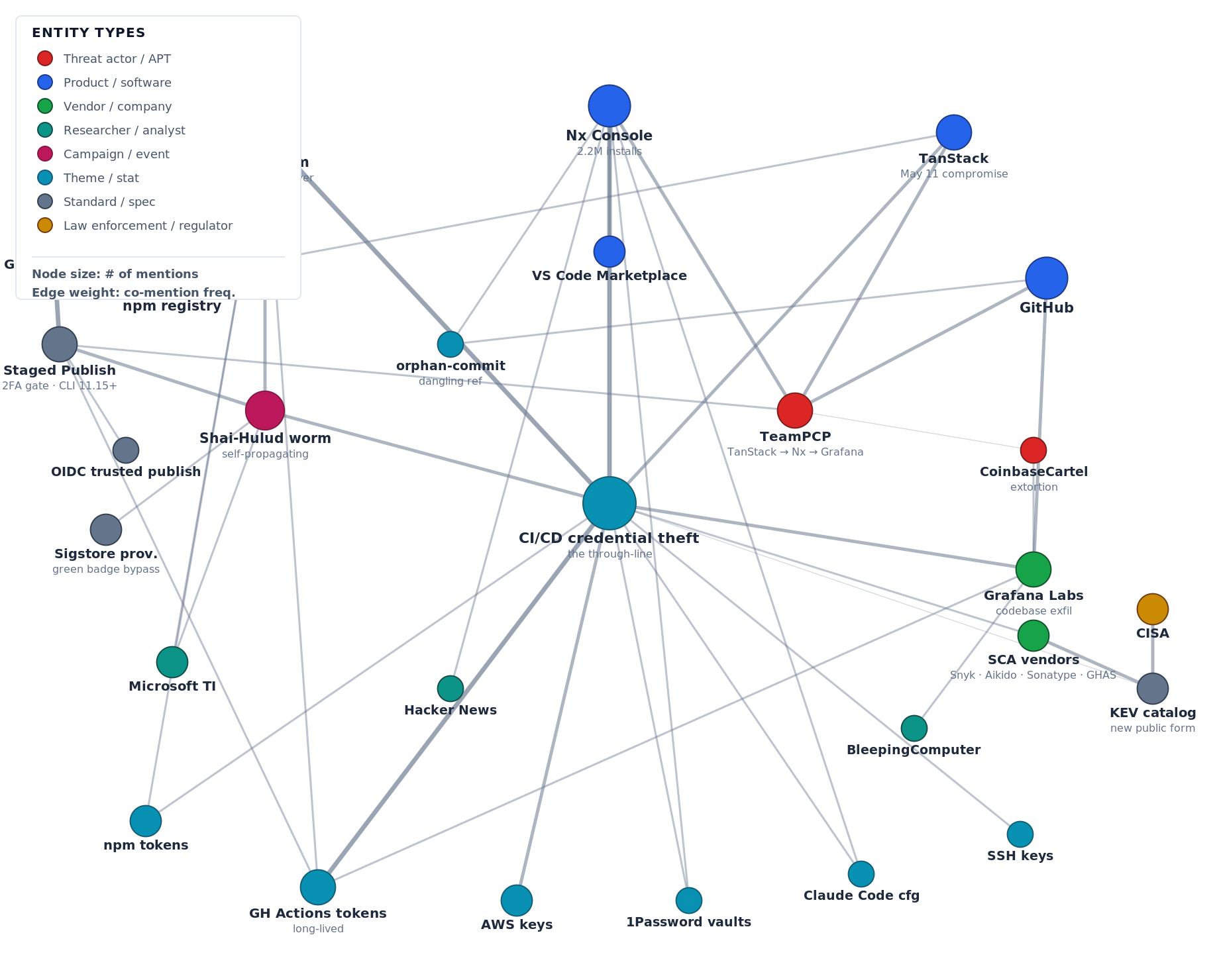
Topic map — June 7, 2026 issue.
Article index
Supply-chain attack postmortems & registry incidents
One definitive maintainer postmortem plus four fresh registry-level compromises and a forward-looking retrospective — the shape of an unresolved trust crisis.
Articles 1, 2, 3, 6, 9, 12
Platform & tooling updates
Substantive platform news from GitLab and GitHub on the controls that surround registries and CI/CD secrets.
Articles 4, 5
Architecture & forward-looking practice
CNCF on shift-left policy and reference IDP architecture, an agent-reliability question for CI/CD, and a foundational primitive that could lift the entire attestation stack.
Articles 7, 8, 10, 11
Detailed write-ups
01
Postmortem: TanStack npm supply-chain compromise
TanStack's own writeup is the definitive maintainer-side breakdown of the May 11 incident: three chained GitHub Actions weaknesses — pull_request_target running untrusted PR code with elevated privileges, cross-trigger cache poisoning carrying that code into trusted workflows, and OIDC token extraction from runner process memory — let attackers publish 84 malicious versions across 42 @tanstack/* packages without ever stealing an npm credential. The unsettling takeaway: trusted publishing did exactly what it was supposed to, the broken trust boundary was upstream in the CI pipeline. Required reading for any team that has migrated from long-lived npm tokens to OIDC publishing.
02
Typosquatted npm packages used to steal cloud and CI/CD secrets
Microsoft Threat Intelligence reconstructs a four-hour burst on May 28 in which alias “vpmdhaj” published 14 npm packages typosquatting OpenSearch, ElasticSearch, and DevOps libraries. Each shipped a ~195KB Bun-compiled stealer targeting AWS keys, HashiCorp Vault tokens, GitHub Actions secrets, and npm publish tokens — designed to fire during preinstall or postinstall. The post includes concrete IOCs and the three mitigations that would have neutralized this campaign for most shops: --ignore-scripts as a default, aggressive token rotation, and egress filtering from CI runners to the stealer's exfil domains. Worth wiring into your registry guardrails.
03
33 malicious npm packages abuse dependency confusion
A day after the typosquat campaign, Microsoft surfaced 33 more malicious packages published under scoped names mirroring real internal corporate namespaces. The twist: rather than dropping a payload immediately, the packages fingerprint the developer environment first — hostnames, CI variables, mounted secrets paths — then decide whether the target is interesting enough to deserve the second stage. It is a sobering reminder that private-registry scope reservation and namespace lockdown remain undone homework at most organizations. If your private scopes are not registered on the public registry, you are paying the dependency-confusion tax whether you know it or not.
04
GitLab 19.0 adds AI workflows, secrets management, self-hosted model support
GitLab's 19.0 release lands two items DevSecOps teams have been waiting on. A public-beta Secrets Manager scopes secrets per-job — closing the long-running gap where pipeline secrets were too easily exposed to unrelated stages — and policy-based enablement now lets platform teams turn on Secret Detection, SAST, and Dependency Scanning across groups by policy rather than per-project YAML edits. SBOM-driven dependency scanning is expanded. For shops standardizing on GitLab Ultimate, this is the first release in a while with material control-plane changes worth queuing into your platform-engineering roadmap.
05
Hard budget limits now available for GitHub Advanced Security
A small change with outsized rollout consequences: enterprise admins can now set hard budget caps on GHAS SKUs so additional license usage is blocked once a threshold is hit. For managers who have been held back from rolling GHAS org-wide because finance refused to write an open-ended check, this removes the last objection. Pair it with the policy-based enablement patterns now mainstream across GitLab and GitHub, and you get a defensible “default-on, capped” security posture across repos — rather than the opt-in patchwork most enterprises still live with.
06
Microsoft's durabletask PyPI package compromised
Three malicious versions (1.4.1–1.4.3) of Microsoft's Azure Durable Functions Python SDK were pushed directly to PyPI on May 19 within 35 minutes, dropping a 28KB payload that steals AWS, Azure, GCP, Kubernetes, and Vault credentials. The notable bit: this hit a first-party Microsoft package and bypassed the official build pipeline entirely. If your supply-chain trust model rests on “we use big-vendor packages,” this is the case study to revisit. StepSecurity's writeup includes IOCs and the publishing-account hardening recommendations that would have prevented the credential abuse behind the push.
07
Why Kubernetes policy enforcement happens too late — and what to do about it
A useful reframe from the CNCF community: OPA, Kyverno, and Conftest at admission time leave a structural gap, because policy violations surface only after the PR is already merged and the manifest is on its way to a cluster. The post argues for earlier policy-as-code touchpoints inside the developer loop — pre-commit hooks, PR-time evaluation against the same rule sets, scoped sandbox apply — so that developers see violations where they can still fix them cheaply. Direct shift-left framing for platform-engineering teams that have invested heavily in admission control but not in feedback latency.
08
Building a cloud-native internal developer platform with Kubernetes, GitOps, and supply-chain security
A reference architecture for an internal developer platform that wires three concerns together: Infrastructure-as-Code primitives, Argo CD GitOps reconciliation, and signed supply-chain controls — presented as a single self-service developer experience rather than three disconnected tools. The piece is concrete enough to use as a blueprint: where signing fits in the pipeline, how policy gates compose with GitOps reconciliation, what golden-path templates look like end-to-end. Worth circulating to platform engineering leads who are still arguing about scope.
09
PyPI packages are increasing rapidly
A data-driven look at PyPI's package-count growth trajectory and what it implies for registry trust, scanning costs, and the size of the surface that defenders are trying to keep clean. The numbers are useful quantitative context for the supply-chain attack stories in the rest of this issue: the absolute volume of new packages is climbing fast enough that any approach relying solely on per-package review — whether by registry operators or by downstream scanners — will keep falling behind. The argument quietly favors structural controls (provenance, signing, namespace ownership) over reactive scanning at scale.
10
Researcher “gave Claude Code ‘ADHD’… and it thinks 2x better now”
An unconventional claim: a researcher reports that a structured-distraction prompting technique made Claude Code reason roughly 2x better on his benchmarks. Outside experts want more reproducible evidence before the technique gets adopted widely — and that caution is the DevSecOps story here. As CI/CD pipelines delegate increasingly load-bearing code work to Claude Code, Copilot, and similar agents, the reliability and reproducibility of prompting strategies is no longer a researcher's curiosity; it is operational risk. Worth tracking how this particular result holds up under wider testing.
11
Certifiably random: Swiss researchers claim perfect random number source
Swiss researchers claim a verifiable, certifiable perfect entropy source — a foundational primitive that, if it holds up, would quietly upgrade the cryptographic floor under SLSA-grade provenance and Sigstore-style attestations. Trusted entropy is the assumed-but-rarely-audited input to every signing operation in modern CI/CD; today most pipelines lean on platform-provided RNGs whose verifiability ends at the kernel boundary. Watch this one through the lens of attestation supply chains, hardware root-of-trust integrations, and whether the verifiability story survives peer review.
12
GlassWorm falls, but the repo problem is far from solved
CSO's forward-looking companion to last week's CrowdStrike-led GlassWorm takedown writeup. The argument is straightforward: the botnet's C2 channels are down, but the registry-trust gaps that let trojanized OpenVSX extensions, poisoned npm/Python packages, and 300+ compromised GitHub repos seed the campaign in the first place are still wide open. Without provenance enforcement, mutable-tag controls, and stronger publisher-identity verification across registries, the next GlassWorm-shaped actor will find the same doors unlocked. Useful framing for boards asking why a high-profile takedown does not equal a closed-loop fix.
On our watch list
- npm 2FA-staged-publish adoption. With trusted publishing now itself a soft target (see TanStack), the next move is staged publishes that require a second human approval before a version is promoted to
latest. Watching how quickly maintainers and registries operationalize this without breaking release velocity. - SLSA provenance enforcement. Provenance generation is mainstream; provenance enforcement at the consumer side — refusing to install artifacts without a verifiable, in-policy attestation — is the gap. Watching for the first major package manager to ship default-on consumer-side verification.
- Internal namespace lockdown patterns. Three weeks, three dependency-confusion-adjacent campaigns. Watching for the emergence of pragmatic playbooks that combine scope reservation, private-registry mirroring, and explicit allowlists at the resolver layer.
- AI in CI/CD reliability practice. The Claude Code prompting experiment and the broader push of agentic coding into pipelines raises operational-risk questions: prompt-version pinning, drift detection, automated rollback when agent-generated changes degrade build or test signals. Watching for emerging SRE-style practice around agent-driven CI.