This week at a glance
AI SRE agents moved from preview to production this week, and every vendor drew the line in the same place. PagerDuty’s Paige is generally available and can sit in an escalation policy as a “virtual responder”, but it fixes things on its own only where a team has authorised it. ServiceNow’s AIOps AI Specialist works only within a defined scope and needs approval to remediate, and Atlassian opened a beta that links incidents to the changes most likely behind them. Traversal raised $120 million at a $1 billion valuation to sell causal root-cause agents, and Thoughtworks told teams to assess the AWS DevOps Agent while warning that its per-second pricing is hard to predict.
Watching the agents is becoming a line item. Datadog grew revenue 35% to $1.20 billion and now sells Agent Observability through Anthropic’s Claude Marketplace, payable from Anthropic commitments, while Claude traces can flow natively into Databricks MLflow. A sponsored study from Cisco’s Outshift is a reminder of the gap: in 75% of its multi-agent debates the agents agreed on the wrong answer, and the token bill went down. On the platform side, Google moved Agent Substrate and gVisor into the CNCF ahead of KubeCon, AWS released Kiro bots that keep memory and run on schedules, and IBM and Snowflake argued that agents scale only when the model has less to guess. Costs are rising underneath: AWS raised GPU block prices four times this year, memory prices have more than doubled, and inference providers are telling buyers to measure cost per task rather than per token.
On our watch list
- Paige in the escalation policy. PagerDuty now lets Paige take lower-priority incidents as a virtual responder. Watch for the first customer accounts of how many incidents it closes without a person, and for PagerDuty publishing its benchmark method so others can rerun it.
- Traversal’s growth after the round. Traversal claims more than ninefold revenue growth and names PepsiCo, DigitalOcean, Nubank and Harvey AI. Watch for independent results on ORCA-bench and for whether the larger platforms answer with acquisitions.
- Approval gates that loosen. ServiceNow, PagerDuty, Atlassian and AWS all require a person to approve fixes today. Watch which vendor first lets a class of fixes run without approval by default, and what audit evidence it offers in exchange.
- Agent-second pricing. Thoughtworks flagged that AWS DevOps Agent bills per agent-second of investigation. Watch whether AWS adds caps or budgets, and whether other AI SRE vendors move to usage pricing or keep allowances and credits as PagerDuty does.
- Datadog’s fourth quarter. Datadog guided full-year revenue to $4.515 billion to $4.525 billion. Watch whether it starts disclosing Agent Observability or AI-native customer numbers, and whether Claude Marketplace purchases show up as a channel.
- Observability bought through model providers. Datadog’s listing can be paid from committed Anthropic spend. Watch for other observability and evaluation vendors joining the same marketplace, and for similar programmes from other model providers.
- KubeCon North America, November 9–12. Google’s Agent Substrate, gVisor and OpenRL arrive at their first KubeCon as CNCF Sandbox projects. Watch for other vendors committing maintainers, for kagent adoption, and for inference and agent-runtime announcements that will fill next week’s issue.
- Telemetry standards for agents. Claude now exports OpenTelemetry spans natively, and MLflow groups recurring agent problems. Watch whether the outcome-level checks Outshift argues for, such as goal agreement, show up as fields in OpenTelemetry’s agent conventions.
- Memory and GPU prices into 2027. Gartner expects “memflation” to last through 2027, and AWS has raised GPU block prices four times this year. Watch AWS’s next Capacity Blocks adjustment and whether vendors keep adding AI surcharges at renewal.
- Routing as a cost lever. Fireworks claims model routing can at least halve a bill and says caching rates differ widely between providers. Watch for buyers publishing cost-per-task figures, which would let these claims be checked.
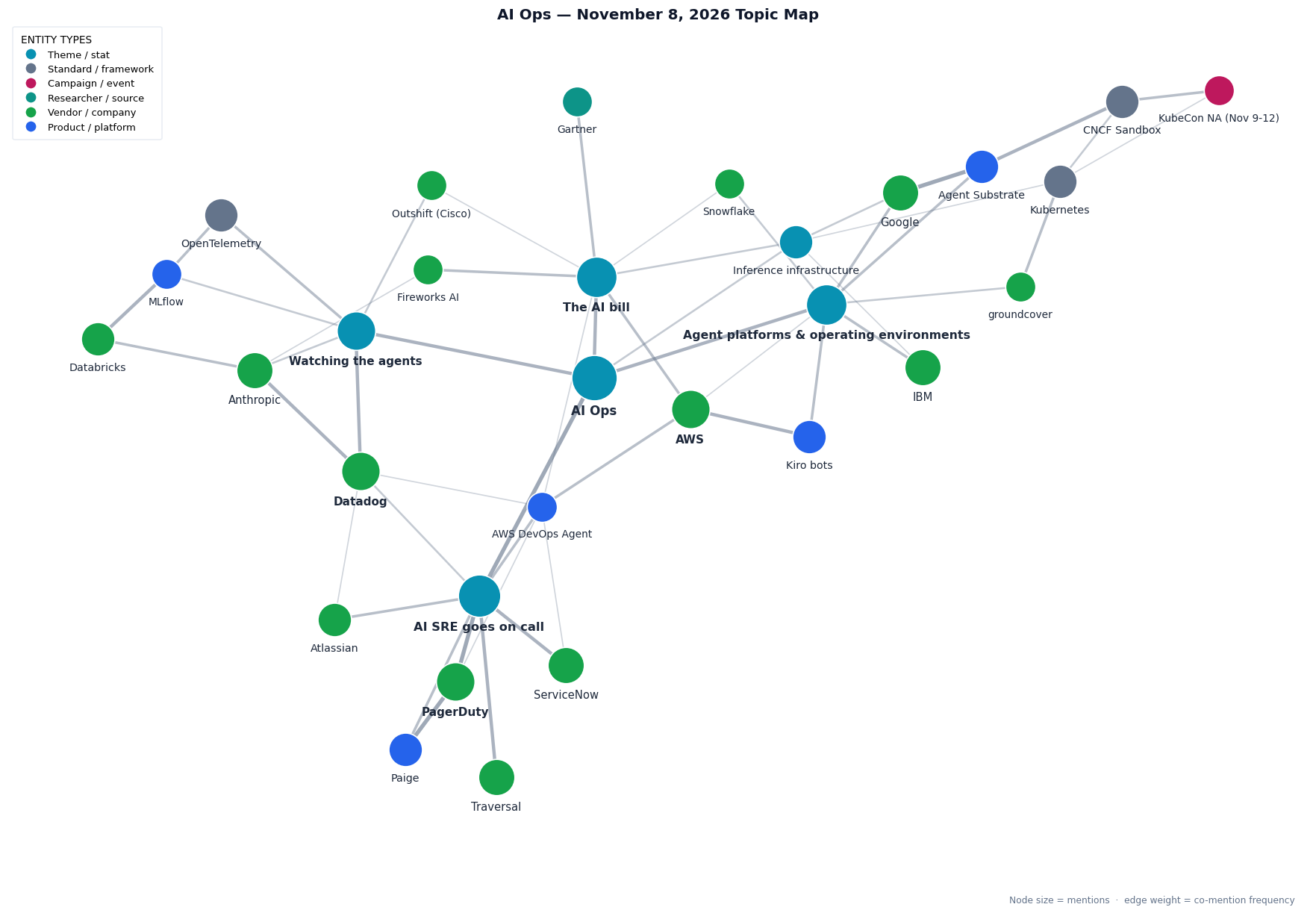
This week’s topic map. AI SRE fills the bottom with PagerDuty, Paige, Traversal, ServiceNow, Atlassian and the AWS DevOps Agent. Watching the agents sits on the left with Datadog, Anthropic, Databricks, MLflow and OpenTelemetry. Agent platforms take the right, with Google, Agent Substrate, the CNCF Sandbox and KubeCon at the top right and AWS Kiro bots, groundcover and IBM below. The AI bill sits above the AI Ops hub with Gartner and Fireworks AI.
View interactive topic map →
Article index
28 articles, grouped by sub-theme. Nineteen are from this week’s coverage window (November 1 to November 8). Nine are longer foundational reads on the beat. Sponsored coverage, vendor blogs and contributed pieces are labelled within each group.
AI SRE goes on call
PagerDuty, ServiceNow and Atlassian each put an incident agent into their platforms, and Traversal raised money to sell one on its own. Every product limits the agent to scoped work and asks a person before it changes anything. The ServiceNow, Atlassian and Elastic items are vendor-published.
Watching the agents
Agent telemetry is being wired into the platforms teams already pay for, and one study shows why latency and token counts are not enough. The VentureBeat debate study is sponsored content presented by Outshift by Cisco. The Datadog and Databricks items are vendor-published.
Agent platforms and operating environments
Where agents run, how long they persist and what they are allowed to touch. The SiliconANGLE IBM piece comes from an interview series IBM pays for, the Google item is a vendor blog, and the DevOps.com essay is contributed.
| Article |
Source |
Published |
| 12. Open infrastructure for autonomous agents comes to CNCF (vendor blog) |
Google Cloud Blog |
Nov 5, 2026 |
| 13. AWS launches agentic AI Kiro bots with memory and support for recurring development jobs |
VentureBeat |
Nov 5, 2026 |
| 14. Oumi’s Frontier AI Engineer now builds AI agents and retrains the models behind them |
SiliconANGLE |
Nov 4, 2026 |
| 15. Groundcover automates Kubernetes sizing. Engineers set the bounds. |
The New Stack |
Nov 5, 2026 |
| 16. Snowflake expands agentic AI platform with business context and governance tools |
SiliconANGLE |
Nov 3, 2026 |
| 17. IBM connects agentic workloads to the demands of always-on AI (foundational, IBM-paid interview series) |
SiliconANGLE |
Nov 3, 2026 |
| 18. IBM TechXchange 2026: Agents scale when the model has less to guess (foundational) |
TechTarget |
Nov 3, 2026 |
| 19. Your AI Agent Needs an Operating Environment. Who’s Engineering It? (foundational, contributed) |
DevOps.com |
Nov 3, 2026 |
Inference and the infrastructure underneath
Serving runtimes, private-cloud packaging, regions and storage for teams running models themselves. The Google item is a vendor blog; the InfoWorld piece is an opinion column.
The AI bill
Prices are rising across GPUs, memory and software even as the cost per token falls. The DCD SLA piece is sponsored, and the DCD cost piece is an opinion column.
Detailed write-ups
1. PagerDuty puts an AI agent on the rota, and Traversal raises $120 million
SiliconANGLE · November 3, 2026
PagerDuty launched Paige, an AI SRE agent, and renamed its flagship Operations Cloud the PD Reliability Platform, which feeds Paige its operational context. Teams decide what Paige may do. Where a person stays in the loop, it speeds triage and asks for approval before any fix; it acts on its own only in low-risk cases the team has explicitly authorised. Paige can also be placed in an escalation policy as a “virtual responder”, so lower-priority incidents may never reach a person. A new console shows incidents, on-call rotations and which agents are active and what each is doing. PD Labs previews a live service map, a parallel root-cause investigator and a shared workspace for people and agents. Paige is generally available now, priced on an allowance of ingested events, automation actions and seats, with credits for overage. PagerDuty says Paige beat leading AI coding agents at diagnosing simulated incidents in its own benchmark report. Chief executive John DiLullo said the answer is “to fight fire with fire, using AI itself as part of how we keep systems running.”
The same day, Traversal raised $120 million at a $1 billion valuation, led by Kleiner Perkins, Redpoint and Khosla Ventures, with Sequoia, Battery and Amex Ventures joining. Its agents learn normal behaviour from logs, metrics and traces, then use causal machine learning to find root causes and simulate the effect of possible fixes. The company says revenue grew more than ninefold in a year, and names PepsiCo, DigitalOcean, Nubank and Harvey AI as customers. On ORCA-bench, a benchmark Traversal helped build, frontier models reach about 25% accuracy on medium-difficulty SRE tasks, with hallucination rates often above 40%. “Site reliability engineering is one of the hardest problems in applied AI,” said co-founder and chief executive Anish Agarwal.
Sources: SiliconANGLE (PagerDuty Paige) — https://siliconangle.com/2026/11/03/pagerduty-debuts-paige-ai-agent-with-renamed-pd-reliability-platform-and-pd-labs/ · SiliconANGLE (Traversal $120M) — https://siliconangle.com/2026/11/03/autonomous-site-reliability-engineering-startup-traversal-bags-120m-in-funding-at-a-1b-valuation/
2. The incumbents ship scoped incident agents, and Thoughtworks flags the cost
ServiceNow / Atlassian / Thoughtworks / Elastic · November 3–6, 2026
ServiceNow’s AIOps AI Specialist is generally available in its November 2026 release. It works only on alerts inside a scope the customer defines and sits on the same dashboards as human operators. It closes alerts that need no action and records the evidence for each closure; operators can reopen one as feedback. For the rest it names a probable cause, maps the impact across services and suggests a next step. It cannot change team configuration or system settings, every action is logged, and remediation needs a person to approve it. “The specialist shortens the time to a decision, but it does not make the decision,” the ServiceNow post says.
Atlassian opened a beta of two Jira Service Management features for Premium and Enterprise customers. Prevention Center flags changes that need a closer look before they cause incidents. Incident Command Center links each incident to recent changes and deployments, related alerts, past incidents and observability data, and writes a post-incident review whose action items become Jira work. Datadog, Sentry and Splunk connect over MCP, with Dynatrace and New Relic through Atlassian’s MCP Gallery. Elastic described a narrower building block: its Significant Events feature watches each alert rule’s own history for change points, then an agent re-runs the rules’ queries and groups rules that describe the same failure. In its example, two payment rules became one alert showing 1,156 failing log lines. Code decides what is stored, and the model cannot edit a rule.
Thoughtworks put the AWS DevOps Agent in the Assess ring of Technology Radar Vol. 35. Its teams are testing it on live alarms and report faster root-cause analysis and less toil. It integrates with Datadog, Dynatrace, New Relic, Splunk, Grafana, PagerDuty, ServiceNow and custom MCP servers. The main concern is money. “The platform charges per agent-second spent investigating an incident, making costs difficult to predict,” the Radar says. It recommends a person checks every finding, tight control over which events can start an investigation, and active cost tracking.
Sources: ServiceNow Community (AIOps AI Specialist) — https://www.servicenow.com/community/itom-blog/shift-left-of-traditional-it-operations-with-the-aiops-ai/ba-p/3618361 · Atlassian (AI-native operations) — https://www.atlassian.com/blog/jira-service-management/ai-operations-for-the-ai-sdlc · Thoughtworks (AWS DevOps Agent) — https://www.thoughtworks.com/radar/platforms/aws-devops-agent · Elastic Observability Labs (root cause analysis) — https://www.elastic.co/observability-labs/blog/automated-root-cause-analysis-significant-events
3. Datadog grows 35% and opens a door through Anthropic’s marketplace
Datadog Investor Relations / Datadog · November 2–4, 2026
Datadog reported third-quarter revenue of $1.20 billion, up 35% from a year earlier, with non-GAAP operating income of $334 million (a 28% margin) and free cash flow of $251 million. About 4,860 customers now pay $100,000 or more a year, up 20%. It guided full-year 2026 revenue to $4.515 billion to $4.525 billion. The release highlights Scout 1.0, its first specialist model, which now runs Bits Investigation, and a Leader placement in Forrester’s AIOps Platforms Wave. It does not give a count of AI-native customers. “We are seeing strong adoption across our platform as customers scale their digital operations and use of AI,” said co-founder and chief executive Olivier Pomel.
Two days earlier, Datadog listed itself on Anthropic’s Claude Marketplace. The only product on offer at launch is Agent Observability, for monitoring, tracing and evaluating agents built on Claude. Customers can pay for it from their committed Anthropic spend, so it needs no new budget line, while Datadog remains the contracting party. It is open to US entities for now and needs no new integration. Datadog says joint customers already trace Claude API calls, bring Anthropic costs into its Cloud Cost Management, and send it Claude Code telemetry. Paying for monitoring out of the model provider’s commitment is a new buying route for observability teams.
Sources: Datadog Investor Relations (Q3 results) — https://investors.datadoghq.com/news-releases/news-release-details/datadog-announces-third-quarter-2026-financial-results/ · Datadog (Claude Marketplace) — https://www.datadoghq.com/blog/datadog-anthropic-claude-marketplace/
4. Claude traces land in MLflow, and a study shows why green dashboards can mislead
Databricks / VentureBeat (sponsored) · November 3–4, 2026
Claude Platform can now export OpenTelemetry traces natively to Databricks MLflow, in public beta. The Anthropic SDKs, the Messages API and Claude Managed Agents emit spans for model requests and tool calls; Databricks takes them in through Zerobus Ingest and stores them in Unity Catalog tables linked to an MLflow experiment, where access is governed and the data can be queried in SQL. Setup is three steps, and Claude Code and the Agent SDK can export through environment variables. Prompts and responses are captured only if content mode is set to “full”. On top, MLflow can explain where a run went wrong, group recurring problems such as repeated searches that waste tokens, queue traces for expert review, and compare a baseline agent with a revised one using LLM judges. “An agent can return a plausible answer while missing an important finding or reading the same source repeatedly,” the post notes.
A sponsored VentureBeat piece presented by Outshift, Cisco’s incubator, makes the case that traces alone are not enough. In Outshift’s experiments with five-agent teams, 75% of debates ended with every agent agreeing on the wrong outcome. Agents that skip the work of reaching agreement use fewer tokens, so a lower bill can be a sign of failure, and standard dashboards that track latency, errors and token spend can look healthy throughout. In one example, a “100,000 users” requirement was built as cumulative users when the customer meant concurrent users. Outshift has published its tools as open source. “All of your dashboards from every observability vendor will show green, while your outcomes are going red,” said Vijoy Pandey, Outshift’s general manager. The findings are Outshift’s own.
Sources: Databricks (Claude OTel to MLflow) — https://www.databricks.com/blog/claude-platform-now-supports-native-opentelemetry-observability-databricks-mlflow · VentureBeat (multi-agent debates, sponsored by Outshift) — https://venturebeat.com/orchestration/ai-teams-agreed-on-the-wrong-answer-in-75-of-debates-and-lower-token-bills-hid-the-failure
5. Google moves its agent runtime into the CNCF ahead of KubeCon
Google Cloud / Google Open Source · November 5, 2026
Google said three of its open-source projects, Agent Substrate, gVisor and OpenRL, were accepted into the CNCF Sandbox last month and are now going through onboarding, with gVisor on a path to Incubation. Agent Substrate reached 1.0 and is generally available on GKE. It snapshots idle agents to storage and restores them in under half a second, and Google cites ten times the container density and more than 500 suspend-and-resume operations a second. It already powers the CNCF project kagent. gVisor, the userspace kernel that keeps untrusted code away from the host kernel, gains Ant Group, Modal and Tines as maintainers. OpenRL is a self-hosted reinforcement-learning loop for post-training open models on Kubernetes. “Agent Substrate on GKE gives us the security isolation to let agents execute code safely, the extensibility to plug in our own runtime, and the density to run every customer’s agents economically at scale,” said Tamir Magen, chief executive of SPIRITT.
Google also open-sourced the XLA Serving Engine, a C++ runtime that serves JAX models on TPUs, GPUs and CPUs. It is aimed at non-LLM models; for large language models the authors point to vLLM or SGLang. In their tests with short requests it delivered two to five times the throughput of the best Python server they built and used 30% to 70% less CPU per prediction. Inside Google it serves more than six million queries a second. All performance figures are Google’s. KubeCon + CloudNativeCon North America runs in Salt Lake City from November 9 to 12.
Sources: Google Cloud Blog (agent infrastructure to CNCF) — https://cloud.google.com/blog/products/containers-kubernetes/open-infrastructure-for-autonomous-agents-comes-to-cncf · Google Open Source Blog (XLA Serving Engine) — https://opensource.googleblog.com/2026/11/supercharging-xla-inference-xla-serving-engine.html
6. The AI bill keeps rising while the token price falls
VentureBeat / The Register / DatacenterDynamics · November 2–7, 2026
VentureBeat tallied the increases. AWS raised prices for EC2 Capacity Blocks for ML four times in 2026, by about 15% in January, 10% in April for some configurations, 20% in July and 15% in October for most US GPU configurations. Gartner says memory prices have more than doubled in a year. Microsoft 365 list prices rose 5% to 13% for enterprise suites with Teams and up to 43% for F1 without Teams. In VentureBeat’s own survey, 56% of respondents said a vendor had added an AI surcharge, raised a renewal citing AI, or moved features to a pricier tier, and 38% said cost overruns had delayed, cut back or cancelled an AI project. “This ‘memflation’ effect is expected to persist through 2027 before hardware pricing begins to stabilize,” said Gartner analyst John-David Lovelock.
A DCD opinion piece puts the paradox in numbers: GPT-4-class output fell from about $20 per million tokens in March 2023 to under $0.50, yet the average enterprise AI budget grew from $1.2 million in 2024 to about $7 million in 2026. Fireworks AI vice president Rob Ferguson told The Register that idle GPUs are the waste, putting 10,000 GPUs at about $1 billion of capital, and argued that routing work across a portfolio of models beats any single model. He said Fireworks cached about 90% of one customer’s tasks, against about 30% it observed with a frontier model. “The token cost is not the real cost. It’s the cost per task,” he said. A sponsored DCD piece adds a financing angle: when a GPU-as-a-service provider misses its SLA, service credits can eat into the cash flows that its debt is built on.
Sources: VentureBeat (rising AI bills) — https://venturebeat.com/infrastructure/the-ai-race-is-raising-companies-bills-from-gpus-to-memory-to-microsoft-365 · The Register (Fireworks model routing) — https://www.theregister.com/ai-and-ml/2026/11/07/fireworks-says-youre-wasting-money-on-ai-unless-youre-using-all-the-models/5308277 · DatacenterDynamics (cost of intelligence, opinion) — https://www.datacenterdynamics.com/en/opinions/from-capacity-to-the-cost-of-intelligence/ · DatacenterDynamics (SLA and credit risk, sponsored) — https://www.datacenterdynamics.com/en/opinions/why-sla-risk-credit-risk/
7. Agents that persist, run on a schedule and stay inside bounds
VentureBeat / The New Stack / SiliconANGLE · November 4–5, 2026
AWS made Kiro bots generally available: persistent agents in its Kiro Crew workspace, each with a name, an ongoing conversation, its own notes and a workspace. A bot can start several worker sessions, track and correct them, and pull their output together, and it can ask a person for a decision while carrying on with other tasks. Developers can set schedules in conversation, such as overnight failure investigations or a weekly summary of changes, and an activity log records the routine work. Memory is tied to the bot’s assignment and users can inspect, edit or delete it. Adding a tool needs approval, and permissions differ by bot: a research bot can read but not edit, and a deployment bot asks before changing anything. Kiro Pro costs $20 a month with 1,000 credits, with extra credits at $0.04 and no per-bot fee.
groundcover applied the same pattern to Kubernetes capacity. Its Autonomous Infrastructure beta, built on the Wand acquisition, resizes CPU and memory requests from the production data its eBPF sensor already collects, and checks how tightly a node is packed before raising one workload’s request. It is off until an administrator turns it on for chosen deployments, namespaces or clusters, works within minimum and maximum bounds, changes requests but never limits, and logs every assignment. The beta costs nothing extra. Oumi extended its Frontier AI Engineer to build agents and retrain the models behind them, leaving a customer’s own orchestration in place. Chief executive Manos Koukoumidis said agents will improve “by training the weights of the models powering them, learning from their own work.”
Sources: VentureBeat (AWS Kiro bots) — https://venturebeat.com/technology/aws-launches-agentic-ai-kiro-bots-with-memory-and-support-for-recurring-development-jobs · The New Stack (groundcover rightsizing) — https://thenewstack.io/groundcover-autonomous-kubernetes-rightsizing/ · SiliconANGLE (Oumi) — https://siliconangle.com/2026/11/04/oumis-frontier-ai-engineer-now-builds-ai-agents-and-retrains-the-models-behind-them/
8. IBM and Snowflake on scaling agents: give the model less to guess
TechTarget / SiliconANGLE / DevOps.com · November 3, 2026
At IBM TechXchange, Omdia analyst Torsten Volk laid out the arithmetic of scale. One IBM customer’s agents make 8.5 million model calls a day; at 99.9% accuracy that is still about 8,500 wrong answers a day. A five-step process at 97% reliability per step succeeds about 86% of the time end to end. Omdia finds 22% of enterprises run some agents in mission-critical production, and moving a successful pilot into production takes about 12 months. IBM’s answer is four layers around the model: facts, functions, permissions and records, built from Streamhouse, Infragraph, Integration Intelligence Hub, watsonx Orchestrate, Vault and Concert. Integration Intelligence Hub stays in tech preview until December, and Infragraph refreshes daily by default. “Last year was all about building agents, this year it’s all about scaling them,” said Dinesh Nirmal, IBM’s senior vice president of products for software.
Snowflake took a similar line. A Business Ontology, in private preview, sets approved business definitions that its agents use to ground answers, and its Cortex AI Gateway adds agent abuse detection, tracing, sandboxes, AI cost governance and dynamic model routing. In a contributed DevOps.com essay, John Capobianco argues that the environment around an agent is an engineering deliverable: define its tools, context, permissions and evidence of completion, and enforce each rule outside the prompt. “If the answer is ‘we put it in the prompt,’ there is more engineering to do,” he writes.
Sources: TechTarget (IBM TechXchange) — https://www.techtarget.com/news/ibm-techxchange-2026-agents-scale-when-the-model-has-less-to-guess/873672/ · SiliconANGLE (IBM operating model, IBM-paid series) — https://siliconangle.com/2026/11/03/ibm-connects-agentic-workloads-demands-always-on-ai-ibmaioperatingmodel/ · SiliconANGLE (Snowflake) — https://siliconangle.com/2026/11/03/snowflake-expands-agentic-ai-platform-with-business-context-and-governance-tools/ · DevOps.com (agent operating environment, contributed) — https://devops.com/your-ai-agent-needs-an-operating-environment-whos-engineering-it
Calls to action
- Write down what your incident agents may do alone. For each AI SRE tool you run or trial, list the incident types it may close or fix without approval, who signed that off, and where its actions are logged.
- Test any AI SRE on your own past incidents. Replay a set of resolved incidents through each candidate and score the root cause and the evidence it cites. Do not rely on a vendor’s own benchmark.
- Put a budget on investigation agents. If you pay per agent-second or per credit, limit which alerts can start an investigation and track the spend weekly.
- Check outcomes, not just agent telemetry. Alongside latency and token counts, sample agent runs and check whether the result was right. Treat a sudden drop in tokens as something to investigate, not only a saving.
- Decide what agent traces may contain. Before turning on full content capture in any trace exporter, agree who can read prompts and responses and how long they are kept.
- Start autonomous rightsizing on low-risk workloads. If you trial automated Kubernetes resizing, begin with development namespaces, set minimum and maximum bounds, and leave limits and stateful production services alone.
- Measure AI cost per task. Track the total cost of completing a task, including retries and cache misses, rather than price per token, and review AI-related price increases at every renewal.
|