This week at a glance
The refrigeration attacks came back, and in more places. Overnight from November 1 to 2, fridges and freezers at more than 100 stores in Belgium, Estonia, Ireland, Luxembourg, the Netherlands and Sweden warmed up, some to 50°C, and problems were also reported in Finland, Italy and Portugal. In October about 700 French supermarkets were hit. That week an attacker also got in through a refrigeration supplier at France’s blood service and pushed cold-room temperatures to extremes at three sites; alarms caught it and the plasma was moved. French investigators have linked the incidents to Danfoss, Copeland and Dixell controllers, and their review of the French cases found exposed admin interfaces and weak passwords, not a software flaw. CISA, the FBI, HHS, USDA and DOT published a fact sheet on hardening cooling systems, and Singapore’s Cyber Security Agency issued its own advisory. Nobody has claimed the attacks. SentinelOne treats Russian-aligned groups as a credible line of inquiry but says the evidence does not establish who is responsible.
Two flaws need patching. CVE-2026-58115 (CVSS 10) lets anyone who can reach the Node-RED editor on a Siemens SIMATIC IoT2050 run code on it, and VulnCheck has seen it exploited since October 30. A CISA advisory covers two CVSS 9.0 flaws in Subnet Solutions’ PowerSYSTEM Center, which utilities use to manage substation devices. On the threat side, the head of the UK’s NCSC expects AI-driven attacks on UK critical infrastructure by 2028. Booz Allen reported that AI agents built on Anthropic and OpenAI models completed all eight stages of an OT attack in a lab, and Australia’s annual risk review now calls AI a “dominant threat multiplier”.
Policy and standards round out the week. The information-sharing law CISA 2015 expires on December 11 unless Congress renews it, and the OT Cyber Coalition joined 34 other groups asking for a ten-year extension in the defense bill. CISA opened its resilience month. NIST’s draft SP 800-82 Rev. 4 adds a water and wastewater section, with comments due November 30. ODVA’s CIP Security is now certified to IEC 62443-4-2 at Security Level Capability 3, and Dragos hired SANS veteran Rob T. Lee as its first chief AI officer.
On our watch list
- A third refrigeration wave, or a first in North America. The attacks went from about 700 French stores in October to more than 100 stores in at least six other countries in November. Watch for incidents at US or Canadian grocers, cold stores or pharmacies, and for whether the US fact sheet is followed by confirmed domestic cases.
- Attribution of the European attacks. No group has claimed them. Watch for an official finding from French or Belgian investigators, and for whether the unverified Telegram claims SentinelOne logged hold up.
- Exposure counts for refrigeration controllers. Censys counted just over 1,000 exposed Danfoss StoreView interfaces worldwide, and France’s count fell from 1,825 to 220 after October. Watch whether other countries’ numbers fall that fast, and whether Copeland and Dixell exposure is measured too.
- Healthcare cold chains. The blood-service incident came through a supplier, and the American Hospital Association says no US hospital cases have been confirmed. Watch for advisories from health ISACs and for any incident at a pharmacy, lab or vaccine store.
- More Node-RED exploitation. VulnCheck has seen 16 attacks from one IP so far. Watch for a jump in scanning for Node-RED editors without authentication, and for other industrial gateways that ship Node-RED.
- CISA 2015 before December 11. The House defense bill carries a ten-year extension and the Senate version does not. Watch the conference agreement, and whether a short extension or a lapse changes how much your ISAC and vendors share.
- NIST SP 800-82 Rev. 4 comments close November 30. Watch for how water utilities and their managed service providers respond to the MSP contract language in the new Section 2.5.5.
- AI attack tests outside the lab. Booz Allen required human sign-off before any physical action. Watch for the first confirmed incident in which an AI agent took an action in a live OT network, and for whether the NCSC’s 2028 timeline moves.
- DOE rules on foreign grid equipment by December 24. The rules will show whether remote access and software updates are judged by function or by where equipment was made.
- CIP Security in shipping products. ODVA’s certification only matters once device makers ship it. Watch for EtherNet/IP products claiming IEC 62443-4-2 certification on the back of it.
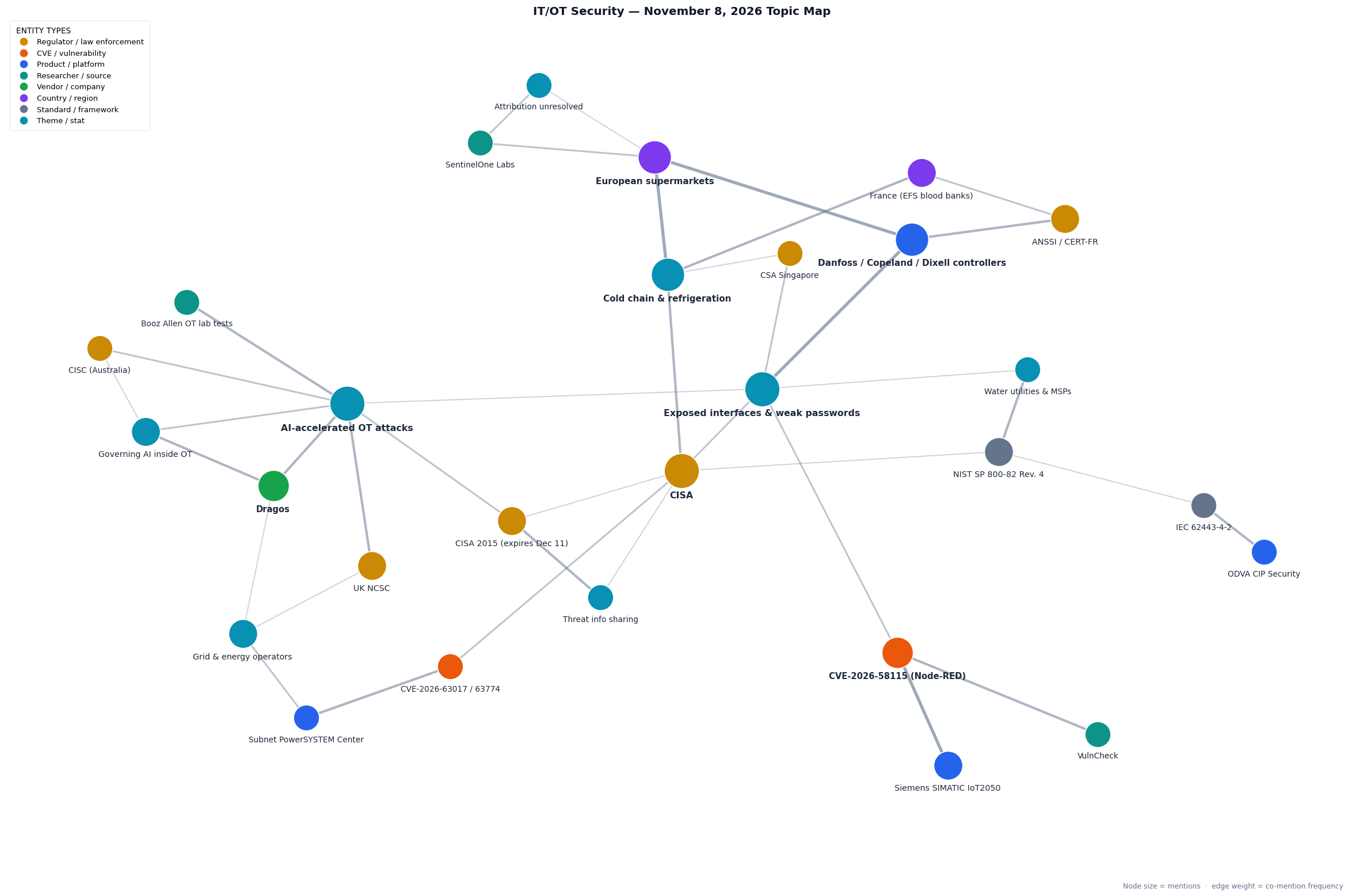
At the top, European supermarkets, the French blood service, and the Danfoss, Copeland and Dixell controllers connect through cold chain and refrigeration to CISA and to exposed interfaces and weak passwords, the week’s central theme. SentinelOne Labs and the unresolved attribution sit above them. At left, AI-accelerated OT attacks link the UK NCSC, Booz Allen’s lab tests, Australia’s CISC, Dragos and the governance of AI inside OT. CISA 2015 and threat information sharing sit between AI attacks and CISA. At bottom left, Subnet PowerSYSTEM Center and its CVEs connect to grid and energy operators. At bottom right, the Node-RED CVE ties Siemens SIMATIC IoT2050 and VulnCheck to exposed interfaces. NIST SP 800-82 Rev. 4 links water utilities to IEC 62443-4-2 and ODVA CIP Security.
View interactive topic map →
Article index
Cold-chain attacks
The second wave of refrigeration attacks across Europe, the French blood-service incident, the US multi-agency fact sheet on cooling systems, SentinelOne’s assessment of who might be behind it, and Singapore’s advisory on exposed OT.
Vulnerabilities and advisories
An exploited CVSS 10 Node-RED flaw on Siemens IoT2050 gateways, authorization and SQL injection flaws in Subnet’s substation management software, and OT-ISAC’s look at aviation supplier and remote-access risk.
AI on the attack side
The UK’s NCSC expects AI attacks on infrastructure by 2028, AI agents complete OT attack chains in the lab, AI reverse engineering erodes protocol obscurity, Australia’s risk review, and a vendor reading of the NCSC speech.
AI inside OT
Dragos hires a chief AI officer, industrial AI adoption runs ahead of security controls, and how new AI incident-readiness guidance applies to OT.
Policy, standards and guidance
CISA’s resilience month, the push to renew CISA 2015, a draft NIST OT guide with a water section, ODVA’s IEC 62443 certification, and an op-ed on trust in long-lived devices.
Energy, defense and readiness
Texas regulators urge energy firms to prepare, industry questions the foreign grid-equipment order, the Army tests zero trust for installation control systems, and incident response for energy OT.
Detailed write-ups
1. Refrigeration attacks spread across Europe and reach France’s blood supply
SecurityWeek · The Record · SentinelOne · Cybersecurity Dive · CSA Singapore · November 3-6, 2026
Overnight from Sunday, November 1, to Monday, fridges and freezers at more than 100 stores in several European countries heated up, some to 50°C. SecurityWeek lists Belgium, Estonia, Ireland, Luxembourg, the Netherlands and Sweden, with problems also reported in Finland, Italy and Portugal. In Belgium, Delhaize reported disruption at several dozen stores, Carrefour at 15 and an IKEA store in Mons, and the federal prosecutor has opened an investigation. The first wave, on October 11 and 12, hit about 700 French supermarkets, including Intermarché, Carrefour, Coopérative U and Monoprix. CERT-FR first linked those compromises to Danfoss AK-SM and AK-SC controllers, then added Copeland and Dixell XWEB systems. Danfoss says it told customers on October 13 to cut their systems’ internet connections. “Most stores took action at that time, but a small number did not,” a Danfoss spokesperson told Dutch broadcaster NOS. Censys counted just over 1,000 exposed Danfoss StoreView interfaces worldwide; in France the number fell from 1,825 before the October attacks to 220.
The same week, the French Blood Establishment (EFS) said an attacker had come in through one of its refrigeration-equipment suppliers and pushed temperatures and defrost thresholds to extremes in cold rooms at three sites. Monitoring and alarms caught the changes, staff regained control and moved the stock, which included plasma for transfusions and for making medicines, and EFS says its integrity was not affected. EFS is working with ANSSI and the health ministry. On November 5, CISA, the FBI, HHS, USDA and DOT published a fact sheet on attacks against refrigeration and cold-chain controllers. It warns that attackers use “unpatched or internet-accessible controllers to remotely alter settings”, trigger continuous heating and defrost cycles, hide temperature readings and create fire risks. Singapore’s Cyber Security Agency followed on November 6 and said the same risk applies to energy, water, manufacturing, building management, cold storage and healthcare.
Attribution is still open. No group has claimed the attacks. SentinelOne’s Tom Hegel calls Russian-aligned groups such as CARR, NoName057(16) and Z-Pentest a credible line of investigation, and notes an unverified Telegram post claiming a joint intrusion at a Spanish supermarket, but concludes that “available evidence does not yet establish who is responsible for the European incidents.” Other reporting has pointed to an Iran-linked group; that is also unconfirmed. The access path matters more to defenders than the attacker’s name. ANSSI’s review of the French cases found exposed administration interfaces and weak passwords, not the publicized Danfoss vulnerabilities, and decoy Danfoss controllers run by Lupovis saw login attempts throughout late October. The US agencies and Singapore give the same advice: take controllers off the internet, use MFA on a managed gateway for any remote access, alert when setpoints change, and set independent temperature limits downstream.
Sources: SecurityWeek, The Record, SentinelOne, Cybersecurity Dive, Cyber Security Agency of Singapore
2. CVSS 10 Node-RED flaw on Siemens IoT2050 gateways is being exploited
SecurityWeek · November 3, 2026
CVE-2026-58115 is a missing-authentication flaw in Node-RED’s HTTP interface, rated CVSS 10. Anyone who can reach the editor can reach the nodes that run system commands. Siemens disclosed it on August 11 for SIMATIC IoT2050 Advanced devices running Industrial OS with Node-RED installed, and fixed it in version 4.3.4.1. Siemens says an unauthenticated remote attacker could create malicious flows and “execute arbitrary code on the underlying server with maximum privileges.”
VulnCheck saw the first exploitation on October 30, from an IP address on Microsoft’s network (AS8075). The attacker deployed a Node-RED flow that downloaded a Linux bot from its own server. By November 1, VulnCheck had seen 15 more attacks from the same address, some installing persistent web shells. The attackers scan for Node-RED instances that have no adminAuth configured and exploit them with a single HTTP request.
Node-RED is common on industrial gateways and edge boxes, often installed for a pilot project and then left running. VulnCheck’s advice is short: “check whether it can be reached from outside your network today.” Update IoT2050 devices to 4.3.4.1 or later, turn on adminAuth for every Node-RED editor you run, and keep editors off the internet.
Sources: SecurityWeek
3. Subnet PowerSYSTEM Center flaws give low-privileged users admin reach
Red Tiger Security · November 3, 2026
CISA advisory ICSA-26-307-01, published November 3, covers two flaws in Subnet Solutions’ PowerSYSTEM Center, which utilities use to manage substation devices such as protective relays. CVE-2026-63017 (CVSS 9.0) is an incorrect-authorization flaw affecting the 2020 line (5.29.x and earlier), the 2024 line (6.0.x to 6.2.x) and the 2026 line (7.0.x to 7.1.x). CVE-2026-63774 (CVSS 9.0) is a SQL injection in the report designer, affecting the 2024 and 2026 lines. Fixes are Update 30 for 2020 users and 2026 Update 1.1 for the others. Chinmay Patel of Digital Boundary Group and Subnet Solutions reported the flaws.
Both need a valid login and adjacent network access, CISA reports no known public exploitation, and neither is in the Known Exploited Vulnerabilities catalog. Until they can patch, operators can monitor user activity records, disable browser developer tools for Client Access Server users and remove access to the report designer. “The server that manages the relays deserves the same care as the relays themselves,” writes Red Tiger Security founder Jonathan Pollet.
The risk is a low-privileged account, such as a contractor or a stolen credential, acting with admin rights over the system that holds relay settings and credentials for a fleet of substations. That makes the server a priority even though the flaws need a login.
Sources: Red Tiger Security
4. AI is already working through OT attack chains
SecurityWeek · BankInfoSecurity · Dragos · Industrial Cyber · Forescout · November 3-6, 2026
Richard Horne, head of the UK’s National Cyber Security Centre, said the UK will likely face AI-driven attacks on its critical infrastructure by 2028, and named AI-powered ransomware as one possibility. The NCSC’s annual report says AI is more likely to scale existing methods than to find whole new classes of flaw, but Horne warned it could let “vulnerabilities that have been tolerated for far too long” be found and exploited at scale. The report puts the cost of malicious cyber activity to UK organisations at almost $20 billion a year. It also cites the December 2025 attack on Poland’s grid, which the UK and EU states attributed to Russia’s FSB and which could have cut power to 500,000 people. Forescout notes that Horne singled out systems that control electricity, water, manufacturing, heating and refrigeration.
BankInfoSecurity reports what two research teams found when they tested this. Booz Allen Hamilton ran AI agents built on Anthropic and OpenAI models against about 20 devices in an air-gapped, multi-vendor lab. Both succeeded in all eight scenarios, which covered reconnaissance, finding flaws, building exploits, moving through the network and manipulating equipment. One went from a perimeter compromise to actions on the OT network in just over 16 minutes, and another found and moved a robotic arm in under three minutes. The researchers required human approval before any physical action, and one run used about $2,000 in tokens. “The models are getting better and better,” said Rob Bair, Anthropic’s principal industry advisor for cybersecurity. A Dragos blog adds that the AI reverse-engineering tool REA went from under 10,000 GitHub stars to more than 400,000 in about a month, and cites an expert who ported a WAGO PLC exploit in 8.5 hours for $535.74.
Australia’s Critical Infrastructure Security Centre reached the same conclusion in its fourth annual risk review: AI has gone from an emerging risk in 2023 to a “dominant threat multiplier” that increases the number of attackers and lowers the skill they need. Dragos’s advice is to “plan as if every device, binary and protocol you run is readable, because for all intents and purposes, it is.” For OT teams, that means the protection that obscure protocols and proprietary firmware used to provide is shrinking fast, and segmentation, access control and monitoring have to carry more of the load.
Sources: SecurityWeek, BankInfoSecurity, Dragos, Industrial Cyber, Forescout
5. CISA 2015 runs out on December 11, and OT groups want ten more years
Industrial Cyber · CyberScoop · November 3-5, 2026
The Cybersecurity Information Sharing Act of 2015, which gives companies liability protection when they share threat indicators and defensive measures with each other and with the government, expires on December 11. In a November 1 letter to the leaders of the House and Senate Armed Services Committees, the Operational Technology Cyber Coalition and 34 other critical-infrastructure organisations asked them to keep Section 1706 of H.R. 8800, the House version of the FY2027 defense bill, which would extend the law through 2035. The Senate version does not include it. “Recent incidents have demonstrated that advanced AI systems can identify and exploit software vulnerabilities at machine speed, collapsing the window between the discovery of a weakness and its use in an attack,” the letter says. OTCC argues a short-term extension or lapse would remove the legal certainty that makes companies willing to share.
CISA, meanwhile, opened Critical Infrastructure Security and Resilience Month on November 2 under the theme “Resolve to be Resilient”, with four practices: know your most important systems and what they depend on, understand the risks that matter, have a plan for response and recovery, and update it from experience. “Resilience comes from knowing what matters most and having a plan you can actually use when something goes wrong,” said Acting Director Nick Andersen. In a CyberScoop op-ed, OmniTrust CEO David Sequino argues that the agency’s new strategy runs into a quieter problem: controllers stay in service for decades while their firmware, credentials and suppliers change, so trust granted at installation goes stale. He suggests buyers make suppliers show how they manage device identities, verify updates and revoke credentials before accepting equipment.
For OT operators, the near-term question is practical: if the law lapses, will your ISAC, vendors and incident-response partners keep sharing at the same pace? It is worth asking them now.
Sources: Industrial Cyber, Industrial Cyber, CyberScoop
6. NIST’s draft OT security guide adds a water and wastewater section
WaterISAC · November 5, 2026
NIST is taking comments until November 30 on the initial public draft of SP 800-82 Revision 4, the Guide to Operational Technology Security. The revision reorganises the guide around Cybersecurity Framework 2.0 and adds material on asset management, network monitoring and applying zero trust ideas to OT.
New Section 2.5.5 covers water and wastewater systems, including treatment processes, pump stations and the telemetry that links them. It recognises that smaller utilities often depend on managed service providers and recommends that cybersecurity responsibilities be written into those contracts. It also covers remote access, authentication, monitoring and patching, and ties cybersecurity decisions to water-safety and reporting obligations. “NIST guidance often shapes the frameworks, assessments, and vendor expectations that utilities later encounter,” WaterISAC notes, adding that because the section is still a draft, practitioners can still influence it.
The MSP language is the part most likely to change contracts. Utilities that rely on an outside provider for SCADA support should read Section 2.5.5 and comment before the deadline.
Sources: WaterISAC
7. ODVA’s CIP Security certified to IEC 62443-4-2 at Security Level 3
Industrial Cyber · November 2, 2026
TÜV Rheinland has certified ODVA’s CIP Security specification against the applicable requirements of IEC 62443-4-2 at Security Level Capability 3. SL 3 is meant to resist deliberate attacks using sophisticated means by attackers with moderate resources, industrial-control skills and moderate motivation. CIP Security is the security extension to EtherNet/IP. It adds device and user authentication, rejects altered data, blocks unauthorized commands and encrypts traffic with TLS and DTLS.
ODVA says the certification lowers the barrier for device makers seeking their own IEC 62443-4-2 certification, and presents CIP Security as a way to meet the EU Cyber Resilience Act’s requirements for confidentiality, integrity and authentication. It has also advanced its “pull model” for distributing device authenticity information, which is meant to simplify commissioning and replacing devices.
For asset owners, the certification is a shortcut in procurement: an EtherNet/IP device that implements CIP Security starts from a certified base. The work of deploying it, including certificates, commissioning and mixed fleets of older devices, still falls to the plant.
Sources: Industrial Cyber
8. Governing AI inside OT: a chief AI officer at Dragos, and adoption ahead of controls
Industrial Cyber · Nozomi Networks · November 3-5, 2026
Dragos has named Rob T. Lee its first Chief AI Officer. He joins from the SANS Institute, where he spent more than 25 years and most recently served as Chief AI Officer and Chief of Research, leading its Critical AI Security Guidelines. He reports to Dragos founder and CEO Robert M. Lee and will advise customers adopting and securing AI in OT, work with AI developers to bring OT knowledge into how AI is built for critical infrastructure, and lead research on the subject.
An Industrial Cyber feature shows why the role exists. It cites Takepoint Research’s finding that 87.7% of organisations use AI somewhere in their OT security work but only 7.9% use it across all functions. The practitioners it quotes agree on the controls: keep an AI bill of materials covering model version, provenance, training data and decision authority; check model inputs against physics and process limits; keep safety instrumented systems and mechanical interlocks independent of AI logic; and keep generative AI as an advisor, not an operator. One put it plainly: “Treat AI as an untrusted vendor.” Nozomi Networks looks at the October 16 incident-readiness guidance from NIST’s CAISSI, the NSA and CISA for frontier AI training and evaluation. It sets out ten voluntary practices across prepare, detect, respond, recover and report, but it was not written for OT and does not address process-safety constraints.
The practical step for OT teams is to bring any AI tool that touches plant data under change management and asset inventory now, before it is given more control than its owners can monitor.
Sources: Industrial Cyber, Industrial Cyber, Nozomi Networks
Calls to action
- Find and disconnect refrigeration controllers. Check your external ranges, and your maintenance providers’ cellular links, for Danfoss AK-SM/AK-SC and StoreView, Copeland and Dixell XWEB interfaces. Take them off the internet and route remote maintenance through a gateway with MFA and individual accounts.
- Set alarms that the controller can’t silence. Use independent temperature monitoring and alert on any remote change to setpoints, defrost settings or alarm limits, especially overnight and at weekends: the November wave struck between Sunday night and Monday morning.
- Patch or lock down Node-RED. Update SIMATIC IoT2050 devices to 4.3.4.1 or later, enable adminAuth on every Node-RED editor, and confirm none can be reached from outside your network.
- Update PowerSYSTEM Center. Move 2020 installs to Update 30 and 2024/2026 installs to 2026 Update 1.1. Until then, remove report-designer access and review user activity records.
- Ask your sharing partners about December 11. Confirm with your ISAC, OT security vendors and incident-response retainers how they will handle threat sharing if CISA 2015 lapses.
- Comment on NIST SP 800-82 Rev. 4 by November 30. Water utilities and their managed service providers should review Section 2.5.5, especially the MSP contract language.
- Put AI tools under change control. List every AI model or agent that reads or writes plant data, record its version and decision authority, and keep safety systems independent of it.
|