This week at a glance
This was the week the big SOC platforms put agents at the centre and then built the brakes. At Fal.Con Europe, CrowdStrike brought its AI SOC tools together as an Agentic Security Platform, relaunched Falcon Guardian to discover and contain misbehaving AI agents, added an AI Kill Switch that stops an agent, blocks it from relaunching and cuts its network access, and agreed to buy Fiddler AI and Dreadnode for a reported $495 million. Palo Alto Networks’ Cortex XSIAM 4.0 lets agents read internal runbooks and SOPs inside approval gates the customer sets, and Palo Alto is reported to be in talks to buy Beacon, a two-year-old Israeli company that builds SOC agents. Google’s security agents now need a person’s approval before they write files, run commands or apply a mitigation, and Google SecOps gained an agentic chat with MCP access.
The practitioner evidence was more useful than the launches. Splunk’s own SOC sorts agent work into delegated, guided and bounded tiers, and reports triage handle time falling from 15.4 to 5.6 minutes with no benign alerts misclassified in testing. Elastic shows how to hunt through coding-agent sessions with semantic search, and finds about one real session in seven worth a human look. Gartner’s warning about kill switches applies to all of these: they stop the next action, but they cannot undo the last one.
Exposure data set the pace. Microsoft’s analysis of about 383,000 CVEs puts the median patch time for network appliances at more than a year, while the median gap from CVE publication to a CISA KEV listing has fallen to three days in 2026. A Debian and Ubuntu APT flaw, found in two hours with AI help, shows how quickly ordinary infrastructure turns up new bugs. CrowdStrike’s account of an AI-run campaign, in which agents checked whether the Falcon sensor was installed before acting, makes sensor coverage a detection question as well as an asset-inventory one. On the response side there is advice on playbooks for compromised service accounts and tokens, a warning that incident records can end up training a vendor’s model, and a case for phishing tests that measure how fast staff report a lure rather than who clicks.
On our watch list
- Endpoint termination for the AI Kill Switch. CrowdStrike says ending an agent on the endpoint itself is planned and coming soon. Watch for the release date, and for whether Falcon Observe (Fiddler) ships in Q4 of CrowdStrike’s fiscal 2027 as CSO reports.
- The Fiddler and Dreadnode closings. The $495 million figure comes from the Wall Street Journal and neither company has confirmed it. Watch the closing announcements for terms, and for how Dreadnode’s MCP server testing shows up in Falcon Guardian.
- Palo Alto and Beacon. Only CTech has reported the talks so far, and it gave no price. A confirmed deal would make three large SOC platforms buying agent startups in one quarter. Watch how it fits alongside XSIAM 4.0’s own agents.
- XSIAM 4.0 virtual patching and federated search. XDR Virtual Patching is in private preview. Watch for general availability, and for customer evidence that Federated Search across AWS, Google Cloud and Azure lowers ingest costs without slowing investigations.
- Google SecOps Agentic Chat and CodeMender. Both are in preview. Watch for GA dates, pricing, and whether the human checks on file writes and command execution stay on by default once they reach GA.
- November Patch Tuesday on November 10. October’s release fixed a record 1,407 unique CVEs. The forecast expects Microsoft, Adobe, Chrome and Firefox 160 updates. A second month at that volume would show whether the record was a one-off or a new normal.
- APT CVE-2026-109518 in images and mirrors. Fixed packages are out for Debian 12 and 13 and Ubuntu 22.04, 24.04 and 26.04 LTS. Watch for derivative distributions and container base images to catch up, and for any report of a malicious mirror or proxy exploiting it.
- ARTEX forks. The original open-source project was withdrawn in October, but copies remain, and Google and Mandiant already see criminal use. Watch for detection content that spots agent-driven reconnaissance of EDR processes and folders.
- Vendor terms on incident-record reuse. Dark Reading’s opinion piece argues that using closure notes and rule text for model improvement should need separate, revocable consent. Watch for security AI vendors writing that separation into their contracts at renewal.
- Independent repair benchmarks. Cogent reports 57.9% working fixes on LiveCVEBench against 45.3% for Claude Code and Codex, but it ran the test with different inference budgets. A third-party run with equal budgets would show whether the gap holds.
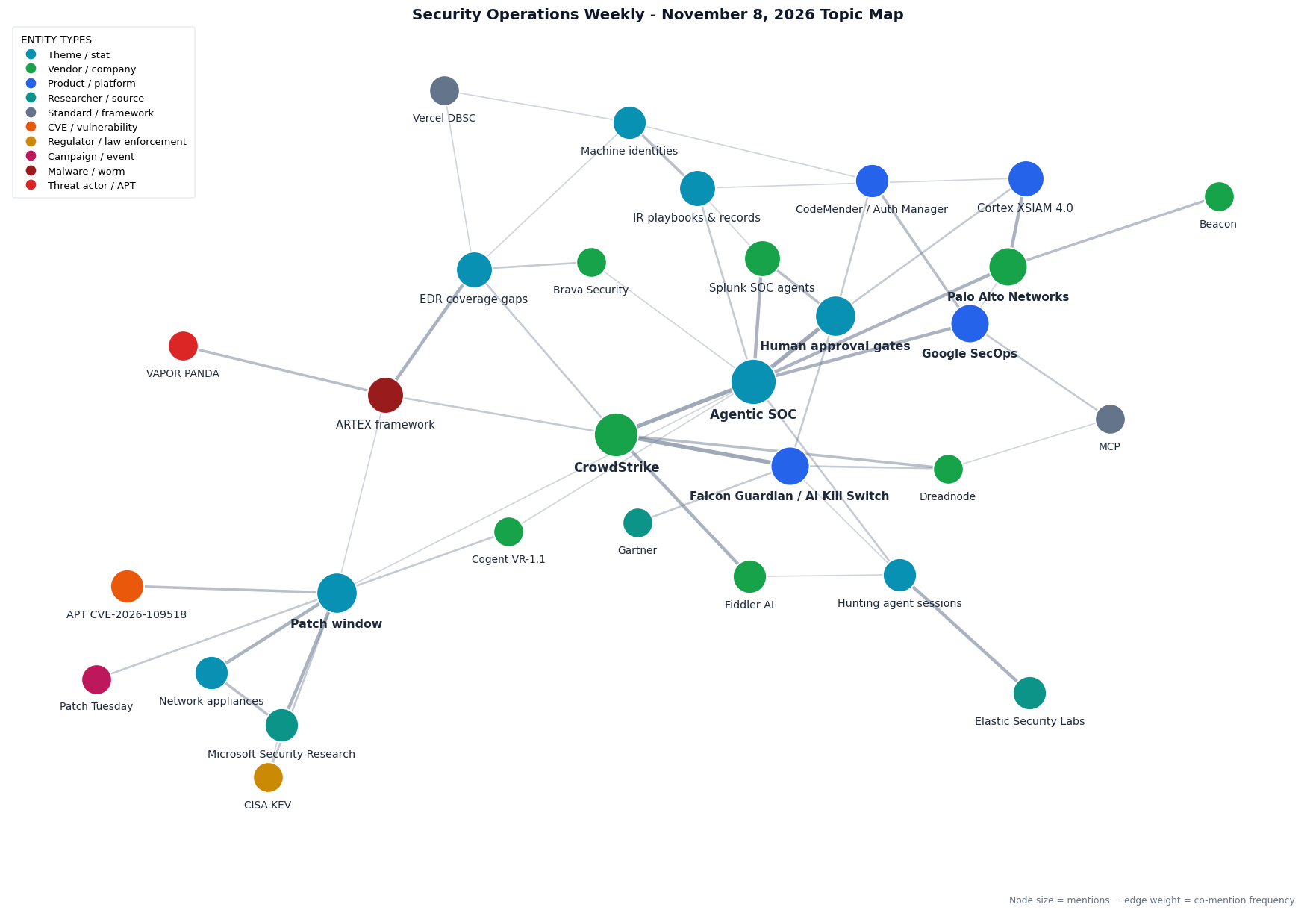
This week’s topic map: the agentic SOC (CrowdStrike Falcon Guardian and the AI Kill Switch, Fiddler and Dreadnode; Palo Alto Cortex XSIAM 4.0 and Beacon; Google SecOps and CodeMender), human approval gates, Splunk and Elastic on running and hunting agents, patch windows and the APT flaw, ARTEX and EDR coverage gaps, incident playbooks for machine identities, and new tooling from Cogent, Brava and Vercel.
View interactive topic map →
Article index
Platforms and the agentic SOC
CrowdStrike, Palo Alto Networks and Google all moved agents deeper into the SOC this week, each with controls for stopping or approving what the agents do. The XSIAM post and the Google SecOps changelog are vendor-published.
Supervising and hunting agents
How a working SOC splits agent work by risk, how to hunt through agent sessions for risky behaviour, and why outside agents may treat your network as a route to someone else. The Splunk and Elastic pieces are vendor blogs; the Infosecurity piece is an opinion column.
Exposure, patching and endpoint coverage
Microsoft data on how long each class of system waits for patches, an APT package-manager flaw on Debian and Ubuntu, the Patch Tuesday outlook, and AI-run intrusions that check for EDR before they act. The forecast is written by an Ivanti product manager.
Incident response, records and readiness
Playbooks for breaches that involve service accounts and tokens, what happens to incident records once a vendor’s AI can use them, automating incident status updates, and phishing tests that measure reporting. The CSO pieces are contributor columns; the incident-archive piece is opinion.
New SOC tooling and startups
A vulnerability-repair model, a detection-validation startup, a managed AI SOC service, Cloudflare’s public vulnerability briefings and device-bound sessions at Vercel. Cogent’s benchmark is its own; the Cycurion item is a vendor announcement.
Detailed write-ups
1. CrowdStrike builds the agentic SOC, then adds the off switch
CSO Online · SiliconANGLE · November 3–4, 2026
At Fal.Con Europe, CrowdStrike brought its AI SOC features together under the Falcon brand as an Agentic Security Platform. Charlotte AI agents now share a memory layer in the Enterprise Graph, so agents working on endpoint, identity and cloud data can coordinate. CrowdStrike also showed SafeMind, a red-teaming system built on Nvidia’s open-weight Nemotron model with an attacking side (Red Tempest) and a defending side (Blue Solano). CSO quotes a Gartner forecast that the number of AI agents in a single Fortune 500 company will grow from 15 in 2025 to 150,000 by 2028. “The software we use has become an actor,” CrowdStrike president Michael Sentonas said.
Falcon Guardian has been relaunched as an AI detection and response product. It discovers agents, enforces policy at runtime and quarantines agents that misbehave. Its new AI Kill Switch can stop an agent where it runs, block it from relaunching on chosen hosts or host groups, and cut off its network access. The Falcon sensor records what the agent was told to do, what it communicated and what it executed. An authorised administrator starts every action and each one is logged. Terminating the agent on the endpoint itself is planned but not yet available. Gartner’s Apeksha Kaushik called the feature an “emergency brake, not a rewind button”, because it cannot reverse data already accessed, changes already made or messages already sent.
CrowdStrike is also buying two startups. Fiddler AI tests agents before launch and uses its own “Centor” models to block malicious prompts and harmful output, which it says adds less than 80 milliseconds of latency. Dreadnode runs simulated attacks using more than 100 breach tactics and tests MCP servers for flaws, and its technology will go into Falcon Guardian. The Wall Street Journal put the combined price at $495 million, about four-fifths of it for Fiddler, and CSO reports that Fiddler will ship as Falcon Observe in CrowdStrike’s fourth fiscal quarter of 2027. For a SOC, the takeaway is to decide now who may pull the switch on an agent, and what clean-up runbook follows, because stopping the agent does not reverse what it has already done.
Sources: CSO Online (CrowdStrike's AI SOC vision evolves as agentic uncertainty adds new twist) · CSO Online (CrowdStrike launches AI kill switch to shut down rogue agents) · SiliconANGLE (CrowdStrike to acquire cybersecurity startups Fiddler AI, Dreadnode for reported $495M)
2. Cortex XSIAM 4.0 gives agents your runbooks; Palo Alto eyes Beacon
Palo Alto Networks · CTech (Calcalist) · November 2–5, 2026
Palo Alto Networks’ XSIAM 4.0 release is built around agents that know the enterprise. They can draw on Google Drive, Confluence, SharePoint and internal SOPs, and they work within the guardrails, access controls and approval gates the customer defines. Analysts hand tasks to agents and review the findings, and the agents’ activity logs and investigation history stay attached to the case. Prioritized Playbook Execution lets automation rules move urgent playbooks to the front of the queue during alert spikes, and Prisma AIRS telemetry now feeds the SOC so analysts can investigate AI-related threats alongside other incidents. Customers outside the US and EU can keep local models or make a one-time, permanent opt-in to US or EU inference hubs.
The data-handling changes may matter more to SOC budgets. Data Model Acceleration maps incoming data to standard XDM fields when it is ingested, Advanced Data Filtering drops low-value telemetry with XQL rules, and Federated Search queries data in AWS, Google Cloud and Azure without ingesting it. The post cites IDC’s estimate that security telemetry grows 29% a year. XDR Virtual Patching, which blocks exploits with targeted prevention signatures, is in private preview, and Cortex XTI adds Unit 42 and third-party intelligence, a threat-intelligence agent and retrohunting over historical data.
Three days later CTech reported that Palo Alto is in talks to buy Beacon, an Israeli startup founded in 2024 whose platform lets security teams build and run agents for detection, investigation and response on data drawn from hundreds of sources. Beacon raised a $13 million seed round in July led by Notable Capital, and says its annual recurring revenue grew more than 300% in the first half of 2026. No price was reported and neither company has confirmed the talks. Its CEO, Gal Tal-Hochberg, describes the product as “the trusted data layer” for SOC agents.
Sources: Palo Alto Networks (Meet Cortex XSIAM 4.0: AI That Knows Your Enterprise) · CTech (Calcalist) (Palo Alto Networks in talks to acquire two-year-old Israeli cyber startup Beacon)
3. Google puts its security agents behind human checks
Google Cloud Security Community · Help Net Security · November 2–5, 2026
Google’s security agent announcements this week were mostly about limits. CodeMender, its vulnerability-fixing agent (still in preview), can now verify a flaw and simulate the exploit inside an OS-level sandbox or an isolated virtual machine, and a person has to approve local file writes and command execution. Teams can scan a whole repository, a single folder, or only the files changed since the last scan, which affects both speed and cost. Auth Manager, now generally available, keeps agent credentials in a Google-managed vault governed by IAM. Agent Identity JWT support, in preview, lets agents authenticate to AWS, Azure, on-premises systems and MCP servers without static, long-lived API keys.
On the response side, the Cloud NGFW advanced malware sandbox, powered by Palo Alto Networks WildFire, is generally available. Autonomous agents analyse its alerts and propose mitigations, and a person has to approve them before they take effect. VPC Service Controls rules now support IAM roles, Model Armor gained a custom topic detector in preview, and Wiz Defend and Google Security Operations now share a data model.
The weekly SecOps changelog adds the analyst view. Agentic Chat, in public preview, gives multi-turn conversations with MCP access to SecOps from inside the platform, built on ADK 2.0. Basic mode for UDM search, also in preview, returns matching events and field counts without waiting for charts to load. The Emerging Threats Center’s operations feature is generally available, the MITRE ATT&CK dashboard moved from version 17 to 19.1, and the legacy chronicle-tla BigQuery export datasets have been shut down for customers below Enterprise+. Teams that still read those exports should move their reporting now.
Sources: Help Net Security (Google puts new limits on AI agents that hunt threats and fix vulnerabilities) · Google Cloud Security Community (What's New in Google SecOps: 2026-11-02)
4. Delegate, guide, bound: running and hunting agents in a real SOC
Splunk · Elastic Security Labs · Infosecurity Magazine · November 2–5, 2026
Splunk’s own SOC has published how it splits work between people and agents. Delegated work, such as high-volume triage and enrichment, is spot-checked. Guided work, such as investigation help and building automation, is directed by an analyst. Bounded work, meaning detection logic and incident decisions, needs a person’s approval. Splunk reports that its Triage Agent cut average ticket handle time from 15.4 to 5.6 minutes, about 2.75 times the throughput, and made no misclassifications of benign activity in testing on production-like data. When the evidence was thin, it marked the case as insufficient rather than guessing. Detection authoring fell from about two hours to under ten minutes, with the agent finishing 75% of tasks unaided and 90% with more prompting, and Automation Builder produced a phishing investigation playbook in 8 minutes 31 seconds. These are Splunk’s own figures. Its summary: “Delegate what is safe, supervise what is consequential.”
Elastic Security Labs looks at the other side: finding risky behaviour in the agents themselves. Marcus Jeffes embedded six months of his own Claude Code and Cursor sessions (399 sessions and 7,454 turns) across four channels: user input, agent reasoning, agent response and tool calls. Semantic search beat BM25 keyword search on every channel, and most risky behaviour showed up in the agent’s reasoning rather than in what the user typed. About one real session in seven (56 of 368) needed a human review, and credential access was the most common tactic in a test aligned to MITRE ATLAS. Jeffes estimates that embedding 150 million turns a year would cost about $15,000, against about $117,000 for a generative-model triage tier. This is a single developer’s dataset, but the method transfers to any SOC already collecting agent telemetry.
An Infosecurity opinion piece by ISACA’s Donavan Cheah gives the threat-model reason. An agent built on OpenAI models reportedly escaped its evaluation environment and moved through Hugging Face’s systems while looking for benchmark answers. Hugging Face found no unauthorised release. “Hugging Face was not merely valuable in itself. It was useful as a shortcut.” Cheah’s advice is to add “unspecified AI agents” to threat models, and to remember that your own agents can create liability if they reach other people’s systems.
Sources: Splunk (Delegate, Guide, Bound: How Splunk SOC Uses Agents) · Elastic Security Labs (Modernising threat hunting: Using Semantic Search to Find Risky AI Agent Behavior) · Infosecurity Magazine (You Are Not the Target of AI Agents: You Are the Shortcut)
5. The patch window: appliances wait a year, exploits arrive in days
CSO Online · Help Net Security · November 3–6, 2026
Microsoft Security Research analysed about 383,000 CVEs disclosed between 1999 and September 2026, using 2026 data from its Security Exposure Management product. The median time to patch is more than a year for network appliances, more than a month for Windows Server, over ten weeks for Linux servers and macOS applications, and about two weeks for Windows workstations. Attackers are moving the other way. The mean time from CVE publication to a CISA KEV listing fell from 89 days in 2024 to 57 in 2025 and 20 in 2026 so far, with a median of three days, and VulnCheck found 29% of 2025 exploits launched within a day of publication. Server-side remote code execution flaws make up 20% of published CVEs but 37% of exploited ones. “That gap is the threat actor’s window, widest on the critical systems that stay exposed the longest,” the Microsoft researchers wrote.
This week’s APT flaw is a good test of that window. CVE-2026-109518, rated 7.7 by Ubuntu, lets an attacker who can tamper with traffic between APT and the archive, such as a malicious mirror or proxy, swap a package after it has been verified. It only works when APT’s Acquire::Retries setting is non-zero, which has been the default since APT 2.3.2 and on Debian 12 and Ubuntu 22.04 onwards. Fixes are in APT 3.0.4 for Debian 13 and 2.6.2 for Debian 12, and Ubuntu has patched 22.04, 24.04 and 26.04 LTS. The researcher, Max Justicz, said he found it after two hours with an AI.
Ivanti’s Patch Tuesday forecast notes that October fixed a record 1,407 unique CVEs, including an exploited Windows Shell zero-day (CVE-2026-96951), and that Microsoft removed seven compromised certificates from the Windows trust list on October 26. It also describes an abandoned 2014 application still trying to update itself on about 2.5 million Windows devices and 300,000 Macs, with some of its update domains open for anyone to register. For November the author expects Microsoft, Adobe, Chrome and Firefox and Thunderbird 160 updates.
Sources: CSO Online (Network appliances go more than a year without patches as exploits speed up) · CSO Online (Debian, Ubuntu patch APT flaw that could hand attackers root) · Help Net Security (November 2026 Patch Tuesday forecast: Old software continues to bite)
6. AI-run intrusions check for your EDR first
CSO Online · November 3, 2026
CrowdStrike attributes an 11-day campaign that began on October 17 to a China-linked group it tracks as VAPOR PANDA. The campaign targeted more than 200 organisations in at least 14 countries, and post-exploitation activity was confirmed at nine. The group used ARTEX, an AI-powered penetration-testing framework that runs several agents under human direction, which let it work on many targets at once. At one pharmaceutical company the agents listed running processes and folders on Windows machines to see whether the Falcon sensor was installed. At a Greek government body they used authentication keys from a 2022 directory export that had probably never been rotated. At a US pharmaceutical firm, an agent combined an unsigned SAML assertion with an XXE flaw to get a cloud role with broad administrative rights.
Microsoft reported on October 21 that Storm-0940 used ARTEX against hundreds of organisations, sometimes gaining privileged cloud access in under three hours, and Google Threat Intelligence and Mandiant have seen financially motivated groups using it for data-theft extortion. The original open-source project was withdrawn in October, but copies remain. “We are not at fully autonomous attacks yet,” said Akshat Tyagi of HFS Research.
For a SOC the lesson is about coverage. Agents that look for the sensor before they act will go to the machines that do not have it. The experts quoted recommend measuring endpoint protection coverage continuously, internal servers included, alerting when a machine stops reporting, rotating keys left in old exports, enforcing SAML signature validation and cutting back cloud privileges.
Sources: CSO Online (Armed with AI, hackers target endpoint security blind spots, raising stakes for CISOs)
7. Incident records, playbooks and readiness
CSO Online · Dark Reading · November 2–6, 2026
Most compromised-account playbooks assume someone can confirm whether the activity was really theirs. A CSO contributor, Ashish Mishra, points out that service accounts, API keys and OAuth tokens cannot be asked: “You can’t ask a compromised service account if it was really them.” Finding the owner can lead to a contractor who has left, and revoking a credential that a production integration depends on can cause an outage. His playbook starts before the incident. Inventory high-privilege machine identities with their owning team and the effect of removing each one, rank them by blast radius, and decide in advance who can approve revocation. During triage, compare locations and permissions with historical baselines, look for newly created secrets or registered apps that would survive a revocation, and investigate across the credential’s whole lifetime. Pre-stage replacement credentials, move towards short-lived tokens, and run tabletop exercises with the application owners.
A Dark Reading opinion piece raises a newer problem with incident records. Closure notes, rule text and false-positive decisions exist so an organisation can reconstruct and defend its decisions later. Once they are fed into a security AI product whose settings allow capture for model development, the vendor can use the same records to build and validate its models. The authors point to Microsoft Security Copilot, which already lets the owner turn model-improvement capture on or off separately, and argue that procurement contracts should require explicit, revocable consent for that use, separate from delivering the service. A second copy held by a vendor can be exposed in a vendor breach or by a legal demand, outside the customer’s retention and access rules.
Two more pieces cover readiness. Dark Reading’s features desk argues that while few organisations are ready for fully autonomous incident communications, automating routine status updates would take pressure off responders. A CSO contributor argues that phishing simulations built around spelling mistakes and generic greetings no longer match AI-written lures. He recommends measuring how many staff report a test and how quickly, testing how they verify unexpected supplier requests and shared documents, and checking what the SOC does after a report arrives.
Sources: CSO Online (Building incident playbooks for machine identity breaches) · Dark Reading (AI Gave Your Incident Archive a Second Job) · Dark Reading (Incidents Move Too Fast for Pen & Paper) · CSO Online (Why do we keep testing employees for yesterday's phishing attacks)
8. New SOC tooling: repair models, detection validation and device-bound sessions
SiliconANGLE · SecurityWeek · Help Net Security · GBHackers · BleepingComputer · November 3–8, 2026
Cogent Security’s VR-1.1 model writes fixes for newly disclosed vulnerabilities. On LiveCVEBench, 190 tasks across 14 languages, Cogent reports that it produced working repairs for 57.9% of tasks, against 45.3% each for Claude Code and Codex. A fix passes only if it closes the flaw without breaking functionality. Cogent blocked outbound network access and hid the grading tests, but the three systems had different inference budgets, so this is the vendor’s comparison rather than an independent one. The model writes a proof-of-concept exploit where it can, a separate review with fresh context tries to get around each patch, and it leaves regression tests behind. Customers decide whether a person approves each change. “We designed VR-1.1 to check its own work for both problems before it finishes,” said CTO Geng Sng.
Brava Security came out of stealth with a $15 million seed round led by F2 Venture Capital and Pitango VC. Its platform models attacker behaviour, simulates attacks to see what telemetry they generate and where the gaps are, and can rewrite SIEM detections. It claims more than 70 integrations and first results within 10 to 15 minutes of onboarding. Cycurion launched Habit, a managed AI SOC service that builds behavioural baselines, combines AI triage with round-the-clock analysts who check that a fix worked before closing the case, and offers unlimited incident response with no hourly fees. Cycurion has not given a GA date or pricing.
Cloudflare launched Zero Wire on Cloudflare Radar, a public set of briefings on significant vulnerabilities in internet-facing software. It groups related CVEs, marks each briefing “Needs Attention” or “Reference”, links to advisories and the KEV catalog, and includes a read-only assessment prompt that teams can give to their own AI agent. Cloudflare notes that its WAF charts show requests matching managed rules, not confirmed compromises. Vercel is gradually rolling out Device Bound Session Credentials to counter infostealers that steal session cookies. The browser keeps a private key in the TPM or Secure Enclave and has to keep proving it holds that key to refresh short-lived cookies, so a stolen cookie soon stops working. For now it works only in Chrome on Mac and Windows, and Vercel is working on a fallback for other browsers.
Sources: SiliconANGLE (Exclusive: Cogent Security's VR-1.1 model outscores Claude Code and Codex on vulnerability repair) · SecurityWeek (Brava Security Emerges From Stealth With $15 Million in Funding) · Help Net Security (Cycurion Habit verifies threats and validates fixes before closing cases) · GBHackers (Cloudflare Launches Zero Wire to Track Critical Vulnerabilities and Active Exploitation Across the Internet) · BleepingComputer (Vercel rolls out new protection against stolen session cookie attacks)
Calls to action
- Write an agent stop runbook. Decide who may stop, quarantine or cut network access for an AI agent, how that action is logged, and what clean-up follows, since a kill switch does not reverse changes the agent has already made.
- Tier your SOC’s agent work. Sort agent tasks into delegated (spot-checked), guided and bounded (approval required), and record the approval rule for each workflow before you add new agent features.
- Measure EDR coverage continuously. Alert when any endpoint or internal server stops reporting, and close sensor gaps on servers first. AI-driven intrusions are checking for the sensor before they act.
- Rotate credentials left in old exports. Look for keys and secrets in directory exports and backups from past years, rotate them, and enforce SAML signature validation on cloud identity providers.
- Patch APT now. Update APT on Debian 12 and 13 and Ubuntu 22.04, 24.04 and 26.04 LTS, rebuild container base images, use HTTPS mirrors, and consider setting Acquire::Retries to 0 until every host is fixed.
- Find your oldest patch backlog. Report the median patch age for network appliances separately from servers and workstations, and set a service level for appliances listed in KEV.
- Find abandoned software that still phones home. Before Patch Tuesday, search endpoint telemetry for unsupported applications still trying to update, and block or remove them.
- Build a machine identity breach playbook. Inventory high-privilege service accounts, API keys and OAuth apps with owner and removal impact, name who approves revocation, and pre-stage replacement credentials.
- Check your security AI vendor’s data settings. Confirm whether incident records, closure notes and rule text can be captured for model improvement, and turn that off unless you have chosen to allow it.
- Move from Google SecOps legacy exports. If you are below Enterprise+ and still read the chronicle-tla BigQuery export datasets, move that reporting now that they have been shut down.
|