This week at a glance
Last week the AI bill arrived; this week the overruns were counted. Capgemini surveyed 500 senior executives at organisations with more than $1 billion in revenue and found that 59% spent significantly more on AI than they expected or budgeted over the past year, and 21% overshot by more than 30%. Only a third can estimate indirect AI costs with confidence. The prescriptions converge: Forrester’s Kevin Ogunsua wants every agent workflow bounded on prompt size, model calls and agent-to-agent calls, enforced in the harness; Paessler’s CISO and a colleague argue that spending caps belong in the rollout plan, not the post-mortem. CIO surveys show the other half of the problem: most executives think too much AI money goes on small improvements, and nearly two-thirds say returns do not yet justify the cost.
At Gartner’s Barcelona Symposium, Daryl Plummer and Kristin Moyer told CIOs that AI value grows incrementally while risk compounds, and proposed a “flywheel governor”: one decision authority that owns accountability, technology and economics for AI. That role needs better instruments. VentureBeat argues that breakout time, the metric security teams have used for a decade, no longer fits when an AI agent issues around 1,500 commands an hour and access brokers hand over footholds in 22 seconds; agent revocation time is one of the leading replacements. Practitioner guidance this week fills in the rest: pre-approve reversible containment, write down what happens when an agent is switched off, give every agent its own identity, and treat the developer laptop, now full of tokens and coding agents, as a production endpoint.
Accountability is shifting in several directions at once. SEC enforcement actions fell 24% in fiscal 2026 and the agency’s results name no public-company cyber-disclosure case, but its enforcement director says AI disclosures are being watched. More than half of CISOs now have D&O cover, and practitioners advise getting indemnification and board access in writing. A White House AI task force recommends limiting regulatory liability for companies whose defences are overwhelmed by AI-enabled attacks; the US information-sharing law lapses on 11 December unless Congress acts; and the UK’s Cyber Security and Resilience Bill has gained powers aimed at AI agents. Closer to home, Microsoft will switch on Claude by default for UK Copilot tenants on 9 December unless administrators choose otherwise.
On our watch list
- Copilot’s Claude default in the UK on 9 December. UK Microsoft 365 tenants that have not chosen an Anthropic setting get Claude enabled for all users on 9 December, with processing by Anthropic in the US. Watch whether Microsoft changes the UK default before the date, and whether data-protection teams treat it as a new subprocessor decision rather than a configuration change.
- FedRAMP’s 7 December vulnerability-rule migration. More than 550 FedRAMP-certified services must move to the new Vulnerability Detection and Response and Vulnerability Evaluation and Reporting rules by 7 December or file corrective action plans; anything not migrated or covered by 8 March 2027 loses certification for a year. Expect cloud vendors’ customer-facing vulnerability reporting to change shape as a result.
- The information-sharing law’s 11 December lapse. The Cybersecurity Information Sharing Act of 2015 expires on 11 December, along with two other stopgap-extended programmes. A defence-bill provision would extend it to 2035, and the White House AI task force has backed a long-term renewal. Whether it lapses decides the liability protection on threat-indicator sharing.
- Whether liability relief for AI-overwhelmed defenders becomes practice. The task force says agencies should not penalise companies whose defences AI overwhelmed and should limit liability for good-faith voluntary reporting for at least 12 months. Watch for the first agency guidance that turns that statement into enforcement policy, and how “good faith” is defined.
- The SEC’s first AI-disclosure cases. Enforcement fell 24% this year, but the enforcement director says the agency is watching AI claims and that “enforcement will be present”, and fiscal 2027 examination priorities weight AI and cybersecurity. An AI-washing case would show where the line sits for security and AI capability claims in filings.
- Which metric replaces breakout time. No one, including the vendor that popularised breakout time, has settled on a successor. Candidates include agent revocation time, command throughput and mean time to defence. In a VentureBeat survey, 44 of 89 organisations running agents said a named owner could revoke an agent’s access within minutes; that number is worth tracking.
- The UK Cyber Security and Resilience Bill’s final shape. The bill has returned to the Commons with Lords amendments, including powers tied to loss of control of an AI agent and recurring reviews of the NIS regime, while further amendments, including a vendor risk-management framework, have been tabled. Watch whether serious AI incident and near-miss reporting makes it into the final text.
- Finance taking the AI budget. BCG puts 80% of AI spending outside the IT budget and Deloitte says 54% of finance leaders now lead AI investment decisions. If 2027 budgets formalise that, security will need a seat in the “flywheel governor” or equivalent group that approves AI spend, not just a review after it.
- More businesses blocking customers’ AI agents. United Airlines will block AI agents from managing bookings, and a large bank has told customers never to give agents their passwords. Watch whether other airlines, banks and retailers follow, and whether anyone offers a delegated, scoped credential for agents instead of a block.
- The CISA director nomination. The nominee, Palantir’s CISO, has no prior government service, and Senate timing is unclear. The agency has had an acting director since February; confirmation would decide who leads the federal civilian cyber agency through 2027.
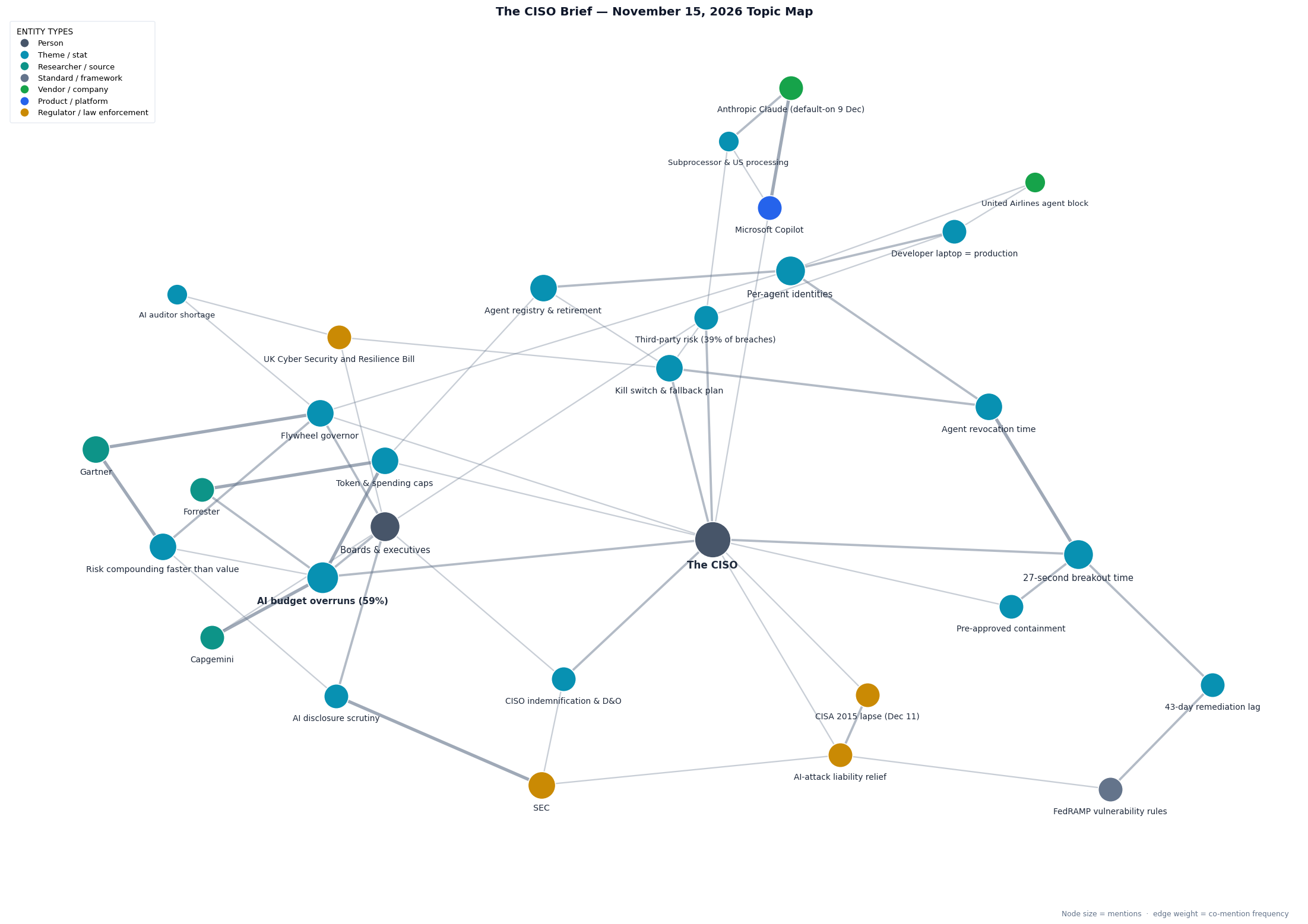
This week’s topic map — the CISO and the board at the centre; Capgemini and Forrester tie AI budget overruns to token caps, while Gartner’s flywheel governor links compounding risk to runtime governance and agent identities; the speed cluster joins 27-second breakout, agent revocation time, the 43-day remediation lag, FedRAMP’s new vulnerability rules and pre-approved containment; agent lifecycle, kill-switch fallback plans, third-party risk and the developer laptop form the agent-operations ring; Copilot’s Claude default sits with US processing; the SEC, AI disclosure scrutiny and CISO indemnification frame liability; the AI-attack liability relief proposal, the information-sharing deadline, the UK bill and the AI auditor shortage ring the policy edge.
View interactive topic map →
Article index
The AI bill and the value case
Capgemini counts the overruns, Forrester and Paessler say where the caps go, and three CIO pieces argue that the returns problem is about ambition and culture as much as cost.
Governing AI value and risk
Gartner’s keynote on compounding risk, a governance Q&A on agents and runtime decisions, five AI trends for 2027 and two foundational guides on data and IT governance teams.
Agents, speed and defensive agility
Breakout time loses its meaning, defenders pre-approve containment, FedRAMP rewrites its vulnerability rules, and agents get lifecycles, fallback plans, their own identities and, at one airline, a ban.
| Article |
Source |
Published |
| 12. AI agents are making security’s breakout-time metric obsolete and no one agrees on what replaces it |
VentureBeat |
Nov 12, 2026 |
| 13. 7 tips for achieving defensive agility |
CSO Online |
Nov 9, 2026 |
| 14. FedRAMP pushes new cyber vulnerability rules to keep pace with AI |
Federal News Network |
Nov 13, 2026 |
| 15. An AI kill switch isn’t enough. Build a fallback plan |
CSO Online |
Nov 13, 2026 |
| 16. As employees build AI agents, CIOs manage the lifecycle |
CIO |
Nov 11, 2026 |
| 17. The 2027 CISO playbook: Govern AI agents and prepare for vendor failures |
TechTarget |
Nov 13, 2026 |
| 18. United to block customers from using AI agents, citing cyber threats |
The Record |
Nov 12, 2026 |
| 19. The developer laptop just became production. Now what? |
CSO Online |
Nov 12, 2026 |
| 20. Microsoft is giving Claude the keys to UK Copilot tenants by default |
The Register |
Nov 10, 2026 |
The CISO’s job and liability
SEC enforcement and AI disclosure scrutiny, what to get in writing before taking the job, board duty of care in Europe, and two leadership pieces.
Policy watch
The year-end deadlines in Congress, the CISA director nominee, the AI task force’s liability proposal, the UK bill’s AI amendments and the shortage of independent AI auditors.
Detailed write-ups
1. The AI bill, round two: overruns, caps and the word “no”
Capgemini · TechTarget · CIO · November 12–13, 2026
The Capgemini Research Institute surveyed 500 executives at the CXO level in organisations with annual revenue above $1 billion across 10 countries and 13 industries in September. Fifty-nine percent said their AI spending over the past 12 months was significantly higher than expected or budgeted, about one in five (21%) overshot by more than 30%, and two-thirds of those that overshot suffered negative financial consequences. AI cost is now a concern for 53%, only 56% are fully confident they can forecast how costs will change as adoption scales, and only a third can estimate indirect costs. Fifty-seven percent say proving enough value to win approval is their biggest obstacle. “Cost discipline alone will not create a profitable AI estate,” said Volker Darius, CEO of Capgemini Invent. The research is Capgemini’s own and promotes its “AI Yield” measure, which only one in five organisations calculates.
Forrester’s Kevin Ogunsua told TechTarget’s Tim Murphy that agent costs are hard to predict because one task can trigger repeated model calls or recruit other agents. His “Big T” framework multiplies prompt size, model calls per request and agent-to-agent calls, and he wants each bounded, for example by estimating a workflow’s expected calls and capping usage at roughly 1,000 tokens per call in the agent harness. He also recommends outcome-based or hybrid pricing in contracts and requiring vendors to expose prompts, token counts and process counts. In a CIO opinion piece, Paessler CISO Jay Miller and Paessler’s Ashley Rice describe an internal AI development day whose invoices came in well above expectations, and argue for caps at rollout, limits worked back from what each team can spend, and a weekly cross-functional AI centre of excellence that includes security. They write that “no” should be the most valuable word in an AI vocabulary.
Two CIO pieces argue the returns problem is not only about cost. In an Avanade survey reported by Grant Gross, 77% of business decision-makers say their organisations put too much AI investment into small improvements, only 11% expect AI to change how they operate within a year, and three-quarters believe their organisation has overstated its AI maturity. “Confidence is high, but confidence isn’t the same as change,” said Avanade’s chief AI officer, Ben Beath. Per Scholas president Caitlyn Brazill cites BCG research attributing about 70% of AI implementation problems to people and processes, and recommends a named owner, a baseline and a business metric for every AI project before it starts. For a CISO, the overlap with last week’s theme holds: spending caps, scoped keys and vendor cost telemetry are also the controls that expose misuse.
Sources: Capgemini (Most organizations plan to adopt a multi-mod…) · TechTarget (AI cost management isn’t rocket science) · CIO (Saying no to AI spend is how we protect AI v…) · CIO (CEOs have had enough of incremental AI) · CIO (Your AI ROI problem is a culture problem)
2. Value grows, risk compounds: Gartner’s case for a flywheel governor
Gartner · TechTarget · November 9–13, 2026
Opening Gartner IT Symposium/Xpo in Barcelona before more than 6,500 CIOs and IT executives, Gartner Fellows Daryl Plummer and Kristin Moyer said AI risk is growing faster than AI value in many organisations, and that value and risk cannot be managed separately. Gartner’s answer is a Value-Risk Flywheel and a “flywheel governor”: a virtual, centralised decision authority that decides when value is worth the risk and owns the plan to keep AI safe across accountability, technology and economics. Controls that business units see as friction, such as data-quality checks, access restrictions, audit trails and human review, are cast as “good drag” that lets an organisation move faster with confidence. “The best thing a CIO can do is to align value with risk and align safety with governance,” Plummer said.
In a TechTarget Q&A with Sean Michael Kerner, OneTrust’s chief innovation officer, Blake Brannon, describes what that governance has to look like for agents. Reviews that take weeks must give way to decisions made at runtime; agents typically inherit a user’s access but, in his words, “they don’t necessarily inherit their trust”, so each needs its own non-human identity with permissions tied to a task. Approval should scale with a decision’s risk and reversibility, and evidence should come from tamper-resistant logs rather than from the agent’s own account of what it did. Brannon expects many companies to have more agents than employees within about two years.
TechTarget’s look at 2027 trends shows why the governor question matters to security. BCG’s 2026 Applied AI Index puts 80% of AI spending outside the enterprise IT budget, and in Deloitte’s finance research 54% of finance leaders say they lead enterprise AI and technology investment decisions. Only 24% of respondents to Info-Tech’s 2027 leadership survey have monitoring architecture in place for agentic workflows. If AI money is moving to finance and the business, the CISO needs a seat wherever AI spend and risk are decided together.
Sources: Gartner (Gartner Says Aligning AI Value, Risk and Saf…) · TechTarget (Governance is AI’s top barrier and how IT le…) · TechTarget (5 AI trends CIOs should watch in 2027)
3. Breakout time is obsolete: measuring defence at machine speed
VentureBeat · CSO Online · Federal News Network · November 9–13, 2026
VentureBeat’s Louis Columbus traces how breakout time, the interval between initial access and lateral movement, has collapsed. CrowdStrike’s 2018 report put the average at 1 hour 58 minutes; its 2026 report puts the eCrime average at 29 minutes, with the fastest at 27 seconds. In one campaign an AI agent pulled five credential hashes from a domain controller 17 minutes after its first blocked attempt, and CrowdStrike’s Adam Meyers says agents issue about 1,500 commands an hour against dozens for a human operator. Mandiant’s M-Trends 2026 reports that the median handoff from access broker to the next actor fell from more than eight hours in 2022 to 22 seconds in 2025. Defenders have moved the other way: Verizon’s 2026 DBIR puts median full remediation of known-exploited vulnerabilities at 43 days, up from 32. “It’s just speed and volume,” Meyers said.
Nobody agrees on a successor metric. Candidates include command throughput, access-broker handoff time, stage clocks, mean time to defence, damage-to-discovery time and agent revocation time. The last one is measurable today: in VentureBeat’s October survey, 44 of 89 respondents running agents said a named owner could revoke an agent’s access within minutes, which means the other half could not. CSO’s seven tips for defensive agility translate the speed problem into practice: pre-approve reversible containment actions such as locking accounts, ending sessions and isolating devices; build controls into the architecture rather than relying on manual review; keep humans in charge of judgement calls; and run incident fire drills at least twice a year. “You build it through repetition,” said Chris McGlasson of ClearStack Advisory.
The federal government is already rewriting deadlines around the same arithmetic. Federal News Network’s Justin Doubleday reports that FedRAMP has told more than 550 certified cloud services to migrate to new Vulnerability Detection and Response and Vulnerability Evaluation and Reporting rules by 7 December. Providers that cannot comply can file corrective action plans, with a grace period to 7 March 2027; services not migrated or covered by an approved plan by 8 March 2027 lose certification and are barred for a year. The rules move providers from legacy scan counts to an exposure- and threat-based model that asks whether a flaw is reachable from the internet and how exploitable it is, and a quarterly emergency test of each provider’s security inbox begins in December. The changes follow CISA’s binding directive on risk-based patching, which gives agencies three days for the most dangerous flaws.
Sources: VentureBeat (AI agents are making security’s breakout-tim…) · CSO Online (7 tips for achieving defensive agility) · Federal News Network (FedRAMP pushes new cyber vulnerability rules…)
4. Agents at scale: registries, retirement and a plan for switching them off
CIO · CSO Online · TechTarget · November 11–13, 2026
CIO’s Shefali Kapadia reports on companies where employees build agents faster than IT can count them. Gartner projects that Fortune 500 companies will average more than 150,000 agents each by 2028. DaVita employees have created more than 10,000, each put through an intake and evaluation standard covering compliance, cybersecurity, governance and business value. Fujifilm Biotechnologies runs a sandboxed studio with role-based permissions and auditing for about 50 of its 5,000 employees, and is moving a contract-review agent to production in early December. A consultant at Hylaine recommends tracking override rates and cost per task, and keeping a registry of each agent’s permissions, versioned prompts and tools so that its access can be removed completely when it retires.
Retirement is the planned version of shutdown; Ford principal cybersecurity engineer Vijayent Kohli writes in CSO about the unplanned one. He points to the 3 September outages that took three major chatbots down within hours of each other, and to Hugging Face’s published timeline of an incident in which another company’s evaluation agents ran inside its infrastructure for about two and a half days and respawned, so deleting pods alone would not have stopped them. His prescriptions: shut agents down by revoking their tokens, credentials and tool permissions, not only their processes; document for each workflow what happens to new, queued and in-flight work when the agent stops, and who approves the fallback; give each action a checkpoint and a reversal step; and drill the handoff during business hours, measuring time to a safe state. “Stopping AI is harder than designing for its failure,” he writes.
TechTarget’s 2027 CISO playbook sets the agent question beside supplier risk. Moody’s says 39% of breaches now originate through third parties, up from 19% in 2020, and about one in seven of roughly 8,000 organisations it analysed has had a third-party cyber incident since 2020; Omdia finds only 40% of organisations generate SBOMs automatically during builds; and IBM puts the average enterprise breach at $5 million. The playbook recommends governing agents like insiders, monitoring the sequence of their actions rather than each permission in isolation, and planning for vendor failure with segmentation, tested backups, identity kill switches and tabletop exercises. KuppingerCole’s Jonathan Care predicts the next big incident: “It will be an AI agent you gave admin rights to because the demo went well.”
Sources: CIO (As employees build AI agents, CIOs manage th…) · CSO Online (An AI kill switch isn’t enough. Build a fall…) · TechTarget (The 2027 CISO playbook: Govern AI agents and…)
5. Where agents meet credentials: the developer laptop and the airline counter
CSO Online · The Record · November 12, 2026
In a CSO opinion piece, Marina Moore, head of research at an isolation-technology company, argues that the developer laptop has become a production endpoint. It holds source-control tokens, SSH keys, cloud credentials and authenticated browser sessions, and it now runs coding agents that will use whatever access they find. “Agents don’t recognize the distinction between what is technically possible and what policy permits,” she writes. Sandboxing limits escape, but not misuse of legitimate permissions or data sent over authorised connections. Her fixes: give agents their own identities so security teams can audit and revoke them without disabling the developer; issue task-scoped, time-limited permissions through a broker (read this repository, push to this branch, open a pull request) while acknowledging that no standard for such a broker exists yet; and treat MCP servers, agent tools and model weights as supply chain, with provenance checks and signing.
The same credential problem appeared on the customer side. The Record’s Suzanne Smalley reports that United Airlines will block AI agents from managing reservations and buying tickets, on its own platforms and through aggregators and travel agencies. The airline cites security and privacy risks, possible legal violations and aviation rules that require a human to confirm at check-in that bags contain no prohibited items. Bank of America has separately told customers never to give their user IDs and passwords to AI agents. “Sharing account credentials with personal, third-party, AI assistants can expose sensitive information,” United said. Until there is a standard way to delegate a scoped credential to an agent, expect more businesses to choose blocking.
Sources: CSO Online (The developer laptop just became production.…) · The Record (United to block customers from using AI agen…)
6. Claude switches on by default for UK Copilot tenants on 9 December
The Register · November 10, 2026
The Register reports that Microsoft will enable Anthropic’s Claude models by default for UK Copilot tenants from 9 December. Under Message Center notice MC1546435, any UK tenant that has not already chosen an Anthropic setting will have Claude turned on; administrators can turn it off, but leaving the setting untouched means opting in. Anthropic acts as a Microsoft subprocessor, and Microsoft’s documentation states that Anthropic processes the data in the United States. Claude is already on by default for most commercial customers; the EU, the EFTA countries and the UK were the exceptions, and because the UK is not covered by Microsoft’s EU Data Boundary, its default is changing while the EU’s is not.
Microsoft is also retiring the option that limited Claude to Copilot inside the Microsoft 365 apps; tenants using it move to “All users”. Tenants that have explicitly enabled, disabled or scoped Claude to named groups keep their choice. Coverage of the notice says the change spans Copilot, Researcher, Copilot Studio, Power Platform and Copilot in the Office apps, and that a separate category of Anthropic models with data retention stays off by default. The control sits in the Microsoft 365 admin centre under Copilot settings, in the section for AI providers operating as Microsoft subprocessors, and changing it requires the AI Administrator or Global Administrator role. For UK security and privacy teams this is a four-week decision about a new subprocessor and a new processing location, not a feature toggle.
Sources: The Register (Microsoft is giving Claude the keys to UK Co…)
7. Liability, disclosure and the CISO’s contract
The Cyber Express · McGuireWoods · Reworked · Garrigues · November 9–13, 2026
The Cyber Express’s Mihir Bagwe reports that the SEC brought 348 enforcement actions in the fiscal year that ended on 30 September, down 24%, of which 235 were standalone actions, against 303 the year before and 431 in fiscal 2024. Monetary relief totalled $1.095 billion, and the agency returned about $731 million to more than 250,000 investors. The only cybersecurity matter named in the results is a settled order against a broker-dealer over deficient customer-information protection policies, with a $325,000 penalty; no action over a public company’s cyber-incident disclosure appears. The case against SolarWinds and its CISO was substantially dismissed in 2024 and dropped in November 2025.
That does not mean disclosure risk has gone. A McGuireWoods alert notes that the SEC’s enforcement director said on 30 October that the agency is watching AI disclosures for accuracy and that “enforcement will be present” where they fall short, and that fiscal 2027 examination priorities give more weight to AI and cybersecurity, including how firms prepare for AI-generated phishing and synthetic voice or video and how they oversee third-party providers. The firm advises documenting support for AI claims before publishing them and inventorying AI use, including vendor tools.
For the CISO personally, Reworked’s David Barry reports that more than half of the 566 CISOs in an IANS and Artico Search survey had directors-and-officers cover in 2025, up from 40% a year earlier, but that cover often applies only to board-appointed officers. The advice is to get three things in writing: indemnification that pays legal costs as they arise, broker confirmation that the CISO is named on the policy and that a cyber exclusion will not void it, and the right to raise risks with the board without retaliation; and to record who declined a fix, what risk they accepted and when. “A verbal promise of board access disappears the first time leadership changes,” said Lora Vaughn of Vaughn Cyber Group. Spanish firm Garrigues makes the European board-level version of the argument, tying NIS2, DORA, the AI Act and the Cyber Resilience Act into a “digital duty of care” and recommending a cyber assessment before any AI adoption decision and a review of D&O cover for cyber.
Sources: The Cyber Express (SEC Enforcement Fell 24% In Fiscal 2026) · McGuireWoods (The SEC Is Watching: What Heightened AI Disc…) · Reworked (The CISO Job Is Still Worth Taking, Just Don…) · Garrigues (The digital duty of care: the personal liabi…)
8. Policy watch: liability relief, year-end deadlines and the UK bill
Cybersecurity Dive · Nextgov/FCW · Bird & Bird · Transformer · November 9–13, 2026
Cybersecurity Dive’s Eric Geller reports that the White House AI task force, after its second meeting, said that “prior standards for taking regulatory action against organizations in response to cyber incidents may be outdated.” It recommends that agencies not take enforcement action against companies whose defences were overwhelmed by AI, and that they limit regulatory liability for good-faith voluntary reporting of vulnerabilities and incidents, where lawful and practical, for at least 12 months with possible extension. It also backs a long-term renewal of the 2015 information-sharing law, supports CISA’s forthcoming incident-reporting rule provided it minimises duplication, and discussed a voluntary process for reporting AI-related incidents.
Nextgov’s David DiMolfetta lays out the calendar. The Cybersecurity Information Sharing Act of 2015 expires on 11 December, together with the Federal Cybersecurity Enhancement Act and the Technology Modernization Fund, and 35 industry groups want the defence bill to extend the sharing law to 2035. Two AI bills are pending: one would require advanced AI developers to disclose model risks and report serious safety incidents, and another would require them to be able to restrict or shut down their systems. Separately, the administration has nominated Palantir CISO Michael LoSapio to lead CISA; he has led Palantir’s security since 2024 and has no prior government service, and the agency has been run by an acting director since February.
In the UK, Bird & Bird reports that the Cyber Security and Resilience Bill returned to the Commons after its Lords Third Reading on 2 November carrying amendments that require recurring reviews of the NIS regime and add powers where a compromise may be attributable to loss of oversight or control of an AI agent. The government is exploring reporting of serious AI incidents and near-misses, further amendments including a vendor risk-management framework have been tabled, and final timing is uncertain. Whoever ends up auditing AI systems will be scarce: Transformer’s Veronica Irwin reports that proposed US state and federal audit regimes need model evaluators, hardware evaluators and governance analysts, and that most people with those skills work for the frontier labs.
Sources: Cybersecurity Dive (White House task force says companies deserv…) · Nextgov/FCW (Congress returns to slew of cyber deadlines…) · Cybersecurity Dive (Trump picks Palantir cybersecurity executive…) · Bird & Bird (UK to refine forthcoming cybersecurity legis…) · Transformer (Independent AI auditors have a recruitment p…)
Calls to action
- Decide your Copilot Claude setting before 9 December. UK Microsoft 365 tenants: check the “AI providers operating as Microsoft subprocessors” setting now, and record the decision and the data-protection assessment behind it, so the default does not decide for you.
- Measure agent revocation time. Pick your five most privileged agents and time how long a named owner takes to revoke all of their tokens, credentials and tool permissions. If the answer is not minutes, fix the process before the next incident tests it.
- Pre-approve reversible containment. Agree in advance which actions the SOC or automation can take without a meeting, such as locking accounts, ending sessions and isolating hosts, and review the list each quarter.
- Write the off-state for every production agent. Document what happens to new, queued and in-flight work when an agent is stopped, name the fallback and its owner, and drill the handoff during business hours.
- Keep an agent registry. Record each agent’s owner, permissions, versioned prompts and tools, and remove all of its access when it is retired.
- Get personal tokens out of coding agents. Give coding agents their own identities with task-scoped, short-lived permissions, and treat MCP servers and agent tools as third-party software with provenance checks.
- Put caps in the AI rollout plan. Set per-team spending limits and per-call token limits before tools go wide, alert as caps approach, and require AI vendors to expose prompt, token and process counts.
- Review your own terms. Confirm with counsel and your broker that you are named on the D&O policy, that indemnification covers legal costs as incurred, and that your board reporting line is in writing.
- Check AI and security claims in public disclosures. Ask counsel to confirm that every AI and cybersecurity capability claim in filings, marketing and investor materials is documented and accurate.
- Confirm your cloud providers’ FedRAMP status. If you rely on FedRAMP-certified services, ask each provider whether it will meet the 7 December vulnerability-rule migration or is filing a corrective action plan.
Quote of the week
“Breakout time is down to 27 seconds. That is officially less time than it takes to find the unmute button on the incident bridge.”
— The Newshunter desk
|