This week at a glance
The week’s first theme is maintainers under the AI bug flood. Linus Torvalds released Linux 7.4-rc2 with “various AI fixes” and passed on a hopeful note from the eBPF lead: on that subsystem, fixes now arrive faster than new reports. Most of the kernel is not there yet. Two days later Arm’s Lorenzo Stoakes said he would stop reviewing outside the memory-management areas he maintains, because AI-generated patch series have gone from weekly to “half of what I see in review”. Microsoft’s AI bug hunter showed where the volume comes from, surfacing a memory-safety flaw in Rust’s standard library that had sat unnoticed for nearly 11 years. FreeBSD’s developer survey shows where policy is heading: 88% want a written AI policy or guidance, and 78% want mandatory human review of AI-assisted code.
The second theme is agent convenience that leaks. GitGuardian found 31,088 distinct secrets in Claude Code’s local settings files across 23,276 public repositories, because “Yes, and don’t ask again” saves the whole command, credentials included, as an allow rule. 5,343 were still valid, and the same files turned up inside public Docker Hub images. Corelight showed that an MCP server “pinned” to one release ran with 15 different dependency sets over five weeks, because its launcher resolved sub-dependencies fresh from PyPI on every rebuild. Microsoft’s .NET 11 answers part of this at the platform level with a NuGet “cooldown” on newly published packages and reproducible container image digests, and it ended support for .NET 8 and 9 on the same day.
The third theme is putting infrastructure around agents. The CNCF accepted Nvidia’s OpenShell and Google’s Agent Substrate at KubeCon North America, two sandbox runtimes that will be integrated so policy and isolation are enforced by the platform rather than the prompt. AWS released an emulator, written and maintained entirely by agents, that lets coding agents test against more than 200 AWS services without holding cloud credentials. On the observability side, an OpenTelemetry team showed agents writing GenAI instrumentation that is checked by Weaver before a human reviews it, and Google open-sourced AQuA to diagnose production agent failures from traces. For leaders, a CIO column argues that coding agents are now suppliers and should be governed like suppliers, banks and Cisco are putting budgets on tokens, and a DLA Piper note spells out what the EU Cyber Resilience Act requires before you integrate a third-party component.
On our watch list
- EN 40000 publication and the delayed CRA standards. On November 10 the Commission extended the deadline for all vertical and some horizontal CRA harmonised standards by three months. The first two horizontal standards, EN 40000-1-1 and -1-2, are due to be published in the second half of November. Watch whether the vulnerability-handling standard EN 40000-1-3 keeps pace, because that is the one most product teams will build their processes around.
- Whether the kernel fix rate overtakes reports beyond eBPF. Torvalds says most subsystems have not reached that point. Watch the remaining 7.4 release candidates for “AI fixes” volume, and whether more maintainers narrow their review scope the way Lorenzo Stoakes did.
- FreeBSD’s AI contribution policy. With 88% of surveyed developers asking for a policy and 79% wanting AI-assisted commits marked in the log, watch whether the core team publishes rules on disclosure, human review and commit tagging. That would follow Debian, which chose to allow AI use with care.
- Claude Code safeguards for allow rules. GitGuardian says Anthropic is exploring built-in secret scanning. Watch whether the “don’t ask again” rule stops saving credentials verbatim, and whether the settings file is ignored by default in new projects.
- Lock-file-respecting MCP launchers. Corelight showed that launch-time resolution bypasses a project’s hash-pinned lock file. Watch whether MCP catalogues change their recommended installs to pin commits and lock transitive dependencies, and whether launchers add a frozen mode.
- Package cooldowns spreading beyond NuGet. .NET 11’s minimum publication age delays newly published package versions. Watch whether other package managers and dependency bots adopt a default cooldown, and how teams handle urgent security releases that fall inside the window.
- OpenShell and Agent Substrate integration. Nvidia and Google say they will combine policy controls with infrastructure provisioning. Watch for the first joint release, and for Swissquote’s on-premises rollout for 1,500 employees as an early production test.
- Agent-maintained infrastructure code. AWS will accept issues but no pull requests on its agent-written emulator, and fixes go into the agents, not the code. Watch how quickly reported behaviour gaps close, and whether other vendors copy the model.
- Token budgets as a governance tool. Cisco is moving managers to token budgets, and JPMorgan capped some engineers’ Claude Code spend at $2,000 a month. Watch whether budgets come with per-tool approval lists that security teams can use to retire unapproved coding agents.
- AI adoption versus actual coverage. Dropzone AI’s survey found UK security teams lead on production AI yet fully investigate only 52% of alerts, and Uplevel found just 4% of engineering leaders have new metrics for AI work. Watch for teams reporting coverage and review-time numbers, not just adoption.
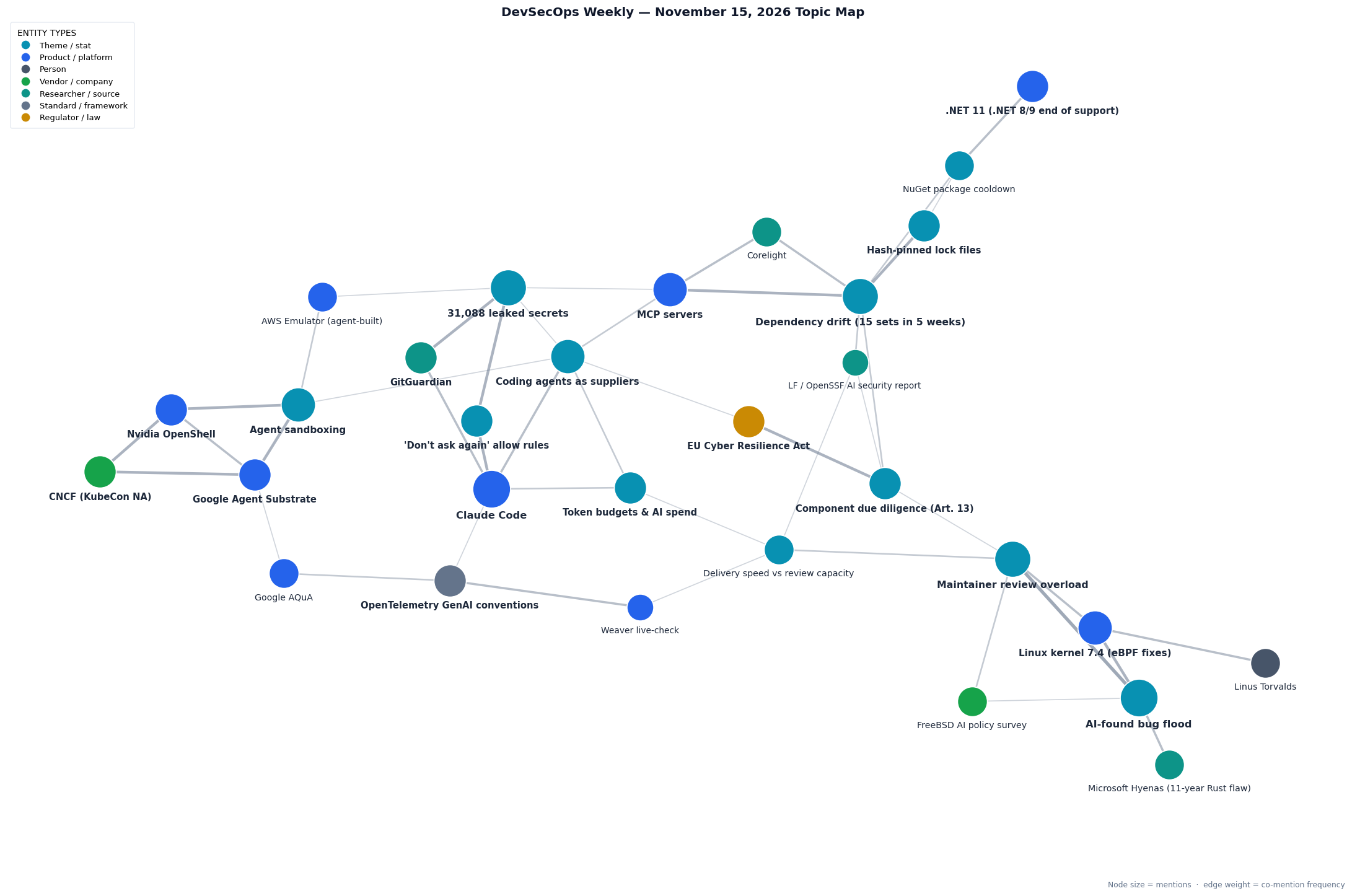
This week’s topic map: the AI-found bug flood links Torvalds, the Linux kernel, Microsoft’s Hyenas and FreeBSD’s policy survey to maintainer overload. Claude Code’s allow rules and GitGuardian’s leaked-secrets count sit beside MCP dependency drift, hash-pinned lock files and .NET 11’s NuGet cooldown. The CNCF, OpenShell, Agent Substrate and the AWS Emulator form the agent-sandboxing cluster. OpenTelemetry, Weaver and AQuA cover LLM-app observability, and coding agents as suppliers connect token budgets to the EU Cyber Resilience Act’s component due diligence.
View interactive topic map →
Article index
Maintainers and the AI bug flood
AI-found bugs keep arriving faster than maintainers can review them. The kernel sees an early sign of relief, a reviewer narrows his scope, and FreeBSD developers ask for a policy.
Secrets in agent settings
One approval click turned into tens of thousands of leaked credentials, and AI-assisted pipelines give secrets new places to hide.
Dependencies, components and the CRA
Pinned servers that are not really pinned, dependency growth from AI coding, a package cooldown in .NET, and what the Cyber Resilience Act expects before you integrate a component.
Agent sandboxes and test environments
Two agent sandboxes join the CNCF, and an agent-written emulator lets coding agents test against AWS without cloud credentials.
Observing LLM applications
Agents that write their own OpenTelemetry instrumentation under a schema check, and a Google agent that diagnoses production agent failures from traces.
Governing coding agents
Coding agents treated as suppliers, budgets and access rules for AI tools, what one engineering team actually spends, and the labs moving into the rest of the workflow.
Measuring delivery and capacity
Speed is the metric everyone uses and few trust. Review is the new friction, alert coverage lags AI adoption, and AI-heavy teams still need senior engineers.
Working with agents
Standing orders instead of prompts, specs and tests as the real artifact, source control built for agents, and testing that does not share the coder’s assumptions.
Detailed write-ups
1. The AI bug flood may be peaking in one corner of the kernel, but not for its reviewers
The Register · November 9, 2026 · The Register · November 13, 2026 · The Register · November 12, 2026 · InfoWorld · November 10, 2026
Linus Torvalds called Linux 7.4-rc2 a big release, partly because of “various AI fixes”. He also passed on a claim from eBPF lead Alexei Starovoitov that, on that subsystem at least, fixes are now arriving faster than new reports. Torvalds was careful: most other areas “haven’t reached that point yet,” and “Don’t hold your breath, but maybe cross your fingers.” The Register puts the surge in context. Microsoft fixed a record 974 flaws in September, after 622 in July, and Oracle fixed 1,449 in a single month.
Review capacity is the constraint. Two days after Torvalds’ post, Arm’s Lorenzo Stoakes, who maintains most of the kernel’s userland memory-management API, said he would stop offering review outside the areas he maintains. AI-generated series, he told The Register, have gone from “once a week” to “daily” to “half of what I see in review.” He keeps his maintainerships: “I just want my inbox to be less horrendous.” Greg Kroah-Hartman put it more bluntly at Open Source Summit: “We need more reviewers.”
The finders keep getting better. Microsoft’s FORGE Lab used Hyenas, the research version of its MDASH agentic discovery system, to find a memory-safety bug in Rust’s standard library process::exit that had gone unnoticed for nearly 11 years, along with panic-safety, UTF-8 and environment-handling issues. Microsoft found no reliable exploitation path for them. Projects are starting to write rules for what arrives. FreeBSD’s developer survey (140 responses) found 88% want a policy or guidance, 78% want mandatory human review and 69% mandatory disclosure, while only 16% would reject AI-assisted code outright. For downstream teams, the practical point is that kernel and runtime update volume will stay high for months. Budget for it in your image rebuild cadence.
Sources: https://www.theregister.com/security/2026/11/09/linus-torvalds-sees-signs-ai-prompted-patch-flood-has-peaked/5308345, https://www.theregister.com/ai-and-ml/2026/11/13/another-linux-kernel-developer-steps-back-from-some-duties-due-to-overload/5309628, https://www.theregister.com/os-platforms/2026/11/12/the-latest-freebsd-report-is-here-and-the-ai-debate-is-ongoing/5309206, https://www.infoworld.com/article/4246801/microsofts-ai-bug-hunter-finds-rust-flaw-that-went-undetected-for-nearly-11-years-2.html
2. A “don’t ask again” click left 31,088 secrets in public repositories
InfoWorld · November 11, 2026 · DevOps.com · November 12, 2026
When a developer answers Claude Code’s permission prompt with “Yes, and don’t ask again,” the tool saves the full command string as an allow rule in .claude/settings.local.json. If the command contained a token or connection string, the credential goes into the file too. GitGuardian scanned public repositories and found 31,088 distinct secrets in these files across 23,276 repositories. 5,343 were still valid when detected. Of the occurrences it could check, 67% worked, and database credentials were the largest valid group (2,280).
The files also travel into containers. Docker’s COPY . . ignores .gitignore, and GitGuardian found 613 secrets (99 valid) in public Docker Hub images. Monthly leaks peaked at 12,535 in April and fell to 959 by October. GitGuardian’s Guillaume Valadon says “we do not yet know what changed.” According to GitGuardian, Claude Code’s lead acknowledged the issue and the team is exploring safeguards, including built-in secret scanning. Anthropic did not immediately respond to the reporter.
A DevOps.com piece on secrets sprawl in AI-assisted pipelines covers the wider pattern: placeholder credentials left in generated code, debug scripts that print tokens into build logs, and generated CI configurations that ask for long-lived credentials. The fixes are familiar: scan locally, at pull request and in CI; block builds on verified secrets; centralise secrets management; and use short-lived credentials. The new point is that an agent’s own configuration file is now part of the attack surface, and it needs the same treatment.
Sources: https://www.infoworld.com/article/4247344/claude-codes-dont-ask-again-button-has-a-secrets-spilling-problem-2.html, https://devops.com/does-ai-coding-make-secrets-sprawl-worse-in-ci-cd-pipelines/
3. A pinned MCP server ran with 15 different dependency sets in five weeks
Help Net Security · November 13, 2026 · OpenSSF · November 9, 2026
Corelight’s James Lagermann watched an MCP server in his lab that was pinned to one release and never reconfigured. Over five weeks it ran with 15 different dependency sets. 23 of its 69 packages changed version, including cryptography, JWT and the MCP SDK itself. The launcher, uvx, resolved one community server’s roughly 60 sub-dependencies fresh from PyPI on every rebuild, skipping the project’s hash-pinned lock file. Pinning the top-level package did not pin anything beneath it. One server started 162 times in a week, and its cache held 19 builds of the same release and commit. These servers made more than 1,600 connections in a week to 11 management systems, including a firewall and a SIEM.
Across 35 MCP servers from two vendor catalogues and the lab, 23 had a recommended install that pulled from a public registry on every launch, install or image build. Freezing worked: five servers pinned to a commit, installed from a hash-pinned lock file and launched directly with update checks off kept identical package lists across 457 starts. Freezing has a cost, though. One frozen server carried 40 packages older than what the launcher would have pulled that day. “I have seen the same pattern in customer environments,” Lagermann says.
The drift lands on teams already stretched by dependency growth. A Linux Foundation report (308 respondents, co-sponsored by the OpenSSF and ActiveState, summarised by ActiveState’s CEO) found 60% say AI coding tools increased their external dependencies, transitive dependencies are reviewed only about half the time, and 58% ship code faster than security review can keep up. Teams with a dedicated AI security role fixed new alerts immediately at nearly twice the rate of those without one (43% vs 23%).
Sources: https://www.helpnetsecurity.com/2026/11/13/corelight-mcp-server-supply-chain/, https://openssf.org/blog/2026/11/09/the-ai-security-gap-hiding-in-routine-maintenance/
4. .NET 11 adds a package cooldown and reproducible image digests
Help Net Security · November 12, 2026
Microsoft shipped .NET 11 on November 10 as a Standard Term Support release with two years of support. .NET 10 remains the long-term support option. The same day, .NET 8 and .NET 9 reached end of support and will get no further fixes. Microsoft advises moving to .NET 11, or to .NET 10 for the longer window.
Two changes target the supply chain. NuGet source configuration gains a minimum package publication age, a cooldown that delays selection of newly published versions. Malicious or hijacked releases are usually caught within days, so a short delay keeps most of them out of builds. Microsoft positions it as a complement to vulnerability checks and dependency review, not a replacement. Container publishing can also produce reproducible image digests using SOURCE_DATE_EPOCH, so teams can verify that an image matches its source.
Smaller hardening changes follow. System.IO.Compression now validates CRC32 when reading ZIP entries. SignalR can refresh authentication without reconnecting, and Blazor Interactive Server components can react when claims change. In-process crash report logging now works on Linux and macOS. The cooldown is the change to copy elsewhere. Set it on internal feeds, and decide in advance how you will let an urgent security release through the window.
Sources: https://www.helpnetsecurity.com/2026/11/12/net-11-security-changes/
5. Two agent sandboxes join the CNCF, and AWS gives agents an emulator instead of credentials
TechTarget · November 11, 2026 · The New Stack · November 11, 2026
The CNCF accepted Nvidia’s OpenShell and Google’s Agent Substrate during the KubeCon North America keynotes in Salt Lake City. OpenShell isolates agents with hardened containers and microVMs, and Nvidia has added Sentry, a hardware policy-enforcement layer on its BlueField-4 DPUs. It has drawn 380 contributing organisations since January. Agent Substrate uses microVM isolation such as gVisor and represents agent sessions as “Actors” that can be snapshotted and resumed, packing more agents onto each node. It has 164 contributing organisations since May. The two companies plan to integrate them, with OpenShell handling policy and API controls and Agent Substrate handling provisioning and orchestration. Swissquote plans to use Agent Substrate for agents serving 1,500 employees on-premises.
Nvidia’s Justin Boitano summed up the approach: “We can’t simply ask agents to follow the rules; the infrastructure must enforce them.” TechTarget notes OpenShell grew partly out of concern about a personal agent escaping containment earlier this year.
AWS took a different route to the same problem. Its new AWS Emulator covers 438 public API models across more than 200 services, runs locally in Rust without a network connection or an AWS account, and was built to let coding agents test code without being handed AWS credentials. Agents wrote it and agents maintain it. AWS takes issues but no pull requests, and when the code is wrong, engineers fix the agent, not the code. “We don’t edit it. We don’t modify it,” the team says. Because AWS was unsure agent output can be copyrighted, the emulator is released under CC0. Operations it doesn’t implement return an error rather than a fake success, which is the right default for anything used in testing.
Sources: https://www.techtarget.com/news/nvidia-google-agent-sandboxes-meet-within-cncf/874392/, https://thenewstack.io/aws-emulator-ai-agents/?taid=6af4ca34c6e52100014d9092
6. Observability for LLM apps: agents write the instrumentation, a schema check keeps them honest
OpenTelemetry Blog · November 12, 2026 · InfoQ · November 13, 2026
Two Alibaba Cloud engineers described on the OpenTelemetry blog a team of agents that adds OpenTelemetry instrumentation to GenAI frameworks. A team-lead agent coordinates research, plan review, coding, code review and testing, deployment and observation. The research agent prefers a framework’s public hooks over wrapping its methods. A plan-review agent writes an execution-plan.md before any code, and that plan is the main point where a human reviews the work. The coding agent maps framework data onto the GenAI semantic conventions using shared utilities.
The check that matters is Weaver live-check. It compares the emitted telemetry against the semantic-convention registry and exits non-zero on a violation. In one case it caught a tool span wrongly marked OK and sent it back to the coding agent. Plugins have shipped for CrewAI, LangChain, LangGraph and AutoGen, each reviewed by a human at the pull request stage. The authors are frank about the limits: “The agents are more reliable at implementing a reviewed plan than choosing the instrumentation strategy alone.” Closed-source components, such as the CLI wrapped by the Claude Agent SDK, can’t be instrumented from outside.
Google’s newly open-sourced AQuA works one step later. It runs outside a deployed agent’s request path, samples up to 1,000 recent sessions from traces and logs, and clusters and verifies failures against criteria a team writes in a goal.md file. It compares failing sessions with a source snapshot captured at deployment and cites file and line ranges. In a controlled replay of a travel app, it found six verified issues, and prompt fixes cut seat-selection bypasses from 15 sessions to two. Google’s principle is a good one for any agent-diagnosis tool: “An insight is its citations, not a self-reported confidence score.”
Sources: https://opentelemetry.io/blog/2026/agent-harness-genai-instrumentation/, https://www.infoq.com/news/2026/11/google-ambient-agent-prod/
7. Coding agents are suppliers now, and companies are starting to ration them
CIO · November 9, 2026 · Business Insider · November 11, 2026 · The Pragmatic Engineer · November 12, 2026
A CIO column by architect Vipin Jain argues that Claude Code, Codex, Cursor and their dependencies “form a supplier ecosystem, not just another developer tool,” and should be governed as one. His example is OpenAI telling Cursor’s new owner it plans to stop supplying models to Cursor, a reminder that a coding tool’s own suppliers can change underneath you. He cites figures linking third parties to 48% of breaches (Verizon DBIR) and unapproved AI tools to 43% of incidents (IBM), and research finding 53% of open-source MCP servers rely on long-lived static keys. His 90-day plan has five moves, each with one accountable owner: inventory, contract terms, secrets controls, MCP server governance and default-deny egress.
Large employers are moving the same way, starting with cost. Business Insider reports that Goldman Sachs won’t give all 45,000 staff frontier models every day. Cisco is giving managers across a 32,000-person organisation token budgets after months of unlimited use, and JPMorgan capped some engineers’ Claude Code spending at $2,000 a month. A KPMG survey cited in the piece found 44% of US workers had used AI at work without authorisation.
The Pragmatic Engineer shows what spend looks like at one engineering team (the author discloses an investment in incident.io). incident.io’s average AI spend fell from about $4,500 to about $1,600 per engineer per month after a model change, and it is on track for about $1.6M this year, roughly 80% on Claude and 20% on Cursor. Infrastructure work cost about five times more per medium-sized pull request than most teams. The security takeaway: once agents have budgets and owners, you have an inventory you can govern. Use it to attach approved MCP servers, secrets scope and egress rules to each tool.
Sources: https://www.cio.com/article/4245820/claude-code-codex-and-cursor-have-become-part-of-your-software-supply-chain-without-approval.html, https://www.businessinsider.com/cisco-goldman-jpmorgan-reconsidering-ai-access-work-2026-11, https://newsletter.pragmaticengineer.com/p/the-pulse-details-of-incidentios
8. What the Cyber Resilience Act expects before you integrate a component
DLA Piper · November 12, 2026
A DLA Piper note sets out the CRA’s rules for third-party and open-source components. Under Article 13(5), manufacturers must exercise risk-based due diligence when integrating components so they don’t weaken the product, and they keep end-to-end responsibility. Supplier assurances alone aren’t enough. Where a component is itself a CRA-regulated product, its conformity assessment can support yours. Recital 34 gives examples: check for CE marking, check whether security updates are provided, search public vulnerability databases, and run extra security testing.
Two obligations reach upstream. Under Article 13(6), a manufacturer that finds a vulnerability in an integrated component, open source included, must report it to the component’s maintainer, and share any fix it has developed. Under Article 14(2), actively exploited vulnerabilities and severe incidents need an early warning within 24 hours, so the note recommends contracts that require suppliers to notify promptly. Legacy components may be integrated without retrofitting. After the transitional period ends on 11 December 2027, due diligence has to use other means where CE marking can’t show conformity. Fines reach €15 million or 2.5% of worldwide turnover. “The CRA places primary responsibility for product cybersecurity on the manufacturer,” the authors write.
The supporting standards are slipping. On November 10 the Commission amended its standardisation request to give three more months for all product-specific standards and some horizontal ones. The first horizontal standards, EN 40000-1-1 (vocabulary) and EN 40000-1-2 (principles for cyber resilience), have been approved and are due for publication this month. Due diligence doesn’t wait for them, so a record of the checks you ran on each component is the evidence to start building now.
Sources: https://www.dlapiper.com/en/insights/publications/2026/11/cyber-resilience-act-due-diligence-obligations-for-third-party-components
Calls to action
- Search for Claude Code settings files in every repository and image. Look for
.claude/settings.local.json in source control and container images, rotate any credentials found in allow rules, and add the file to .gitignore and .dockerignore.
- Scan agent configuration files for secrets before commit and in CI. Block commits and builds that contain verified secrets, and keep credentials out of commands you approve for an agent. Use environment references or a secrets manager instead.
- Freeze the MCP servers you run. Pin each one to a commit, install from a hash-pinned lock file, launch it directly with update checks off, and schedule deliberate updates so frozen dependencies don’t simply age.
- Move .NET 8 and .NET 9 workloads now. Both lost support on November 10. Target .NET 10 for long-term support or .NET 11. Then set a NuGet minimum package publication age and turn on reproducible image digests.
- Stop handing cloud credentials to coding agents for testing. Point agent test runs at a local emulator or sandbox, and run agent-executed code behind a container or microVM isolation boundary that the platform enforces.
- Instrument LLM applications with the OpenTelemetry GenAI conventions. Add Weaver live-check to CI so a semantic-convention violation fails the build rather than reaching dashboards.
- Register every coding agent your engineers use as a supplier. For each one, name an owner, set contract terms, limit the secrets it can reach, approve its MCP servers and apply default-deny egress.
- Write down your CRA component due diligence. For each third-party and open-source component, record the checks you ran (update support, vulnerability databases, testing), add supplier notification terms to contracts, and set up a route for reporting flaws and sharing fixes upstream.
- If you maintain a project, publish an AI contribution policy. Say whether AI-assisted patches must be disclosed and who reviews them, so maintainers can decline drive-by submissions without arguing each case.
|