This week at a glance
France put a name to October’s refrigeration attacks. On November 9 its cyber crisis centre attributed the sabotage of controllers at about 700 French grocery sites, which spoiled food worth tens of millions of euros and started at least 15 fires, to Shahid Kaveh, an IRGC cyber unit better known as CyberAv3ngers. The same operators targeted Schneider Electric equipment at small hydroelectric sites, and French investigators say the unit has been able to control Schneider, Siemens and Rockwell equipment since 2024. The Paris prosecutor has requested arrest warrants. The early-November wave across other European countries is not covered by France’s finding and remains unclaimed. Whoever is behind any of it, the way in was the familiar one: exposed interfaces and weak or default passwords.
Patching got harder. PHP2Shell, two exploited flaws in the PHP runtime, now reaches Siemens Spectrum Power, Energy Engage and building products, some of which have no fix; Phoenix Contact and Hitachi Energy confirmed exposure too, and Siemens flagged Node2Shell in its November advisories. AI arrived on both sides. Forescout’s AI harness found 99 flaws in embedded network stacks in 90 hours for an estimated $1,200 to $2,300 in model costs, Duke Energy and other utilities are testing Anthropic’s Mythos to find vulnerabilities, DOE is building its AI-FORTS program, and Anthropic released a manufacturing plugin that gives Claude access to ERP and production scheduling.
The SANS 2026 survey puts numbers on the strain: 34% of industrial organizations had an OT incident, detection slowed for the first time, and only 15% could run manually for more than two days. Water utilities are asking for help, with state regulators petitioning Congress and the Watershed 250 pilot facing a funding gap when it ends. CISA started notifying owners of exposed OT through equipment makers, allied agencies published post-quantum questions for vendors, and the UK launched an assured red-team scheme. And investigators have so far found no sign of hacking in Friday’s FAA ground stop.
On our watch list
- Attribution for the November wave. France’s report covers only October. Watch whether Belgium, Ireland, Sweden or other affected countries attribute the second wave, and whether it is tied to the same unit.
- EU sanctions and the warrants. France will propose new EU sanctions and the Paris prosecutor wants international arrest warrants. Watch whether EU member states agree and how quickly.
- Schneider Electric guidance. ANSSI says the same operators targeted Schneider gear at small hydro sites. Watch for a Schneider or CERT-FR advisory naming the products and access paths involved.
- PHP2Shell in OT products. Exploitation has so far hit IT gateways, not Siemens OT. Watch for the first confirmed exploitation of an OT product, and for fixes for AMIS TS, blueplanet and Spectrum Power 4.
- More vendors confirming PHP2Shell exposure. Siemens, Phoenix Contact, Hitachi Energy and several VDE CERT members have confirmed products. Watch for other OT vendors whose web interfaces and portals ship PHP.
- Fixes for the AI-found stack flaws. Of 66 new bugs, 29 are still under investigation, including in three closed-source stacks. Watch for vendor advisories and CVE assignments, and for Siemens guidance on APOGEE, Desigo and TALON.
- What utilities find with Mythos. Duke Energy and others have not said what the models turned up. Watch for disclosed vulnerabilities, vendor advisories or utility statements, and for whether cost slows adoption.
- AI agents with write access in plants. Claude for Manufacturing can reorder supplies and reschedule production with approval. Watch for the first plant-floor connectors and how vendors handle permissions and logging.
- Watershed 250 after the pilot. The six-month pilot ends in early 2027. Watch for a funding plan, and for whether Congress acts on the NARUC resolution.
- Installed Base results. Watch which OEMs join CISA’s program and whether exposure counts for named product lines start falling.
- The FAA root cause. Investigators see no sign of an attack. Watch for the official finding on whether an update to the communications network caused the outage.
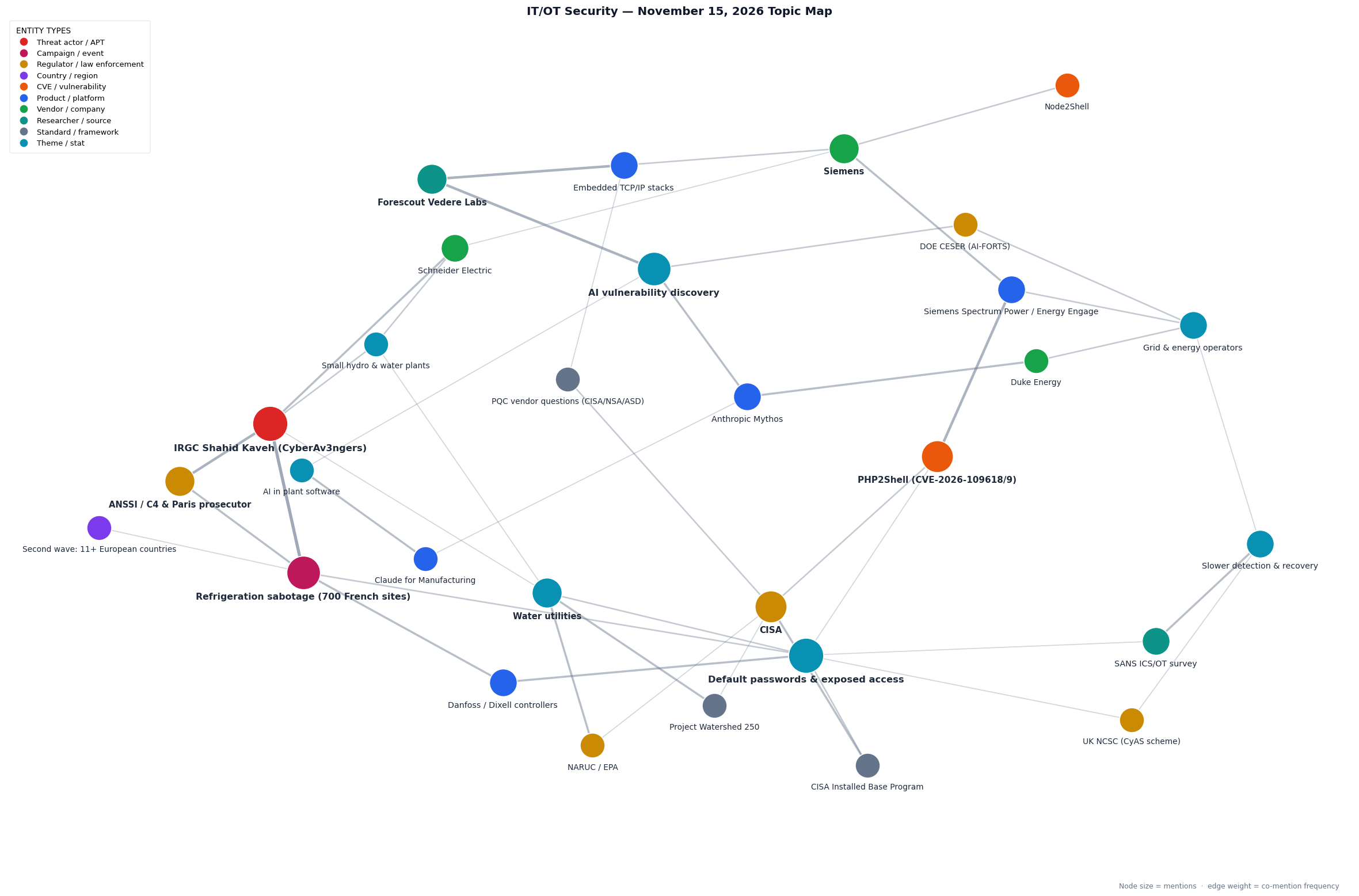
At left, the IRGC’s Shahid Kaveh unit connects to the refrigeration sabotage, ANSSI and the Paris prosecutor, Schneider Electric and small hydro and water plants, with the second European wave beside them. The refrigeration attacks and the Danfoss and Dixell controllers link to default passwords and exposed access at bottom centre, the week’s common thread, which also ties to water utilities, NARUC and Project Watershed 250, CISA’s Installed Base Program, the SANS survey and the UK NCSC. At top, Forescout and AI vulnerability discovery link to embedded TCP/IP stacks and Siemens, and to Anthropic Mythos, Duke Energy, DOE’s AI-FORTS and Claude for Manufacturing. At right, PHP2Shell connects CISA to Siemens Spectrum Power and grid operators, and Node2Shell hangs off Siemens.
View interactive topic map →
Article index
Iran and the refrigeration attacks
France formally attributes October’s supermarket refrigeration sabotage to an IRGC cyber unit and opens a criminal case, with analysis of what it means for cold-chain operators in Australia, Spain and healthcare.
Vulnerabilities and advisories
PHP2Shell and Node2Shell reach Siemens energy and building products, the month’s ICS Patch Tuesday, and default credentials behind two automakers’ connected-car apps.
AI on both sides of OT
An AI harness finds 99 flaws in embedded network stacks, utilities start testing Anthropic’s Mythos, DOE’s AI-FORTS program, and AI agents arriving in plant business software.
Water utilities
State regulators ask Congress for help, the funding cliff facing Project Watershed 250, a legal gap in federal powers, and why open doors keep explaining incidents.
Programs, standards and guidance
CISA works with equipment makers to notify owners of exposed OT, allied agencies publish post-quantum questions for vendors, the UK assures adversary-simulation providers, and a remote-access architecture guide.
Readiness and the industry
The SANS survey on incidents and recovery, a FedRAMP certification for OT monitoring, a device-firmware security raise, and an aviation outage that turned out not to be an attack.
Detailed write-ups
1. France names Iran’s Shahid Kaveh unit for the supermarket refrigeration sabotage
The Record · The Register · Industrial Cyber · Legal 500 · El País · Claroty · November 4-13, 2026
On November 9, France’s Cyber Crisis Coordination Centre, which brings together ANSSI, military cyber command and the DGSE and DGSI intelligence services, published a five-page report attributing the October 11-12 attacks on refrigeration controllers at about 700 French grocery sites to Shahid Kaveh, a cyber unit of Iran’s Islamic Revolutionary Guard Corps that US agencies have previously identified as CyberAv3ngers. The attacks spoiled food worth tens of millions of euros and started at least 15 fires. The Register lists Casino, Leclerc, Coopérative U, Metro, Carrefour and Intermarché among the chains hit; The Record adds butchers, a slaughterhouse and cooperative food-processing plants. The report’s annex names the head of the IRGC’s Electronic and Cyber Center and two Shahid Kaveh commanders, one of whom had not been publicly identified before.
The OT detail matters as much as the name. ANSSI says the same operators targeted Schneider Electric equipment at several small hydroelectric sites, with what it called moderate effects, and the report says the unit has been able to scan, access and control Schneider Electric, Siemens and Rockwell industrial equipment since at least June 2024. France’s case rests on infrastructure that was also used to reconnoitre Schneider equipment at small and medium energy and water production units, techniques the unit has used since at least April 2026, traces of Farsi in the attack infrastructure, and an Iranian outlet linked to the unit that publicised the incidents by October 13. The foreign ministry called it “the first cyber offensive campaign carried out purely for the purpose of sabotage on national territory.” The Paris prosecutor has opened a judicial investigation and requested international arrest warrants, and France will propose EU sanctions. Iran’s foreign ministry rejected the accusation. France’s report does not cover the early-November wave that hit businesses in at least 11 other European countries and three French blood-service sites, and nobody has claimed that wave.
The defensive lesson has not changed since October. Experts quoted by El País say early investigations point to weak or default passwords and outdated equipment. “The attack does not seem very sophisticated, and that should worry us even more,” said Eusebio Nieva of Check Point Software in Spain. Claroty notes that the same controllers run grocery, pharmaceutical and blood cold storage, and that contractors’ direct remote portals often bypass access controls. For Australian operators, lawyers at Corrs Chambers Westgarth point out that commercial refrigeration and building-management controllers fall outside the consumer smart-device standard, and that the enhanced SOCI risk-management rules in force since June already require legacy-technology, MFA and segregation controls.
Sources: The Record, The Register, Industrial Cyber, Legal 500, El País, Claroty
2. PHP2Shell and Node2Shell reach Siemens energy and building products
SecurityWeek · CISA · Nozomi Networks · October 26 – November 12, 2026
November’s ICS Patch Tuesday brought nine new Siemens advisories covering 10 vulnerabilities, two of them on how Node2Shell affects Siemens products. SecurityWeek reports exploitation attempts against Node2Shell but no sign of attacks aimed specifically at Siemens. High-severity flaws were fixed in ROS#, Simcenter Femap, Mendix Studio Pro’s MCP server, Simatic SCADA and PCS 7, Meta-iot2050 and Simatic WinCC Graphics Designer, though several products have no patch yet and some versions will not get one. Phoenix Contact and Hitachi Energy confirmed products affected by PHP2Shell, VDE CERT’s eight advisories include several on third-party PHP, and Schneider Electric and Johnson Controls published their own fixes.
PHP2Shell is the pair CVE-2026-109618 and CVE-2026-109619, flaws in the PHP runtime itself that PHP fixed on October 21 and CISA added to its Known Exploited Vulnerabilities catalog on October 26. Because the bug is in the runtime, it reaches whatever ships PHP. On November 12 CISA republished Siemens’ advisory as ICSA-26-316-01, listing energy and building products including Spectrum Power 3, 4, 7 and TG, Energy Engage, AMIS TS, blueplanet 360, Heliox Rapid and the bt-monitoring-vm local monitoring component, rated CVSS 9.8. The exposure sits in web and monitoring layers such as Nagios or Zabbix add-ons and web portals rather than in control logic. Some products have fixes; AMIS TS, blueplanet and some Spectrum Power 4 configurations have none yet, and Energy Engage V2.0SP9 will not be fixed. Nozomi notes that PHP turns up in device web interfaces, MES portals, historian reporting, building management and remote-maintenance portals, and that PHP 8.1 and earlier no longer get normal security updates. “The flaws sit in the PHP runtime itself rather than in any specific application,” it writes. No exploitation of Siemens OT products has been reported.
Sources: SecurityWeek, CISA ICSA-26-316-01, Nozomi Networks
3. Off-the-shelf AI finds 99 flaws in embedded network stacks in 90 hours
Forescout Vedere Labs · CIO Dive · November 12-13, 2026
Forescout’s Vedere Labs pointed a supervised AI harness, built on Anthropic’s Claude Sonnet and Opus models plus Semgrep, Joern and Ghidra, at ten TCP/IP stacks used in embedded and industrial devices, including Contiki, Ethernut, FNET, PicoTCP, Nucleus NET, lwIP, wolfIP and three closed-source stacks. In about 90 hours it confirmed 99 vulnerabilities: 33 rediscoveries of flaws Forescout had found by hand in earlier research, and 66 new ones. “AI cut the analysis time from 9 months to 90 hours,” the researchers write, and they put total model spend at $1,200 to $2,300. Siemens confirmed that its APOGEE, Desigo and TALON building-automation controllers run Nucleus NET and are affected.
CIO Dive’s Eric Geller reports that about half the bugs were memory corruption, with integer and input-validation problems making up most of the rest; the harness was weak on logic and design flaws, and binaries cost about six times more to analyse than source code. Of the 66 new flaws, 54 were reported, 24 are fixed and 29 are still being investigated; the Ethernut developer did not respond. Seven of the flaws, including hardcoded administrator credentials, are in a stack used in an unsupported wireless access point. “Unsupported legacy products such as this access point abound,” Forescout said. The point for asset owners is cost: if a defender can do this for a couple of thousand dollars, so can an attacker with the same access, and devices that will never be patched need isolating now.
Sources: Forescout, CIO Dive
4. Utilities start testing Anthropic’s Mythos as DOE builds AI-FORTS
Bloomberg Law · Industrial Cyber · November 11-13, 2026
Bloomberg reports that some US power companies, including Duke Energy, are testing Anthropic’s most capable cyber models and building them into their defences to find software vulnerabilities. Duke’s chief security and information security officer, Martin Strasburger, said Anthropic opened access to utilities in late summer, after months of requests to the company and to US officials. According to reports summarising the article, access to the least-restricted versions requires company approval and US government review, Duke also has access to OpenAI’s Daybreak program, and utilities still pay for model use. “The dollars you have to spend to actually use the models is absolutely a big concern,” Strasburger said. Utilities have not said what the models found.
On the government side, the Department of Energy’s Office of Cybersecurity, Energy Security, and Emergency Response is advancing AI-FORTS, a program launched in 2024 with three pillars: defending the grid from AI-enabled attacks, using AI for detection, hunting and OT visibility, and hardening the AI systems utilities deploy. Its projects include Sandia’s C2E2, which DOE says cut energy-system data preparation from about two months to a few hours with 95 percent accuracy in detecting and locating threats, and testbeds at Sandia and Lawrence Livermore that stress-test AI models in emulated grid environments. Taken with the Forescout results, the week shows AI vulnerability discovery reaching energy operators from both directions.
Sources: Bloomberg Law, Industrial Cyber
5. SANS: one in three industrial organizations had an OT incident, and detection got slower
Industrial Cyber · November 13, 2026
The SANS 2026 State of ICS/OT Security survey of 696 practitioners found that 34% had a confirmed incident affecting control systems in the past year, up from 22%, the largest jump in the survey’s nine-year history. Ransomware and compromise of credentials or identities shared between IT and OT each accounted for 31% of incidents, and supply-chain compromise for 21%. The consequences were worse too: 72% of incidents caused facility or system downtime, safety impacts rose from 7% to 13%, and reported theft of intellectual property went from 6% to 31%.
For the first time since SANS began tracking it, detection slowed: 41% of incidents were found within 24 hours, down from more than half in the two previous years. OT-specific monitoring platforms found 38% of incidents, ahead of IT perimeter tools at 31% and trained operators at 20%, but only 13% of respondents report full IT/OT visibility, and budget is the most-cited barrier. Recovery is the weak point. Only 15% could run critical operations manually for more than 48 hours, and 31% of ransomware incidents took eight to 30 days to restore. “Not only did the rate of reported incidents increase by a factor of 1.7 from 2025, but the impacts were more severe,” SANS writes.
Sources: Industrial Cyber
6. Claude for Manufacturing puts AI agents into plant business systems
The Decoder · November 13, 2026
Anthropic released Claude for Manufacturing, a plugin with 17 skills that connects Claude to Autodesk Fusion, Oracle NetSuite, Microsoft 365 and Infor, with other systems reachable through file exports. It drafts quotes from actual inventory, compares suppliers, writes quality reports and design variants, and reads sensor data and manuals during machine downtime. Through the Infor plugin it can order from backup suppliers and reschedule production, actions that require human approval, and its outputs link to source documents for review. The Decoder says the plugin does not control physical machines. Separately, Anthropic is previewing a Model Hardware Standard to connect agents to devices such as robotic arms through standard drivers.
None of this touches PLCs or SCADA today, but it brings an agent with write access to ERP and production scheduling into the business layer that sits next to operations. The SANS survey’s finding that shared IT/OT credentials drove 31% of incidents is the relevant warning: whatever accounts and connectors an agent uses become part of the path into operations, and should be scoped, logged and approved like any other vendor’s access.
Sources: The Decoder
7. Water utilities: regulators ask Congress for help as Watershed 250 nears its funding cliff
VitalLaw · Industrial Cyber · UT Austin · Substack · November 10-14, 2026
The board of the National Association of Regulatory Utility Commissioners adopted a resolution asking Congress to close CISA’s funding shortfall, strengthen WaterISAC, put water utilities’ sharing of attack information on a statutory footing exempt from public-records requests, and authorize EPA to create an independent Water Risk and Resilience Organization to set minimum cybersecurity requirements. The resolution cites attacks on water utilities in at least 12 states in July and August, and says CISA lost roughly a third of its workforce since 2025 and scaled back its free assessments in September.
Industrial Cyber’s look at Project Watershed 250 shows the funding problem in practice. The six-month pilot, launched in San Antonio on August 31, gives participating utilities free red-team assessments, AI tools, threat intelligence, training and remediation help. Vendors must disclose what their services will cost afterwards, but nobody has said who pays. “When the pilot ends, the donated services and tools become paid subscriptions or go away if there is no payment,” said Alycia Farrell of the Roosevelt Group. The pilot followed a July 30 FBI and EPA alert about internet-exposed Rockwell MicroLogix PLCs whose passwords and addresses were changed. A UT Austin blog argues the Safe Drinking Water Act gives EPA no clear power to order the removal of a confirmed intruder. Nathan Hammer’s newsletter makes the practical point: every confirmed US water, pipeline or power incident he reviewed came through an open door such as a default password, shared login or exposed remote access.
Sources: VitalLaw, Industrial Cyber, UT Austin NGS, Nathan Hammer
8. Exposure notifications, post-quantum vendor questions and assured red teams
Industrial Cyber · Forescout · November 9-13, 2026
CISA launched an Installed Base Program that works with equipment makers to find internet-exposed OT and reach its owners. OEMs help with discovery, CISA analyses exposure and ownership, uses administrative subpoenas to internet providers where the owner is unclear, and sends owners a mitigation guide that includes the manufacturer’s advice. Shared data is handled as TLP:AMBER+STRICT, and CISA says the notifications have already taken thousands of assets off the internet. CISA, NSA and Australia’s ACSC also published 31 post-quantum questions for vendors. They single out industrial control systems and IoT as long-lived and hard to update, and ask suppliers for a cryptographic bill of materials, disclosure of hardcoded or hardware-bound cryptography, versioned dates for post-quantum-ready products well before the end of 2030, and post-quantum support in base licensing.
In the UK, the NCSC launched its Cyber Adversary Simulation (CyAS) scheme, which assures providers that run reconnaissance-led, customer-specific attack simulations for critical infrastructure and government, using UK-based teams and registering every engagement with the NCSC in advance. “You cannot improve what you do not know,” said NCSC CTO Ollie Whitehouse. For teams fixing remote access, a Forescout guide pairs CISA’s exposure-reduction guidance with the Secure Connectivity Principles for OT and recommends one brokered, time-limited and monitored path for vendors.
Sources: Industrial Cyber (Installed Base), Industrial Cyber (PQC), Industrial Cyber (CyAS), Forescout
Calls to action
- Close the open doors France described. Find refrigeration, building-management and small-plant controllers reachable from the internet or through contractor portals, take them off, change every default password, and route remote maintenance through one gateway with MFA and named accounts.
- Check Schneider, Siemens and Rockwell gear at small sites. The unit France named has targeted all three. Confirm remote sites such as pumping stations and small generation units have no direct internet exposure and that their logins are not shared or default.
- Inventory PHP in your OT estate. Ask vendors which products embed PHP, apply Siemens’ fixes for Energy Engage V3.1SP1, bt-monitoring-vm and Spectrum Power TG, and isolate AMIS TS, blueplanet, Spectrum Power 4 web components and Energy Engage V2.0SP9 until fixes exist.
- Isolate devices that will never be patched. Forescout found hardcoded credentials in a stack on an unsupported access point. List end-of-life network devices in OT segments and wall them off or replace them.
- Test manual operation. Only 15% of SANS respondents could run manually for more than 48 hours. Run a drill on one critical process without its central control system and write down what breaks.
- Separate IT and OT identities. Shared credentials drove 31% of incidents in the SANS survey. Remove shared accounts between corporate and plant systems, including service accounts used by AI or ERP connectors.
- Add post-quantum questions to OT procurement. Use the CISA/NSA/ACSC list to ask suppliers for a cryptographic bill of materials and whether any cryptography is hardware-bound.
|