This week at a glance
The SIEM market is being repackaged around agents. Microsoft’s Integrated Security Operations Center (ISOC) in Defender, in public preview since September, gives eligible Microsoft 365 E5 and E7 customers SIEM features that used to need a separate Sentinel purchase. From today, November 15, included Defender data retention rises from 30 to 90 days and existing Sentinel customers who qualify can choose to move across. Splunk now bundles agentic SOAR and a base allowance of agent capacity into Enterprise Security Essentials at the same price, with four times that capacity in Premier. Google and SentinelOne will send EDR events straight into Google SecOps without an intermediate storage hop. Startups are following: Daylight raised an $80 million Series B for its managed AI SOC, Embed Security lets analysts teach its agents how they investigate, and Picus launched autonomous penetration testing with hard limits on what the agent may do.
Patch week was heavy. Microsoft fixed more than 1,000 flaws, 63 of them critical, including an exploited Outlook bug that leaks NTLM hashes despite a moderate 6.5 score. Apache fixed CVE-2026-119618, an unauthenticated remote code execution flaw in HTTP/2 handling that Anthropic’s OSS Scanner and Google researchers found independently, and Fortinet shipped 89 advisories covering nearly 100 flaws. By Friday the 2026 CVE count had passed 100,000, more than double last year’s total.
The numbers are now beyond what a ticket queue can absorb. In a ProjectDiscovery survey, 44% of teams close or deprioritise findings without fully verifying them, and 78% receive findings from AI tools. A Symantec analyst told IRISSCON delegates to stop measuring mean time to patch and start measuring mean time to mitigate. Meanwhile SOCs are still working out how far to trust their own agents: nearly half of respondents in an Abnormal AI report say they cannot baseline agent behaviour at all, and Securonix’s survey finds most SOC use cases still have AI recommend and a person approve. Job postings tell the same story from the hiring side, with AI security engineer listings up 268% while analyst listings fell by almost a third.
On our watch list
- Microsoft Ignite, November 17–20. ISOC is still in preview with no general availability date. Watch for a GA date, final pricing for non-Microsoft data beyond the $2.40 per GB preview meter, and how retention and eligibility are set at GA.
- Sentinel customers deciding whether to move. From today, Sentinel customers with eligible licences can move to ISOC. Watch for early migration accounts and for total cost comparisons from organisations with a lot of non-Microsoft telemetry.
- Exploitation of the Apache HTTP/2 flaw. A public proof of concept crashes servers but does not yet show code execution, and no attacks had been reported by November 12. Watch for a working exploit, a KEV listing, and fixed packages from the distributions and for standalone mod_h2.
- More use of the Outlook NTLM zero-day. CVE-2026-124194 is already exploited. Watch for named campaigns and for whether attackers relay captured hashes or crack them offline.
- Fortinet2Shell details. Fortinet held back technical detail to give customers time to upgrade. Watch for the full write-up and any exploitation once it is published, especially where FortiPAM is enabled.
- SentinelOne’s direct ingestion into Google SecOps. Phased delivery is targeted for the end of the year, starting with Mandiant Managed Defense customers. Watch for measured latency and cost figures, which the announcement did not give.
- The year-end CVE total. VulnCheck counted 100,222 CVEs on November 13. Watch the December total, and whether triage capacity, not discovery, becomes the published bottleneck.
- Time to exploit. The Zero Day Clock project puts average time to exploitation at about a day in 2026 and projects about a minute in 2027. Watch the next public exploitation timings for high-profile flaws as a test of that curve.
- The CIRCIA final rule. It went to the White House for review on October 1 and is still pending. Watch for publication and an effective date for the 72-hour incident and 24-hour ransom-payment reporting requirements.
- Splunk’s alpha agents. AI Threat Graph Detection, the Insider Threat agents and the Exposure Analytics agent are in alpha. Watch for beta and GA dates and which ES tier each lands in.
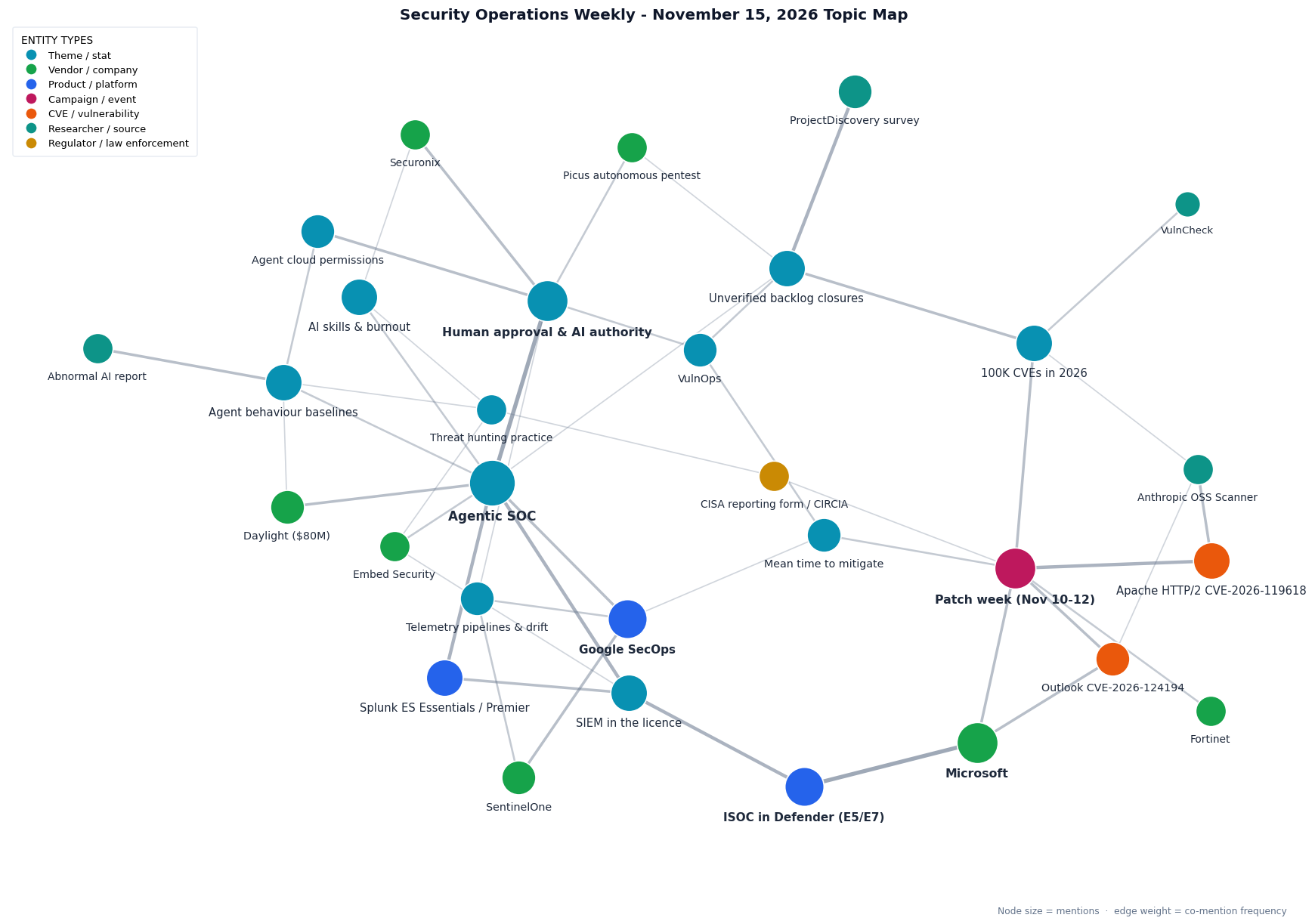
This week’s topic map: the agentic SOC and SIEM moving into the licence (Microsoft ISOC, Splunk ES tiers, Google SecOps and SentinelOne), AI SOC startups (Daylight, Embed, Picus), patch week (the Outlook zero-day, Apache HTTP/2, Fortinet), vulnerability operations (100,000 CVEs, unverified closures, VulnOps, mean time to mitigate), supervising agents, and SOC skills and practice.
View interactive topic map →
Article index
SIEM platforms and the agentic SOC
Microsoft, Splunk and Google all changed how SIEM and SOC agents are packaged this week: SIEM features inside Microsoft 365 licences, agent capacity inside Splunk’s Enterprise Security tiers, and direct SentinelOne ingestion into Google SecOps. All four items are vendor-published.
AI SOC startups and launches
A large funding round for a managed AI SOC, investigation agents that analysts can teach in plain language, and autonomous penetration testing with hard limits. The Embed and Picus items are vendor announcements.
Patch week and exposure
Microsoft’s November release with an exploited Outlook flaw, a critical Apache HTTP/2 bug, nearly 100 Fortinet fixes, the 2026 CVE count passing 100,000, and a case for measuring time to mitigate rather than time to patch.
Vulnerability operations
What teams do with findings they cannot verify, and what a continuous, AI-run vulnerability operation would need. The ProjectDiscovery post presents its own survey.
Supervising AI in the SOC
Baselining what agents normally do, limiting what they can reach in the cloud, and deciding how much authority AI gets. The Securonix and Exaforce pieces are vendor content, the Next Web piece is contributed, and the SecurityWeek piece is an opinion column.
SOC people, practice and reporting
Job postings shifting towards AI skills, why analysts leave, how to run threat hunting as a repeatable practice, and CISA’s new incident reporting form. The Command Zero and Cribl posts are vendor blogs.
Detailed write-ups
1. SIEM moves inside the licence: Microsoft ISOC and Splunk’s agent tiers
Microsoft Partner Network blog · Splunk · November 10–12, 2026
Microsoft’s November partner update returns to the September 23 launch of the Integrated Security Operations Center (ISOC) in Microsoft Defender, which is still in public preview. ISOC combines XDR and SIEM in the Defender portal. Microsoft says it is “not a new standalone product” but a benefit for customers with an active Defender Suite, Microsoft 365 E5 or E7 licence, adding security operations features that previously needed a separate Sentinel purchase: case management, workbooks and playbooks generated from plain-language descriptions. Logs from Microsoft’s own Defender products arrive without separate ingestion. An ISOC workspace, which needs an Azure subscription, unlocks more than 500 connectors, UEBA and threat intelligence, and since October 1 non-Microsoft data has been metered at $2.40 per GB.
Two changes take effect today, November 15. Included Defender data retention rises from 30 to 90 days, and existing Sentinel customers with eligible licences can choose to move to ISOC. Until now the preview has been limited to tenants without an active Sentinel workspace, and Microsoft has given no GA date. The same update says granular delegated admin privileges (GDAP) for Sentinel and Defender XDR are generally available in the Defender portal, so MSSPs can work in customer tenants from their own tenant without guest accounts. It also confirms that Defender for IoT OT security will reach end of support on May 31, 2028, with no first-party replacement.
Splunk took a similar approach at Cisco Live APJC. Enterprise Security Essentials now includes Agentic SOAR, Automated Threat Analysis and a base allowance of agent capacity “at the same price”, with autonomous Tier 1 and Tier 2 triage and investigation and agents that help build detections and connectors. ES Premier adds native UEBA, four times the agent capacity, Autonomous Response, a malware reverse-engineering agent and agentic threat hunting. Cloud Connect lets self-managed ES customers use cloud-delivered AI features without moving their deployment. “Start with what you have. Put agents to work. Expand with confidence,” Splunk writes. For SOC leaders, the price of a SIEM is shifting from gigabytes ingested towards licence tier and agent capacity, and the cost models need redoing.
Sources: Microsoft Partner Network blog (November update: What's new in Security for partners) · Splunk (Democratizing the Trusted Agentic SOC: Breaking Down Barriers to Entry)
2. Google SecOps: SentinelOne streams in directly, and Gemini writes parsers
Google Cloud Blog · Google Cloud Security Community · November 9–13, 2026
Google and SentinelOne are rebuilding the pipeline between them. SentinelOne will stream EDR events straight into Google Security Operations through APIs, removing the intermediate cloud storage step and its fees. A modernised EDR schema shrinks the average event, and SentinelOne Cloud Funnel filters let customers choose which telemetry they send. Parsers, alert models and SOAR playbooks were built with Mandiant’s incident response and Managed Defense teams, so analysts can isolate hosts, run full-disk deep visibility scans, extract malware and enrich artifacts from inside SecOps. Delivery is phased and targeted for the end of the year, with Mandiant Managed Defense and Threat Defense customers first. The post gives no measured latency or cost figures. “Modern defense requires direct action, not delayed transit,” writes Google’s Andre Alfred.
The weekly SecOps changelog puts more Gemini agents into private preview. AI Parsing writes new custom parsers and parser extensions (limited to 10 extension sessions a day and five messages per session). A read-only 3P Context Agent enriches alerts and entities with third-party data for the Triage and Investigation agent, which may use about 5% more AI quota when it calls the agent. Gemini can also generate Python response actions in the SOAR IDE from a plain-language prompt. Analysts can now tag and filter activity on the Case Wall, SIEM and SOAR settings are moving into one menu, and the ListCaseEvents API was deprecated on November 2 in favour of ListCaseEvidenceData. The team also released 23 community detections for PHP2Shell.
Sources: Google Cloud Blog (Autonomous defense at cloud speed with SentinelOne and Google Security Operations) · Google Cloud Security Community (What's New in Google SecOps: 2026-11-09)
3. AI SOC startups: Daylight’s $80 million, teachable agents and bounded pentesting
SecurityWeek · Help Net Security · November 11–12, 2026
Daylight, founded in 2024 and based in New York and Tel Aviv, raised an $80 million Series B led by Goldman Sachs Alternatives’ Growth Equity, with Okta Ventures, Bain Capital, Craft Ventures, Vintage Partners and Maple Capital, bringing its total to $120 million. Its Aura platform detects, analyses and contains threats, and customers choose a fully managed, co-managed or forward-deployed-engineer model. Daylight says Aura also protects AI tools against prompt injection, risky MCP servers and rogue AI activity. The money goes to product, hiring and expansion in the US, EMEA and APAC. “As these agents become more capable, they’ll fundamentally change how threats are detected, investigated, and contained,” said CEO Hagai Shapira.
Embed Security’s update starts from the analyst. Teams describe how they approach a security question in plain language, and Embed turns that into a customer-built investigation agent (an “iStep”) that runs on the same orchestration as its built-in library and fires automatically when an alert matches. NoiseIQ Memories links organisational knowledge, including context that changes over time, to the evidence, and a detection engineering feature reviews investigated alerts and recommends changes to the customer’s own SIEM detections. “Analysts already know how to investigate,” said CEO Seth Summersett. Embed gave no pricing or dates.
Picus Autonomous Penetration Testing lets an AI agent pick the next technique and target, chain findings into attack paths and attempt exploitation. The guardrails are the part SOCs should look at: scope and techniques are approved in advance, hard-deny rules block destructive actions, one control stops all activity, every action is logged, and users choose a Cautious, Standard or Elevated mode or a deterministic technique library. Findings feed a single deduplicated backlog. All three are company announcements, and none has published independent results.
Sources: SecurityWeek (Daylight Lands $80 Million for AI-Powered Security Operations) · Help Net Security (Embed Security lets analysts teach its AI SOC Platform how to investigate) · Help Net Security (Picus puts AI agents on the offensive with autonomous pentesting)
4. Patch week: an exploited Outlook flaw, Apache HTTP/2 and Fortinet
CSO Online · BleepingComputer · SecurityWeek · November 10–12, 2026
CSO counts 1,094 Microsoft fixes in November, 63 of them critical. The one to act on first is CVE-2026-124194, an Outlook flaw that is already exploited. It is rated only 6.5, but opening a malicious Office file can leak the user’s NTLMv2 hash for relaying or cracking. It affects Microsoft 365 Apps for Enterprise and Office LTSC 2021 and 2024, and Microsoft credited an Anthropic researcher using Claude. “Don’t let the low score fool you,” said Nick Carroll of Nightwing. Four Microsoft flaws scored 9.8, including Windows LDAP (CVE-2026-119958) and Exchange Server (CVE-2026-118207) remote code execution bugs that need no credentials or user action. The same day brought a Chrome zero-day (CVE-2026-125350, the eighth of 2026), two CVSS 10 SAP “ICM2Shell” flaws, 110 Adobe CVEs and Firefox 160.
Apache HTTP Server 2.4.71, released November 11, fixes CVE-2026-119618, a race condition in mod_http2 that can corrupt heap memory and lead to unauthenticated remote code execution. It affects versions 2.4.55 to 2.4.70 and standalone mod_h2 2.0.8 to 2.0.42, but only where HTTP/2 is enabled through the h2 or h2c protocols. Servers that serve only HTTP/1.1 are not affected. Anthropic’s OSS Scanner reported it on October 26 and Google Cloud Vulnerability Research found it independently. Red Hat rates it 9.8. No attacks had been reported by November 12. Where you cannot upgrade yet, removing h2 and h2c from the Protocols directive closes the path.
Fortinet published 89 advisories covering nearly 100 flaws, about 17 of them critical. FortiMail has the most critical fixes, followed by FortiAuthenticator, FortiOS, FortiManager and FortiAnalyzer, with more in FortiSASE and FortiClient. The FortiClient bug, nicknamed “Fortinet2Shell” by researcher Kevin Joensen, is a CORS misconfiguration that a malicious website could use to run code, but only when FortiPAM is enabled. Fortinet reports no exploitation, and says releasing fixes from its AI-assisted testing before technical details appear “gives customers time to prioritize upgrades”.
Sources: CSO Online (November 2026 Patch Tuesday: 63 Critical Microsoft fixes, plus an Outlook zero day that allows theft of hashed credentials) · BleepingComputer (Apache HTTP Server patches critical HTTP/2 remote code execution flaw) · SecurityWeek (Fortinet Patches Nearly 100 Vulnerabilities)
5. 100,000 CVEs and the findings nobody verifies
The Register · Help Net Security · ProjectDiscovery · CSO Online · Infosecurity Magazine · November 10–13, 2026
The number of CVEs published in 2026 passed 100,000 on November 13. VulnCheck counted 100,222 that afternoon, more than double 2025’s total, and The Register puts the growth down to AI. “It’s kind of wild,” said VulnCheck’s Josh Bressers. “We don’t have a security problem anymore. We have a data problem now,” ran The Register’s subheading. A ProjectDiscovery survey of 214 practitioners and leaders shows where that data goes. 44% close or deprioritise findings without fully verifying them because they lack time, rising to 54% among security leaders and CISOs. 74% say their backlog grew this year, only 22% reached zero in the past month, and 78% now receive findings from AI tools or agents, more than from their own research. Help Net’s analysis of the same survey finds most large enterprises sitting on more than 1,000 untriaged findings and about a quarter on more than 10,000, and teams pulling from five or more sources are nearly twice as likely to close findings unverified. 72% worry that real vulnerabilities are sitting unnoticed in their backlog.
CSO asks what it would take to make “VulnOps” real. The term, proposed by Heather Adkins, Gadi Evron and Bruce Schneier, means vulnerability research and remediation run as a continuous, automated operation. The Cloud Security Alliance has an operating model and SANS has published guidance. SANS’s Ed Skoudis proposes “governance-in-the-loop”, with low-risk fixes automated and riskier ones reviewed. Evron goes further: “We simply can’t move fast enough for the vast majority of operations to have a human in the loop.” The sceptics point out that many organisations still lack a full asset inventory, and that patches can break legacy systems.
At IRISSCON in Dublin, Symantec’s Dick O’Brien gave the timing argument. The Zero Day Clock project estimates the average time to exploitation fell from about a week in 2025 to about a day in 2026, and projects about a minute in 2027. Exploitation attempts against PHP2Shell appeared 19 minutes after disclosure. In a September attack on the Dutch Institute of Vulnerability Disclosure, detection took 19 minutes but response began 19 hours later. “Stop measuring your mean time to patch and start measuring your mean time to mitigate,” he said, recommending behaviour blocking, default-deny execution, least privilege for agents and tokens, and tying every agent action to a named person.
Sources: The Register (This year's bug count just passed 100K) · ProjectDiscovery (Probably Not Exploitable) · Help Net Security (Nearly half of big firms shelve or close vulnerability findings they haven't confirmed) · CSO Online (What will it take to make VulnOps a reality?) · Infosecurity Magazine (Security Teams Must Shift from Patching to Mitigation in the AI Era)
6. Watching the agents: behaviour baselines and cloud permissions
Help Net Security · Dark Reading · November 10–13, 2026
Abnormal AI’s 2026 State of Behavioral Security Report, covered by Help Net Security, shows where agent monitoring stands. 43% of respondents named AI agents as their top area for behavioural-monitoring investment over the next two years, more than three times the share choosing API integrations. Respondents are split on whether they can baseline agent behaviour: nearly half say they are not effective at all, while about two in five say they are very or extremely effective. About 76% keep baselines for user sign-ins, but coverage for AI agents, API integrations and service accounts is only around half each. Just over half say investigating a behavioural anomaly takes at least four hours, and false positives and defining “normal” are the main obstacles. The report does not give its sample size.
Dark Reading works through a simple failure. An agent asked to restore a failing cloud service widens network access and restarts a workload. The service recovers, but a private database is now exposed, and the agent used valid credentials and permitted actions throughout. The article’s remedy sits in the cloud controls rather than the model. Give each agent its own identity, a named owner and a delegation trail. Make access short-lived and task-scoped (read-only log access for 15 minutes to diagnose a failure, not standing admin rights), “granted only when needed, reassessed as risk changes, and revoked when the task ends.” Enforce boundaries at the tools the agent calls, keep human approval for high-impact actions such as deleting production data or changing security controls, and record the agent identity, initiating user, task and a per-run ID so agent sessions can be matched to cloud audit logs.
Sources: Help Net Security (Security teams want to spot unusual AI agent behavior while they're still defining normal) · Dark Reading (When AI Agents Have Cloud Access, Who Has Control?)
7. How much authority should AI have in the SOC?
Securonix · Help Net Security · The Next Web · SecurityWeek · October 28–November 14, 2026
Securonix’s chief product officer, Simon Hunt, draws on the company’s survey. On average, 48% of SOC use cases have AI recommend an action that a person approves, 13% run with full autonomy, and 32% of respondents expect human involvement always to be needed. His rule for drawing the line: approval should depend on how much an action could disrupt the business and how easily it can be reversed, because blocking an account or isolating a system can stop legitimate work as well as a threat. Only 27% describe their AI governance as optimised. He recommends judging AI on response time, investigative workload and detection quality rather than alert volume. In a sponsored Help Net piece, Exaforce’s Aqsa Taylor describes the usual adoption path: AI investigates and recommends, every step is logged, and autonomy widens only once accuracy is proven. “Every step is recorded, so the reasoning can be audited after the fact.”
Two other pieces question the foundations. In a contributed Next Web article, Fig Security co-founder Gal Shafir argues that the single-SIEM SOC is splitting into pipelines, SIEMs, data lakes and federated detection engines, and that a renamed field upstream can silently break both detections and the agents that rely on them. He wants “SecOps as Code”, with every layer versioned, tested and able to be rolled back: “Putting your rules in GitHub protects the link that rarely breaks on its own. Drift happens upstream.” In a SecurityWeek column, F5 field CISO Joshua Goldfarb warns that leaning on AI for analysis can weaken the critical thinking analysts need when no playbook exists, and urges teams to set firm limits on when they use it.
Sources: Securonix (How Much Authority Should AI Have in the SOC?) · Help Net Security (I underestimated how fast security teams would trust AI to act in the SOC) · The Next Web (Gal Shafir on why the SOC of 2030 will run like a software team) · SecurityWeek (Is AI Making Us Worse at Cybersecurity?)
8. SOC people and practice: AI skills, burnout, hunting and CISA’s new form
IANS · Command Zero · Cribl · Infosecurity Magazine · November 10–12, 2026
IANS, using CyberSN data for January to September, reports that security engineer job postings fell 32.3% and security analyst postings 30.5% compared with 2025, while AI security engineer postings rose 268%, from 60 in September 2025 to 372 in September 2026. Nearly 15% of all cybersecurity postings now mention AI or machine learning. “Specific AI skills have a shelf life measured in months,” said IANS faculty member Lisa Perdelwitz. Command Zero brings together this year’s retention data: 76% of practitioners report burnout (Tines), stress is the top reason people leave (52%, ISACA), and SANS finds meaningful work (26%) and career progression (24%) matter more for retention than pay (14%). Replacing an analyst costs between half and twice their salary.
Cribl’s guide to building a threat hunting practice is a useful counterweight to the automation news. Start each hunt from a testable hypothesis about attacker behaviour, hunt for techniques rather than indicators, fix the scope and expected deliverable in advance, size log retention to how long attackers stay undetected, agree escalation rules with incident response first, and end every hunt with a new detection, a refined baseline or a documented gap. “A threat hunting practice is a loop, not a project.”
CISA launched an enhanced incident reporting form on November 9, with more detailed questions about incident type and observed activity described using MITRE ATT&CK. For now only federal civilian agencies must report, and other organisations may report voluntarily. The CIRCIA final rule, which would require covered critical infrastructure organisations to report incidents within 72 hours and ransom payments within 24, has been under White House review since October 1. “In the team sport of cybersecurity, one organization’s detection is another’s protection,” said CISA’s Chris Butera.
Sources: IANS (AI Skills Take Priority as Cybersecurity Job Postings Decline) · Command Zero (SOC Analyst Burnout: How Alert Fatigue Drives Attrition) · Cribl (Building a cybersecurity threat hunting practice from scratch: best practices and implementation strategies) · Infosecurity Magazine (CISA Expands Incident Reporting Form While CIRCIA Mandate Waits)
Calls to action
- Patch the Outlook zero-day first. Deploy the fix for CVE-2026-124194 across Microsoft 365 Apps and Office LTSC 2021 and 2024 ahead of higher-scored items, and tighten email-gateway filtering of Office attachments until coverage is complete.
- Find every Apache server that speaks HTTP/2. Check the Protocols directive on each virtual host, including containers and appliances that bundle Apache, upgrade to 2.4.71 or a patched distribution build, and remove h2 and h2c where you cannot patch yet.
- Work through the Fortinet criticals. Prioritise FortiMail, FortiAuthenticator, FortiOS, FortiManager and FortiAnalyzer, and check which FortiClient installs have FortiPAM enabled.
- Check your ISOC position today. If you hold Microsoft 365 E5 or E7 without Sentinel, confirm the 90-day retention and decide which non-Microsoft sources are worth $2.40 per GB. If you run Sentinel, do a cost comparison before choosing to move.
- Re-open a sample of unverified closures. Take a sample of findings closed or deprioritised without verification in the past quarter, validate them, and use the miss rate to decide whether that practice can continue.
- Add mean time to mitigate to your metrics. Track the time from disclosure to a compensating control (blocking, isolation, configuration change) alongside time to patch, and set a target for internet-facing systems.
- Write down your AI authority rule. For each SOC automation, record whether AI may act, recommend or only inform, based on business disruption and reversibility, and who owns the decision.
- Give every agent an identity and an owner. Replace shared service accounts used by agents with per-agent identities, task-scoped and time-limited access, and logs that tie each run to the person who started it.
- Migrate off the ListCaseEvents API. Google SecOps users with scripts or integrations on ListCaseEvents should move them to ListCaseEvidenceData now that it is deprecated.
- Turn your next hunt into a detection. Scope one hypothesis-led hunt this month with a defined deliverable, and close it with a new detection, a refined baseline or a recorded visibility gap.
|