This week at a glance
Microsoft Ignite gave operations agents write access. Microsoft’s ARM MCP Server, which until now let agents read across more than 3,500 Azure resource types, now lets them create, change and update resources. Azure Policy checks those requests the same way it checks changes from the portal. The Azure SRE Agent gained customer-managed keys, Entra agent identities and agent-to-agent communication in preview, and Microsoft says it runs more than 11,000 of these agents internally. Elsewhere the week was about putting agents on call. Resolve AI released SRE-1, an open-weights model trained to root-cause production alerts. groundcover added a moderator agent that has to sign off on every conclusion. OpenAI described Performance Factory, a Codex system that ran more than 1,700 investigations into ChatGPT slowdowns in three months, but only about 15 of the fixes it shipped were Codex-authored pull requests. PagerDuty’s playbook and GigaOm’s AIOps Radar say the same thing: agents are good at explaining incidents, and few can yet act on them and confirm recovery.
The guardrails are moving into code. Pulumi previewed agents whose permissions live in code and widen only through a reviewed pull request. An InfoQ architecture for a regulated utility keeps the risk rating of every action outside the model. Google rewrote the SRE book for the first time in ten years, adding chapters on GPU clusters, non-deterministic outputs and AI-assisted triage. On the observability side, Datadog began testing agent versions on live traffic, and OpenSearch’s executive director warned that agent mistakes often come back as successful responses. Inference got cheaper to run: AWS put GPUs behind Lambda and managed NVIDIA Dynamo on SageMaker HyperPod, CoreWeave linked production traffic back to retraining, and Microsoft made Foundry Local generally available on Azure Local. In KubeCon follow-ups, Omdia found only 22% of organizations track inference cost per agent or task.
On our watch list
- Agents with write access on Azure. The ARM MCP Server can now create and update resources under Azure Policy. Watch for the first published cases of policy blocking an agent change, and whether Microsoft adds approval steps beyond policy for production subscriptions.
- Azure SRE Agent leaving preview. Customer-managed keys, Entra Agent ID, Agent 365 integration and cross-agent communication are all in public preview. Watch for general availability dates and for customer figures beyond Microsoft’s own 11,000 internal agents.
- Independent numbers for SRE-1. Resolve AI’s claims (up to 80% of paged alerts handled without escalation, up to 95% root-cause accuracy) are its own. Watch for third-party benchmarks, and whether the model becomes usable outside Resolve’s platform.
- How much agents fix, not just find. OpenAI’s factory found root causes in more than 600 cases, and about 15 Codex-authored pull requests shipped. Watch whether that ratio improves in a follow-up, and whether other operators publish similar funnels.
- AWS re:Invent, November 30 to December 4. groundcover will demo Agent Investigations there. Watch for AWS’s own operations-agent announcements and more GPU options on Lambda.
- Pulumi Agents in real teams. Both Pulumi products are in public preview. Watch for customers that move agents from assisted to supervised mode, and for how often permission-widening pull requests get approved.
- Rollback as a standard feature. GigaOm found that rolling back an action an agent has executed is rare across 31 AIOps products. Watch for vendors that ship tested undo for agent actions, which PagerDuty treats as a precondition for autonomy.
- Windows Server 2028 and local inference. Windows Server 2028 is in public preview, with AMD Instinct MI350P support due in preview in the first half of 2027, and Dell, HPE and Lenovo have validated Foundry Local systems without delivery dates. Watch for shipping dates.
- Per-agent cost tracking. Omdia found only 22% of organizations track inference cost per task or agent. Watch for observability and FinOps tools that make this a default view.
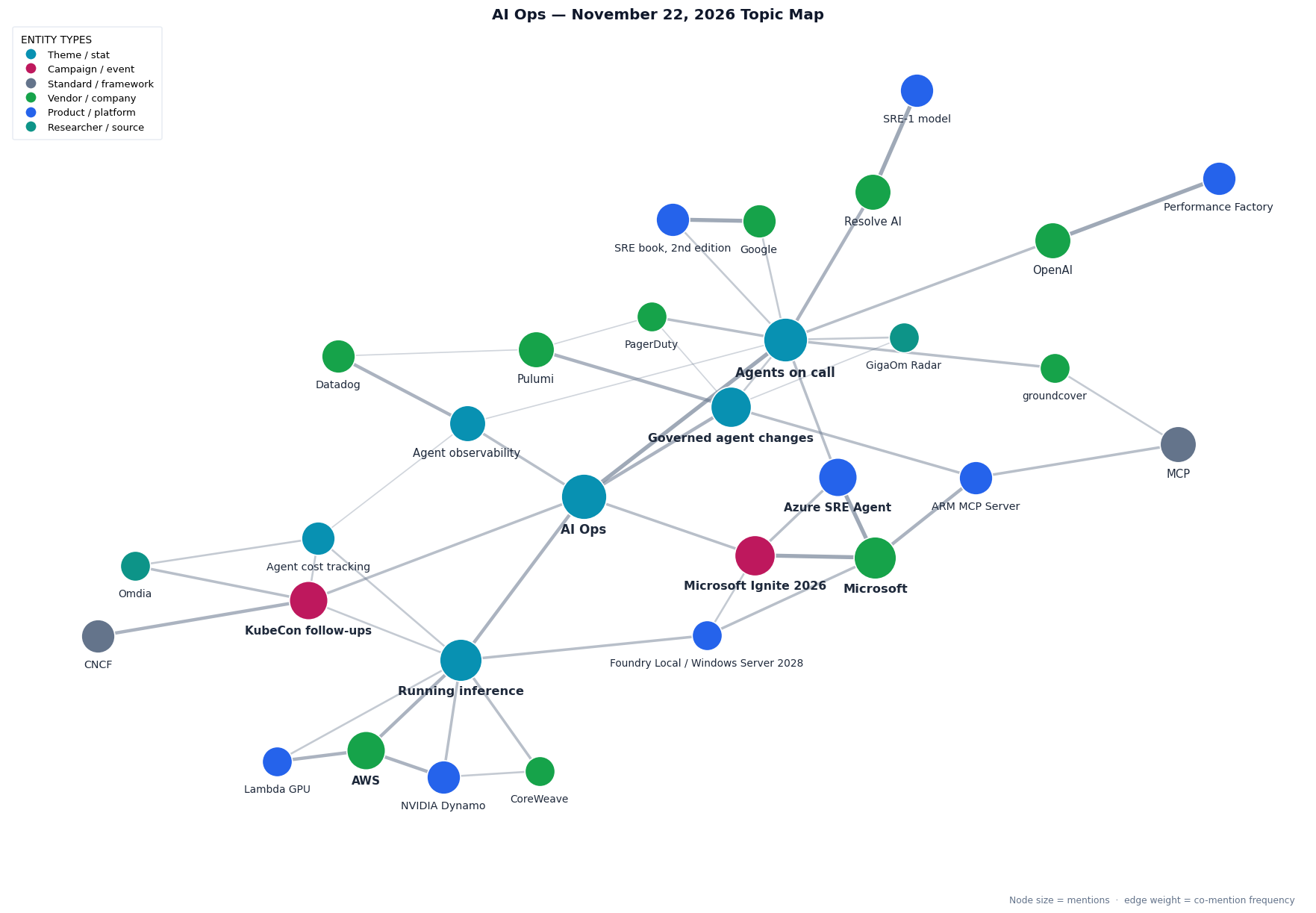
This week’s topic map. Agents on call fill the top with Resolve AI, OpenAI, Google’s SRE book, groundcover, PagerDuty and the GigaOm Radar. Microsoft, Ignite, the Azure SRE Agent and the ARM MCP Server sit at the right. Pulumi and Datadog link governance and agent observability, KubeCon, the CNCF and Omdia sit at the left, and inference with AWS, NVIDIA Dynamo, Lambda GPU and CoreWeave fills the bottom.
View interactive topic map →
Article index
25 articles, grouped by sub-theme. Eighteen are from this week’s coverage window (November 15 to November 22). Seven are longer foundational reads on the beat. Sponsored coverage, vendor blogs and guest posts are labelled within each group.
Ignite: Azure agents get write access
Microsoft gave agents write access to Azure resources under Azure Policy and added identity and encryption controls to the Azure SRE Agent. The Microsoft item is a vendor blog.
Agents on call
Root-cause models, shared investigation workspaces and a performance-regression system at OpenAI, plus two guides on how far to trust incident agents and a new edition of the book that defined SRE. The PagerDuty playbook is a vendor blog.
| Article |
Source |
Published |
| 3. Resolve AI’s SRE-1 model finds root causes of production alerts as AI agents go on call |
SiliconANGLE |
Nov 19, 2026 |
| 4. Groundcover launches Agent Investigations, a shared workspace for AI agents and engineers |
SiliconANGLE |
Nov 19, 2026 |
| 5. Exclusive: OpenAI reveals Performance Factory, a Codex-powered software optimization system that keeps ChatGPT fast |
VentureBeat |
Nov 19, 2026 |
| 6. Ten Years On, Google Updates the SRE Book for the AI Era |
InfoQ |
Nov 17, 2026 |
| 7. AIOps Agents Can Explain Incidents. Can They Act on Them? (foundational, analyst) |
GigaOm |
Nov 17, 2026 |
| 8. The SRE Agent Playbook (foundational, vendor blog) |
PagerDuty |
Nov 20, 2026 |
Governing what agents change, and seeing what they do
Agent permissions written as code, risk classes the model cannot downgrade, and observability for agent mistakes that return as successful responses.
KubeCon follow-ups
Second looks at KubeCon in Salt Lake City: what running agents on Kubernetes actually takes, and how early production adoption still is. The ScaleOps segment is sponsored by ScaleOps; the first SiliconANGLE item is a guest column by an industry analyst, and the Vultr item is theCUBE event coverage.
Running inference
Managed serving on AWS, GPUs behind serverless functions, inference on premises with Microsoft’s stack, and the release engineering that keeps big clusters productive. The New Stack CoreWeave piece is written by CoreWeave, the AWS item is a vendor blog, the VentureBeat item is a guest post, and the Pragmatic Engineer piece is for paid subscribers.
| Article |
Source |
Published |
| 18. Managed NVIDIA Dynamo on Amazon SageMaker HyperPod Inference (vendor blog) |
AWS Machine Learning Blog |
Nov 17, 2026 |
| 19. AWS Lambda Now Runs GPU Inference with 48 Concurrent Invocations Sharing One Model per GPU |
InfoQ |
Nov 22, 2026 |
| 20. CoreWeave connects custom training loops to model serving (CoreWeave-authored) |
The New Stack |
Nov 17, 2026 |
| 21. Dell, Microsoft target enterprise AI inference with Nvidia HGX B300 |
TechTarget |
Nov 20, 2026 |
| 22. Microsoft brings AI inference closer to enterprise data with Windows Server 2028 |
Network World |
Nov 18, 2026 |
| 23. Sovereign AI is about control, not just location (analysis) |
Network World |
Nov 19, 2026 |
| 24. Inference engineering for software engineers (foundational, subscriber-only) |
The Pragmatic Engineer |
Nov 17, 2026 |
| 25. Even the fastest AI clusters can be held back by their release pipelines (foundational, guest post) |
VentureBeat |
Nov 21, 2026 |
Detailed write-ups
1. Microsoft gives Azure’s operations agents write access, under policy
Microsoft Tech Community / Redmond Magazine · November 16–17, 2026
At Ignite, Microsoft extended the ARM MCP Server from reading Azure resources to changing them. Agents that speak the Model Context Protocol could already discover and read more than 3,500 Azure resource types. They can now create, manage and update them, and Azure Policy evaluates each request that comes through the server, so a change from an agent faces the same rules as one from the portal. The Azure Copilot deployment agent, which turns plain-language requirements into infrastructure and deployment code, is generally available. Copilot spaces and custom skills, which keep team context and operating knowledge, are in public preview. Azure Monitor health models, which map telemetry to application health and business impact, are generally available.
The Azure SRE Agent gained customer-managed encryption keys, Entra Agent ID, Agent 365 integration, communication with other agents and Microsoft Teams integration, all in public preview. Microsoft says more than 11,000 agents built on it run inside the company, about seven times the number at its general availability in March, and that 61% of their tasks over the past 90 days were proactive. Redmond Magazine’s round-up adds the identity side: Entra now treats agents as identities of their own, with preview controls for dynamic agent risk assessment and Conditional Access policies that tell a user apart from an agent acting for them. It also covers Azure Catalyst, which uses agents to plan migrations from VMware and Hyper-V. An Ecolab engineering manager described the shift in Microsoft’s post as “transforming operations from reactive troubleshooting to proactive resilience.”
Sources: Microsoft Tech Community (agentic operations on Azure, vendor blog) — https://techcommunity.microsoft.com/blog/azureinfrastructureblog/advancing-agentic-operations-on-azure-at-ignite-2026/4573831 · Redmond Magazine (Azure updates at Ignite) — https://redmondmag.com/articles/2026/11/17/major-azure-updates-for-enterprise-it-land-at-microsoft-ignite.aspx
2. Incident agents go on call, and the playbooks say keep them on a short leash
SiliconANGLE / PagerDuty / GigaOm · November 17–20, 2026
Resolve AI released SRE-1, a 27-billion-parameter open-weights model trained to find the root cause of production alerts, alongside Primary On-call, a generally available service that puts agents on call ahead of human engineers. A team of 16 researchers trained it on up to 512 GPUs through Snowflake’s Cortex Training service, and the company says reinforcement learning alone raised the single-investigation pass rate from 6.9% to 38.8%. Resolve claims its full system solved about twice as many of 178 production investigations as general-purpose coding agents, and that up to 80% of paged alerts are handled without escalation. Salesforce reported the agent closed more than 70% of one team’s paging alerts in early dark-launch tests. SRE-1 is only available inside Resolve’s own platform. “No engineering team can keep up with how fast code and patches land in production,” said chief executive Spiros Xanthos.
groundcover launched Agent Investigations, a shared workspace where its own agents, a team’s coding agents and on-call engineers work the same incident. An Investigator agent builds a graph of hypotheses and tests each against logs, metrics, traces and Kubernetes data, and a Moderator agent is the only one allowed to close a hypothesis, sending back any claim without supporting evidence. Claude Code and Codex can join through groundcover’s MCP server, and progress posts to the original Slack alert thread. PagerDuty’s SRE agent playbook advises starting read-only, letting an action run automatically only after the agent has proposed it correctly many times and a quick undo exists, and recording MTTR and time-to-root-cause baselines first. It notes that in fault-injection tests the strongest agent averaged only about two-thirds root-cause accuracy. GigaOm’s 2026 AIOps Radar of 31 products found only a minority can choose a runbook, run it and confirm recovery from live telemetry, and that rolling back an executed action is rare. “Controls over remediation are maturing faster than controls over models,” it concludes.
Sources: SiliconANGLE (Resolve AI SRE-1) — https://siliconangle.com/2026/11/19/resolve-ais-sre-1-model-finds-root-causes-of-production-alerts-as-ai-agents-go-on-call/ · SiliconANGLE (groundcover Agent Investigations) — https://siliconangle.com/2026/11/19/groundcover-launches-agent-investigations-a-shared-workspace-for-ai-agents-and-engineers/ · PagerDuty (SRE agent playbook, vendor blog) — https://www.pagerduty.com/eng/the-sre-agent-playbook/ · GigaOm (AIOps agents) — https://gigaom.com/blog/aiops-agents-can-explain-incidents-can-they-act-on-them/
3. OpenAI’s Performance Factory: 1,700 investigations, 15 agent-written fixes
VentureBeat · November 19, 2026
OpenAI built Performance Factory on Codex to investigate and help fix performance regressions in ChatGPT, and runs it in production. In just over three months it tracked more than 1,700 investigations, about 17 a day, and identified root causes in more than 600. Work moves through fixed stages from alert to investigation, root cause, code change, review and verification, and agents hand each other findings and reproducible queries rather than raw telemetry. The system has four parts: a task service, a dispatch loop that starts Codex sessions, an internal API for running Codex in the cloud, and subscriptions that pause a task until something outside happens, such as an engineer commenting on GitHub.
The useful detail is the funnel. Of the 600-plus root causes, about 400 led to a proposed fix. Roughly 50 shipped fixes matched or were shaped by agent suggestions, and about 15 were pull requests Codex wrote itself. An “adversarial review” step has a separate Codex session with fresh context challenge each diagnosis, and it now sends back about 25%. Engineers review every pull request and decide whether to merge. Codex does best on clear causes with contained fixes and struggles with architectural changes, and VentureBeat reports the team accepts that the results fall short of its ambitions for automated remediation.
Sources: VentureBeat (OpenAI Performance Factory) — https://venturebeat.com/orchestration/exclusive-openai-reveals-performance-factory-a-codex-powered-software-optimization-system-that-keeps-chatgpt-fast
4. Google rewrites the SRE book for AI workloads
InfoQ · November 17, 2026
Ten years after the first edition, Google’s Betsy Beyer and David Huska announced a fully rewritten second edition of Site Reliability Engineering. It recasts the discipline around cloud architectures, platform engineering and AI workloads. SLO guidance moves from basic availability targets and manually enforced error budgets to user-centred, multi-tier SLOs with dynamic burn-rate alerting and automatic policy enforcement. Observability now centres on OpenTelemetry, distributed tracing and automated anomaly correlation instead of static dashboards and manual alert triage.
New material covers the reliability of large GPU and TPU clusters, models whose outputs are not deterministic, and training and fine-tuning pipelines, as well as AI tools that help with incident triage and postmortem writing. Reliability testing shifts from scheduled game days and synthetic load tests to continuous resilience checks and canary verification in production. “Modern production environments operate under constant change,” the authors wrote. The print edition is sold through Google Books and the digital edition through O’Reilly.
Sources: InfoQ (SRE book second edition) — https://www.infoq.com/news/2026/11/google-sre-book-ai-era/
5. Pulumi and a utility put the guardrails outside the model
DevOps.com / InfoQ · November 16–18, 2026
Pulumi released two products in public preview. Pulumi Delivery lets teams write release pipelines, including canary and blue-green rollouts, as code in TypeScript, Python, Go and other languages. Pulumi Agents are narrowly scoped agents for incident investigation, deployment troubleshooting, cost investigation, drift, maintenance, security remediation and infrastructure migration. Each agent has its own identity that limits which stacks and environments it can reach. Its permissions are written in code, and widening them requires a reviewed pull request. Every action an agent takes becomes code that produces a deterministic, reviewable plan, where agents that call cloud APIs directly leave little record of what changed or why. “There is no single DevOps platform that provides that capability,” said chief executive Joe Duffy.
An InfoQ architecture for a regulated utility follows the same principle. Agents may analyse signals and propose actions, but a control plane stops them from touching production directly. A versioned action catalog gives every action a risk class and approval requirement that the model cannot downgrade. All actions go through one tool gateway that checks authorization and argument schemas, uses scoped credentials and records evidence, and only a single remediation agent may propose production changes. Autonomy starts read-only and widens one action class at a time, based on accepted proposals, validated outcomes and rollback tests, and it can be withdrawn. “Authority never lives inside the model,” the author writes.
Sources: DevOps.com (Pulumi Delivery and Agents) — https://devops.com/pulumi-previews-devops-platform-extensions-for-the-agentic-ai-era · InfoQ (governed autonomy for a utility) — https://www.infoq.com/articles/utility-governed-autonomous-intelligence-ai/
6. Testing agents on live traffic, because their failures look like successes
InfoQ / The New Stack · November 17–20, 2026
Datadog added online experiments to its Agent Observability platform, so teams can compare agent versions on live production traffic rather than only on fixed evaluation sets. Experiments pair evaluator scores with latency, token use, estimated cost and workflow errors, and feature flags control how much traffic each version gets. In InfoQ’s worked example, two model versions split traffic evenly and scored almost the same on investigation quality, 3.84 against 3.86 out of 5, while the newer one cost an estimated 44.3% less. Trace inspection showed the newer model passed invalid tool parameters more often and recovered through retries, a problem the quality score did not reveal.
That gap is the point Bianca Lewis, executive director of the OpenSearch Software Foundation, made to The New Stack. An agent can call the wrong API and still get a valid response, so its mistakes never show up as errors. She argues for pairing OpenSearch with OpenTelemetry to trace which services an agent called, and using cost data to see where a run went off course. “In the agentic AI era, we are not querying like humans anymore,” she said.
Sources: InfoQ (Datadog online experiments) — https://www.infoq.com/news/2026/11/datadog-ai-agent-observability/ · The New Stack (OpenSearch on agent observability) — https://thenewstack.io/opensearch-ai-agent-observability/
7. After KubeCon: agents need isolation, cost tracking and patience
SiliconANGLE / TechTarget / The New Stack · November 16–19, 2026
Omdia’s Torsten Volk set out three requirements for running agents in the enterprise: move them off employee laptops, isolate them more strongly than a standard container because they run generated code with little review, and track cost per agent or task because idle agents still hold CPU and memory. Omdia found 44% of organizations have staff running open-source agent frameworks on laptops outside IT’s control, and only 22% track inference cost per task or agent, against 36% who track GPU utilization. “Everybody’s moved from simple prompt engineering to building harnesses to now we want continuous agents running 24/7,” said Nirmata chief executive Jim Bugwadia. In a segment sponsored by ScaleOps, its chief executive said agents crash for lack of resources 80% more often than ordinary microservices.
In a guest column, Intellyx analyst Jason English reported the CNCF’s figure that inference traffic has risen fourfold in eight months, and noted that Splunk’s Eval-G1 model scores prompts and responses in under a second for less than a cent. CNCF executive director Jonathan Bryce told The New Stack that systems built for human speed are not ready for agent traffic, and that outside software development, adoption is still low. “We’re very, very, very early in the path to billions of agents that are taking action on our behalf on a constant basis,” he said. Vultr’s chief marketing officer told theCUBE that GPU-only neoclouds will face pressure to become full cloud platforms.
Sources: TechTarget (3 requirements for agents) — https://www.techtarget.com/news/kubecon-2026-3-requirements-for-running-ai-agents-in-the-enterprise/874995/ · SiliconANGLE (KubeCon AI control, guest column) — https://siliconangle.com/2026/11/16/at-kubecon-2026-the-illusion-of-ai-control-meets-the-reality-of-implementation/ · SiliconANGLE (ScaleOps, sponsored) — https://siliconangle.com/2026/11/17/autonomous-orchestration-helps-kubernetes-keep-up-ai-agents-kubeconna/ · The New Stack (Bryce interview) — https://thenewstack.io/cncf-bryce-ai-agents/?link_source=ta_bluesky_link&taid=6afc5e017730250001980839 · SiliconANGLE (Vultr, theCUBE) — https://siliconangle.com/2026/11/19/enterprise-ai-pushing-cloud-infrastructure-beyond-gpu-kubeconna/
8. Inference gets managed, serverless and local
AWS / InfoQ / The New Stack / TechTarget / Network World · November 17–22, 2026
AWS made NVIDIA Dynamo a managed option on SageMaker HyperPod. The add-on installs Dynamo, its operators and the KAI Scheduler, and splits serving into separate prefill and decode pools that scale independently, moving the KV cache between them over AWS’s EFA networking. In AWS’s benchmark of a Qwen3 235B model on 16 H200 GPUs, disaggregated serving produced 207 output tokens per second per GPU, against 101 without it. Separately, AWS Lambda now runs GPU inference on G-series instances through Lambda Managed Instances. One copy of a model in GPU memory serves up to 48 concurrent invocations, and pricing is the EC2 on-demand rate plus a 9.75% management fee and the usual request charge. “You build an OCI image, point the function at it, and let Lambda handle provisioning, scaling, and event integration,” said AWS solutions architect Daniel Abib.
CoreWeave described Forge, which captures production inference traffic, turns it into training data for distillation, and hot-loads new checkpoints into live endpoints during reinforcement learning runs without dropping requests; its programmable training API is in limited preview. On premises, Microsoft made Foundry Local generally available on Azure Local, and Dell is pairing it with Nvidia HGX B300 systems. HPE and Lenovo also have validated systems, though no delivery dates have been given. IDC found 85% of enterprises say their AI workloads need both on-premises and public cloud infrastructure. Windows Server 2028, in public preview, adds tools to manage AI hardware and route model requests, with AMD Instinct MI350P support due in preview in the first half of 2027.
Sources: AWS Machine Learning Blog (managed Dynamo, vendor blog) — https://aws.amazon.com/blogs/machine-learning/managed-nvidia-dynamo-on-amazon-sagemaker-hyperpod-inference/ · InfoQ (Lambda GPU inference) — https://www.infoq.com/news/2026/11/aws-lambda-gpu-managed-instances/ · The New Stack (CoreWeave Forge, CoreWeave-authored) — https://thenewstack.io/coreweave-forge-training-loops/ · TechTarget (Dell and Microsoft inference) — https://www.techtarget.com/news/dell-microsoft-target-enterprise-ai-inference-with-nvidia-hgx-b300/875421/ · Network World (Windows Server 2028) — https://www.networkworld.com/article/4250500/microsoft-brings-ai-inference-closer-to-enterprise-data-with-windows-server-2028.html
Calls to action
- Check what your agents can now write. If you run MCP-connected agents against Azure, review which identities can reach the ARM MCP Server and confirm your Azure Policy assignments cover the changes those agents can now make.
- Give every agent its own identity. Register operations agents as distinct identities rather than letting them borrow an engineer’s credentials, and scope each to the environments it needs.
- Record baselines before you pilot an incident agent. Capture MTTR, time to acknowledge and time to root cause now, so any agent’s effect can be measured instead of asserted.
- Treat agent conclusions as hypotheses. Require evidence for every root cause an agent proposes, and add a second check, by a person or a separate reviewing agent, before a fix ships.
- Test undo before you grant autonomy. For every action class an agent may run unattended, confirm a tested rollback exists first.
- Trace tool calls, not just errors. Turn on tracing of agent tool calls and parameters, since many agent failures return successful responses.
- Track inference cost per agent. Tag inference spend by agent or task so idle and runaway agents show up in your cost reports.
|