This week at a glance
The week opened with the US still counting the cost of a run of outages: an FAA ground stop that halted thousands of flights, a global Microsoft Outlook outage and slowdowns at banks. No one has identified a cyberattack behind them. CISA’s acting director said nothing the agency found points to malicious activity in the FAA stop, and argued that the online debate about an AI “vulnpocalypse” risks crowding out the less glamorous work of building and testing resilience. Washington’s response came fast anyway. A bipartisan House bill would create a standing National Cyber and AI Investigations Board inside CISA that could investigate serious disruptions caused by faulty updates, configuration errors or AI failures even when there is no attack, and two senators asked the White House AI task force for a national effort on AI-powered defence after the Director of National Intelligence linked the outages to the rush to patch vulnerabilities that defenders are now finding with AI.
That rush is the second theme. Google Project Zero is shortening its disclosure deadline from 90 days to 60 in February 2027 and to 30 in January 2028, citing AI-accelerated discovery and exploitation. Forescout says AI assistance cut its analysis of ten TCP/IP stacks from roughly nine months to 90 hours and turned up 99 vulnerabilities, 66 of them zero-days. The week’s test case was Java4Shell (CVE-2026-114938), a Base64 decoder flaw in OpenJDK 17 and later that its finder showed could give pre-authentication code execution in several widely deployed Java applications in default configurations, including self-managed JFrog Artifactory. Dark Reading’s reporters asked the question every CISO is now fielding: when every week brings a 9.2, how do you avoid the costly preemptive shutdowns and warning fatigue that followed October’s PHP2Shell?
The rest of the issue is about who pays and who decides. Gartner expects spending on AI platforms and models to rise 54% in 2027 even as token prices halve; a new Linux Foundation project wants common definitions for what a token costs. Several large US banks now tell customers that if they hand their credentials to a third-party AI agent, they own what that agent does, including if it is hacked. Forrester argues security should become a “trust and assurance” organisation that produces evidence that AI systems stay inside their boundaries, and a CIO contributor separates an agent’s permission from its authority. On the policy edge: UK MPs want a regulator that can halt dangerous AI models, the FCC is publishing rules for its Cyber Trust Mark, and cryptographers are debating whether AI-assisted mathematics is starting to chip at public-key cryptography.
On our watch list
- What the outage investigations actually find. The FAA says legacy equipment became unstable under a flood of connection attempts, with early findings pointing to two sites, one where a new router was being installed; the cause is still under investigation and no cyberattack has been identified. Whether the final findings tie the outages to rushed patching, to change management or to neither will shape how hard boards push on patch speed versus change control.
- Whether the ROOT CAUSE Act moves. The bill would put a permanent investigations board inside CISA with authority to examine non-malicious failures, including AI systems acting beyond their authorisation, and would bar the executive branch from disbanding it. Watch for committee action and whether private-sector incident reviews fall within its scope as drafted.
- Self-managed JFrog Artifactory patch releases for Java4Shell. JFrog says its SaaS platform is already mitigated and that self-managed customers should apply the -XX:UseAVX=2 JVM flag until patched releases ship; version numbers will be added to its advisory. Watch for those releases and the equivalent fixed builds from other vendors that bundle their own Java runtime.
- First confirmed in-the-wild Java4Shell exploitation. The researcher demonstrated pre-authentication code execution in several applications, but there is no universal payload and exploitation depends on the processor, the Java version and how each application uses Base64. A public exploit for a specific product would change the priority overnight.
- Project Zero’s 60-day deadline on 2 February 2027. The 30-day grace period has already gone. Watch which vendors shorten their own patch cycles in response and whether other research teams follow Google to shorter fixed deadlines.
- AI-found vulnerability volume in vendor patch cycles. JFrog counted 36,952 CVEs published in the third quarter of 2026, more than triple a year earlier, and Forescout found 66 zero-days in ten network stacks in 90 hours. Watch December patch releases for the share of fixes credited to AI-assisted research.
- More banks changing their terms for AI agents. Citi, Citizens and PNC updated terms or warned customers this week, following JPMorgan and Bank of America last month. Watch whether insurers, brokerages and card issuers follow, and whether any bank offers a scoped, delegated credential for agents instead of shifting the risk to customers.
- The FCC Cyber Trust Mark comment period. The proposal appears in the Federal Register on 23 November with comments due 23 December, covering label rules, post-market surveillance and testing of devices after a major attack. Connected-product makers should watch the final testing and renewal obligations.
- The UK government’s response to the AI safety report. A Commons committee wants an AI Safety and Security Bill with a regulator able to pause training, block deployment and suspend services, plus mandatory incident and near-miss reporting. The government has until 18 January 2027 to respond and has not committed to legislate.
- Tokenomics Foundation definitions. The Linux Foundation project plans vendor-neutral definitions for input, output, reasoning and cached tokens and an extension of the FOCUS billing format. If providers adopt them, AI cost reporting becomes comparable across vendors for the first time.
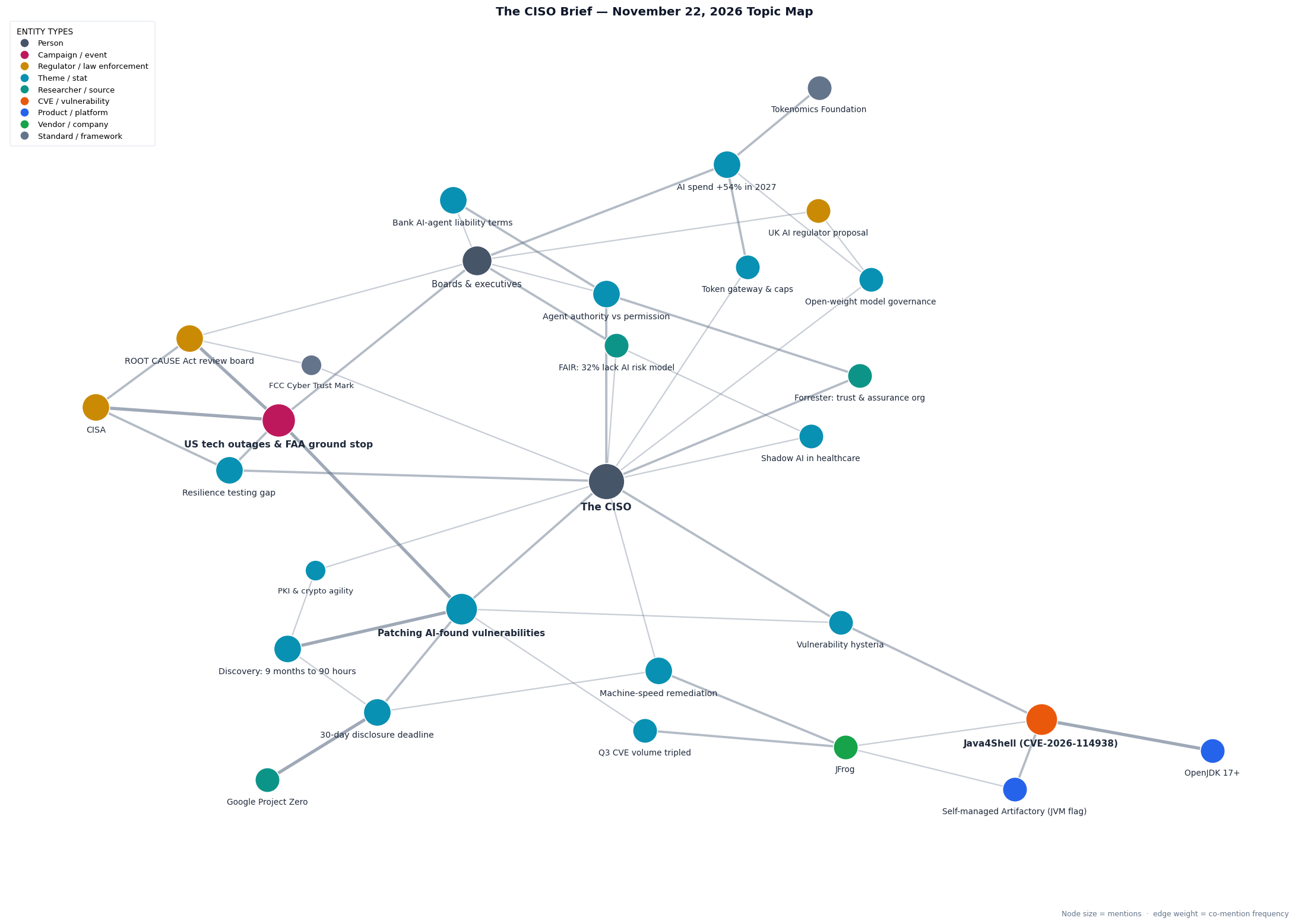
This week’s topic map — the CISO and the board at the centre; the US outages and FAA ground stop tie CISA, the ROOT CAUSE Act review board and the resilience testing gap to the patching of AI-found vulnerabilities; Project Zero’s 30-day deadline and the nine-months-to-90-hours research feed the same pressure; Java4Shell links OpenJDK, self-managed Artifactory and the vulnerability-hysteria debate to machine-speed remediation; the AI bill, token gateways, the Tokenomics Foundation and open-weight governance form the cost ring; bank liability terms, agent authority, Forrester’s trust and assurance organisation and the AI risk-model gap sit with the board; the UK regulator proposal, the Cyber Trust Mark and PKI ring the policy edge.
View interactive topic map →
Article index
Outages, resilience and the review-board push
A week of non-malicious outages, CISA’s case for resilience over panic, a bill for a standing investigations board, a call for defensive AI, and two views on why spending does not buy recovery.
Vulnerability velocity
Shorter disclosure deadlines, AI-compressed research, Java4Shell, the argument against vulnerability hysteria, and JFrog’s case for machine-speed remediation.
The AI bill and AI governance
Cheaper tokens and bigger bills, a standards body for AI costs, one bank’s control plane, open-weight model governance and shadow AI in healthcare.
Agents, liability and the security org
Banks shift agent risk to customers, Forrester redraws the security org, the CIO/CISO/CRO lines blur, and risk quantification still struggles to reach the business.
Policy and standards watch
A UK watchdog with an off switch, Cyber Trust Mark rules, state and EU AI rules that outlast federal deregulation, and AI-assisted mathematics versus PKI.
Detailed write-ups
1. Outages without an attacker: the resilience agenda arrives
CyberScoop · Nextgov/FCW · The Record · CSO Online · November 16–18, 2026
Speaking at FedTalks on 17 November, acting CISA director Nick Andersen described a disruptive stretch: FAA ground stops, a global Microsoft Outlook outage and slowdowns at banks. He said nothing CISA had found indicated malicious cyber activity behind the FAA ground stop, and that the online focus on an AI-driven “vulnpocalypse” of rapid vulnerability discovery risks overshadowing the work of building and testing resilience, which he tied to the agency’s CISA 2030 strategy. “At the end of the day, people just care about the outcomes,” he said. The FAA has said legacy equipment became unstable under a surge of connection attempts, with early findings pointing to two sites; a vendor blog from NetBrain sets out those details and argues for checking every change against live network state.
Lawmakers moved anyway. On 18 November a bipartisan pair of House members introduced the ROOT CAUSE Act, which would create a National Cyber and AI Investigations Board within CISA to determine why significant incidents happen. Its investigators could examine serious disruptions caused by faulty updates, configuration errors or AI failures without evidence of an attack, including shared software and cloud services, AI-assisted attacks and AI systems acting beyond their authorisation; national security systems would be excluded, and the board could not be abolished or have its findings altered without another act of Congress. Two companion bills would have CISA help agencies track and limit AI agents’ access on federal civilian networks and codify DHS’s role in securing the IT sector. Separately, two senators asked the White House AI task force for faster deployment of AI-powered defensive tools, security standards for autonomous agents and a national “grand challenge” to shorten the time from finding a critical vulnerability to protecting against it, after the Director of National Intelligence linked the outage wave to patching vulnerabilities found with AI scanners.
For CISOs the useful lesson is the one Protiviti’s Andrew Retrum draws in CSO: recovery usually fails in the handoffs between security, service owners, recovery teams and third parties, not for lack of spending. Protiviti’s 2027 CISO survey found only 29% of CISOs highly confident in their ability to respond with agility. “The investment didn’t fail; the expectation did,” he writes. If your change process is now being compressed by AI-found vulnerabilities, test the rollback as hard as the patch.
Sources: CyberScoop (Cyberattack or no, parade of tech outage…) · Nextgov/FCW (Bipartisan bill would create cyber and A…) · The Record (Lawmakers call on White House to develop…) · NetBrain (Friday’s ground stop could happen on you…) · CSO Online (The resilience gap: Why cybersecurity in…)
2. Discovery at machine speed: 30-day deadlines and 90-hour research
BleepingComputer · Infosecurity Magazine · November 16, 2026
Google Project Zero is retiring its “90+30” disclosure policy. The 30-day extension was removed on 13 November; the deadline drops to 60 days on 2 February 2027 and to 30 days on 3 January 2028, after which details are published whether or not a fix exists. Early disclosure still applies when a flaw is exploited in the wild, when details are already public or when a vendor asks. Project Zero says AI has accelerated both discovery and exploitation and makes it easier to reverse-engineer patches soon after release. Vendors warned that moving straight to 30 days would expose users and could pull maintainers away from more severe flaws reported by others, which is why the change is phased.
Forescout’s report on finding critical infrastructure bugs with off-the-shelf AI shows why the clock is moving. Using a harness built on publicly available models, its researchers analysed ten widely used TCP/IP stacks and found 99 vulnerabilities, 66 of them zero-days. Work it estimates would have taken about nine months took 90 hours: roughly ten hours of AI analysis and 80 of manual validation. Static analysis across all ten stacks cost about $935, and binary analysis cost about six times as much as source-code analysis. “AI did not eliminate the need for expert vulnerability researchers, but it dramatically compressed the work,” said Forescout’s Daniel dos Santos. The findings are the vendor’s own. Its advice is familiar but now urgent: prioritise by reachability and exploitability, turn off unused services, isolate what cannot be patched, and write SBOMs and support lifetimes into procurement.
Sources: BleepingComputer (Google Project Zero cuts bug disclosures…) · Infosecurity Magazine (AI Cuts Vulnerability Discovery from Nin…)
3. Java4Shell, and how to respond without hysteria
JFrog Security Research · Dark Reading · November 17–19, 2026
CVE-2026-114938, which its finder Calif named Java4Shell, is an out-of-bounds heap write in the AVX-512 version of OpenJDK’s Base64 decoder. According to JFrog Security Research, a system is vulnerable only when three things are true: it runs OpenJDK 17.0.6 or later on the 17, 21, 25 or 27 branches (or a distribution built from them), it runs on x86-64 hardware with AVX-512 VBMI (Intel Ice Lake or AMD Zen 4 and newer), and it decodes Base64 that comes from outside, such as authentication headers, JWTs or uploads, often before any login check. Standard Java 8 and 11 builds, OpenJ9 and ARM64 machines are not affected. Calif rates it 9.2 under CVSS v4; Oracle rates it 8.1 under CVSS v3.1. There is no universal payload, but Calif demonstrated pre-authentication remote code execution in default configurations of several widely deployed Java applications, including Keycloak, Jenkins, PingFederate and JFrog Artifactory.
Fixed builds are 17.0.21.1, 21.0.13.1, 25.0.5.1 and 27.0.1.1; branches 18–20, 22–24 and 26 get no fix. Until patching, either -XX:-UseBASE64Intrinsics or -XX:UseAVX=2 prevents exploitation on x86-64, with a possible performance cost. JFrog’s guidance for its own products is that JFrog SaaS is already mitigated and needs no customer action, while self-managed deployments should apply -XX:UseAVX=2 as an interim workaround until patched releases are published. Products that bundle their own Java runtime need the vendor’s fix, not just an operating-system update.
Dark Reading’s monthly Reporters’ Notebook, with TechTarget and Cybersecurity Dive, puts Java4Shell next to October’s PHP2Shell, when a chaotic disclosure led many organisations to take services offline preemptively and the expected wave of machine-speed exploitation did not immediately arrive. The panel’s warning is about early-warning fatigue: if every 9.2 triggers a shutdown, teams stop listening. Their prescription for CISOs is to communicate exposure clearly to the executives who weigh security against continuity, rather than unilaterally ordering shutdowns, and to prioritise by real exposure. Java4Shell rewards exactly that triage: processor, Java version and input path decide whether a system is in scope.
Sources: JFrog Security Research (Java4Shell: What We Know About the Criti…) · Dark Reading (Navigating Vulnerability Hysteria in the…)
4. From threat intelligence to remediation at machine speed
JFrog · November 16–17, 2026
Two JFrog posts make the vendor’s case that the bottleneck is no longer knowing about vulnerabilities but fixing them. “The Race to Remediation” recalls “Black October”, a week in which security teams faced a certificate-authority failure, PHP vulnerabilities released after a broken embargo, a compromised open-source AI gateway and thefts of customer secrets from developer platforms. JFrog counted 36,952 CVEs published in the third quarter of 2026, more than triple the 11,725 a year earlier, and cites a Cloud Security Alliance survey of more than 900 security leaders in which only 9% remediate critical or high-severity production vulnerabilities within 24 hours and 74% take one to seven days. Its argument: threat intelligence describes the outside world, not your own software, and arrives too late; teams need a complete inventory, trusted fixes and automated remediation measured in hours.
In “The Vulnerability Playbook Is Broken: A CISO’s Cheat Sheet To AI-Era Cybersecurity”, JFrog Field CISO Nico Thirion lays out a five-layer model (prevent, detect, prioritise, remediate, prove) and seven properties for remediation that is automated, policy-driven, auditable, fast and does not break builds. Two points stand out for security leaders regardless of tooling: detection has to work on binaries, not just manifests, and every remediation action should leave a signed record that an auditor can examine. “You cannot fight machine speed with human delays,” the post says. Both posts are vendor perspective.
Sources: JFrog (The Race to Remediation: Black October S…) · JFrog (The Vulnerability Playbook Is Broken: A…)
5. The AI bill: cheaper tokens, bigger invoices
TechTarget · InfoWorld · CIO · November 16–19, 2026
TechTarget’s 2027 outlook starts with a paradox. Major providers have halved per-token prices, yet Gartner forecasts that global spending on AI platforms and models will rise 54.2% in 2027, from $64 billion to $99 billion, as agentic workloads multiply calls. Futurum found 42% of 200 enterprises running open-weight models in production in September, up from 31% in July, although open-weight models still account for only 5% of spending on usage-based AI services. “It won’t be a beauty contest among raw models anymore,” said Gartner’s Deepak Seth: the question becomes cost and quality per task.
Measuring that is the gap the Tokenomics Foundation wants to close. In an InfoWorld opinion piece, Red Hat’s Raul Leite describes the Linux Foundation project, launched in August alongside the FinOps Foundation, which plans vendor-neutral definitions for input, output, reasoning and cached tokens, a seven-layer model of where AI costs originate, an extension of the FOCUS billing format and practitioner certification. “Most teams can tell me their monthly bill. Very few can tell me which use drove it,” he writes. Commonwealth Bank of Australia shows what control looks like in practice: chief AI officer Ranil Boteju told an FST conference audience, in an interview written up for CIO, that the bank routes token spend through a single gateway with caps for engineers, registers every AI asset, tests agents before deployment and has an independent team validate outcomes. For security leaders, the gateway that controls cost is also the place to log and govern use.
Sources: TechTarget (2027 AI outlook: Cheaper tokens, steeper…) · InfoWorld (Tokenomics Foundation: Making sense of w…) · CIO (AI leadership: 3 success lessons from CB…)
6. Governance gaps: open weights and shadow AI
SecurityWeek · Cybersecurity Dive · November 17–19, 2026
Open-weight models are spreading because they are cheaper and keep data in-house, but in a SecurityWeek column Cato Networks’ Etay Maor argues that adopters often skip the ownership a provider would otherwise supply. Open weights are not open source; the best open models trail the leaders by about four months; model files can execute code when loaded; re-uploaded copies can carry backdoors or weaker safety rules; and your copy will not update itself. His controls: a named owner per model, a record of source, version, licence, fine-tunes and file hash verified against a trusted reference, adversarial testing, isolation from passwords and keys for models that read source code, and a previous version kept ready for rollback. “Open-weight models need to be scrutinized like any other software brought inhouse.”
Healthcare shows what happens without that discipline. In DNSFilter research reported by Cybersecurity Dive, drawn from 30 healthcare IT and security respondents in a 400-person survey, 60% rely on AI and SaaS vendors to tell them about security incidents, 40% monitor fewer than half of their security tools, 27% know of unauthorised AI connections to their platforms and another 23% suspect them, and 47% let employees approve new AI tools without higher sign-off. Seventy percent have AI policies but only 40% enforce them consistently, the lowest of any sector surveyed, while 87% are confident they would detect a breach within six hours. The sample is small, but the gap between confidence and visibility is the point.
Sources: SecurityWeek (The Governance Gap in Open-Weight AI and…) · Cybersecurity Dive (Healthcare firms fail to monitor AI tool…)
7. Who owns the agent’s decision?
TechCrunch · Forrester · CIO · FAIR Institute · November 17–18, 2026
Banks have given one answer: the customer does. TechCrunch reports that Citi’s updated online user agreement makes customers responsible for what third-party AI agents do with account access, including when the AI tool leaks credentials or is hacked; Citizens sent a similar warning, PNC changed its terms on 18 November, and JPMorgan and Bank of America announced similar policies last month. Agents the bank provides itself carry no such added liability, which TechCrunch notes is also a competitive position. A Citi spokesperson said the bank wants “customers to understand the risks associated with sharing banking credentials.”
Inside the enterprise the question is harder. Forrester’s Jess Burn and Madelein van der Hout propose that CISOs build a “trust and assurance organization” whose output is evidence that AI systems stay inside approved boundaries: enforced controls, continuous validation and examinable records. In Forrester’s 2026 State of AI survey, 37% of C-level AI decision-makers said six or more AI or agentic projects failed before production. Their diagnostic is simple: trace one production AI use case and ask who owns the outcome, who can change the agent’s permissions and what current evidence shows the boundaries hold. In a CIO opinion piece, Maman Ibrahim describes an agent that shut down an identity service to contain a suspected threat, within its policy, and locked out the call centre and payments teams. He separates identity (which agent acted), permission (what it can do) and authority (whether it was entitled to act then), and recommends a written mandate per agent and a decision trail.
The FAIR Institute’s 2026 State of Cyber Risk Management Report, produced with GuidePoint Security from 400 respondents with established programmes, shows how far there is to go: 32% have no AI-specific risk assessment model, only 16% use quantification to justify budgets, and only 14% say business and product leaders actually use risk information.
Sources: TechCrunch (More banks say customers using AI agents…) · Forrester (AI Is Rewriting Security’s Job: Your Org…) · CIO (AI is blurring the lines between CIO, CI…) · FAIR Institute (Closing the Gaps: What the 2026 State of…)
8. Policy and standards watch: an AI off switch, device labels and PKI
The Register · Cybersecurity Dive · CyberScoop · CSO Online · November 17–20, 2026
The House of Commons Business, Innovation, Science and Trade Committee’s report, Guardrails for Growth, calls for an AI Safety and Security Bill in the next parliamentary session and a regulator, separate from the AI Security Institute, with powers to halt high-risk training and testing, block deployments or suspend services when risks cannot be contained. It identifies ten gaps, including no mandatory incident reporting, limited access for independent testers and weak whistleblower protection, and wants scrutiny before high-risk open-weight models are released, since copied weights cannot be recalled. The recommendations are not binding; the government must respond by 18 January 2027.
In the US, the FCC will publish proposed rules for its Cyber Trust Mark IoT labelling programme on 23 November, with comments due 23 December, covering label design, the product registry, renewal, post-market surveillance and ad-hoc testing of devices after a major attack. In a CyberScoop op-ed, HackerOne’s Ilona Cohen urges the Justice Department’s new Task Force on Super Intelligence to measure how quickly organisations triage outside vulnerability reports and to recommend safe harbours: “Finding flaws is no longer the hard part.” And a CIO contributor reminds leaders that state and EU AI rules, several taking effect in January 2027, mean federal deregulation does not reduce enterprise obligations.
Further out, CSO’s John Leyden reports cryptographers debating whether AI’s progress in mathematics threatens public-key infrastructure. AI helped cut the HAWK signature scheme’s security roughly in half and find a shortcut on McEliece parameters, and Germany’s cyber agency withdrew its Classic McEliece recommendation in September. Experts note that the main post-quantum standards, ML-KEM, ML-DSA and SLH-DSA, have more than a decade of analysis behind them; the practical response is cryptographic agility, not panic.
Sources: The Register (UK MPs want AI watchdog with power to pu…) · Cybersecurity Dive (FCC to propose regulations for Cyber Tru…) · CyberScoop (The Super Intelligence Task Force should…) · CIO (The AI deregulation illusion: Why CIOs f…) · CSO Online (Do AI’s mathematical advances put PKI un…)
Calls to action
- Inventory every Java runtime, including bundled ones. Find OpenJDK 17.0.6 and later on x86-64 hosts with AVX-512 VBMI, starting with internet-facing login, identity and CI systems. Install fixed builds or apply a tested JVM-flag workaround, and restart so the change takes effect.
- Self-managed JFrog Artifactory: apply the interim flag. Follow JFrog’s guidance to set -XX:UseAVX=2 on x86-64 nodes until patched releases ship. JFrog SaaS customers need take no action.
- Ask your SaaS and hosting vendors about Java4Shell in writing. Request a yes or no per service, what was done and when, and whether logs were checked for unexpected JVM crashes since disclosure.
- Write a shutdown threshold before the next 9.2 arrives. Agree with the business which conditions justify taking a service offline preemptively, who decides, and how the decision is reviewed, so the response is a policy, not a panic.
- Test the rollback, not just the patch. For your most critical services, confirm that an emergency patch can be rolled back quickly and that the handoffs between security, service owners and third parties have been rehearsed.
- Plan for 60-day disclosure. Check that your own products and critical suppliers can investigate, fix and ship within 60 days, the Project Zero deadline from February 2027.
- Route AI spend through a gateway. Put model access behind a single gateway with per-team caps and usage logging, so cost control and security monitoring share one record.
- Register every model, including open-weight ones. Give each model an owner, record its source, version, licence and file hash, and keep models that read source code away from secrets.
- Update guidance on AI agents and credentials. Tell staff not to give corporate or banking credentials to third-party AI agents, and check your banks’ updated terms for corporate accounts.
- Write a mandate for each production agent. State what the agent is authorised to do, when it must escalate, and who owns the consequences of its actions.
Quote of the week
“Vulnerability discovery is down from nine months to 90 hours. The change advisory board would like everyone to know it still meets on Thursdays.”
— The Newshunter desk
|