This week at a glance
Refrigeration controllers are still the week’s clearest lesson. VulnCheck disclosed 14 flaws in Copeland’s XWEB EVO, a product line that lost software support in March, and saw opportunistic scanners try two of them less than two hours after the CVE records went live. Five of the flaws affect current firmware and will not be fixed; nearly 2,000 XWEB EVO hosts sit on the internet. A Dutch researcher found six pre-authentication bugs in Danfoss’s AK-SM800A in under an hour, by hand, and told operators to stop spending scarce time on patches and pull the devices off the internet instead.
Energy companies were busy. Equinor and Skagerak Energi in Norway both disclosed intrusions into IT systems a day apart; both say production was untouched, neither has named an attacker, and nothing public links the two. Dragos counted 1,266 ransomware incidents against industrial organizations in the third quarter, up 11%, with manufacturing at 69% of victims and impact still reaching plants through IT, ERP and virtualization rather than controllers. Intel 471 found access brokers selling footholds into 172 manufacturers this year. Ukraine arrested four suspected members of a Conti-linked network that took about $40 million from at least 28 companies, including Warren Oil and Newpark Resources.
Research and policy filled in the picture. AttackIQ mapped how Iranian groups pass access to one another and reach well-defended targets through contractors, and Trellix described the same OT playbook repeating across sectors. Dragos tested cyber-permissive frontier models on industrial ranges and found they lower the skill floor for reconnaissance and vulnerability research, while also knocking a PLC offline by accident. Texas lined up 63 companies to help water utilities for free, GAO found gaps in federal support for the food sector, CISA picked about 100 companies for hardening talks, and the OT Cybersecurity Coalition asked for resilience to be treated as part of AI security policy.
On our watch list
- Copeland and Danfoss follow-up. Copeland won’t fix five XWEB EVO flaws that affect current firmware. Watch for a CERT-FR, CCB or CISA advisory on both product lines, a Danfoss statement on the six AK-SM800A bugs, and whether scanning turns into confirmed exploitation.
- Exposure counts falling, or not. Onyphe counted nearly 2,000 exposed XWEB EVO hosts. A drop over the next few weeks would show operators acting on disclosure; a flat line means these controllers stay a standing target.
- What happened in Norway. Equinor says its attack is stopped; Skagerak had not said the same. Watch for an attack vector, an attribution, any link between the two, and whether NSM issues sector guidance.
- Dragos Q4 numbers. Manufacturing’s share has risen every quarter this year (62%, 65%, 69%). The Q4 report will show whether that trend holds and whether any operator reaches Stage 2 of the ICS Kill Chain, which none did in Q3.
- More arrests in the Ukraine case. Authorities say the network had at least 27 members and links to more than 60 people across eight jurisdictions. Watch for further arrests, US charges, and a named ransomware strain.
- AttackIQ emulations. AttackIQ says adversary emulations based on its Iran research are coming. Watch whether they cover the move from stolen access to destructive action, which is what OT operators most need to test.
- Watershed 250 results. The six-month Texas pilot has 63 partners but no published enrollment or outcomes yet. Watch for the first numbers on utilities served and fixes made, and whether the model is extended beyond water or Texas.
- CISA’s 100-company talks. Watch which sectors and interdependent suppliers are pulled in, and whether CI-Fortify isolation and recovery assessments come out of the first conversations.
- OTCC follow-up papers. The coalition plans more papers and convenings with policymakers and AI developers. Watch for movement on its two concrete funding asks: the Cyber Response and Recovery Fund and a reconstituted Cyber Safety Review Board.
- Nozomi’s vendor disclosure. Nozomi reached a 0-click RCE chain on an unnamed device and is still working with the vendor. Watch for the advisory naming the product.
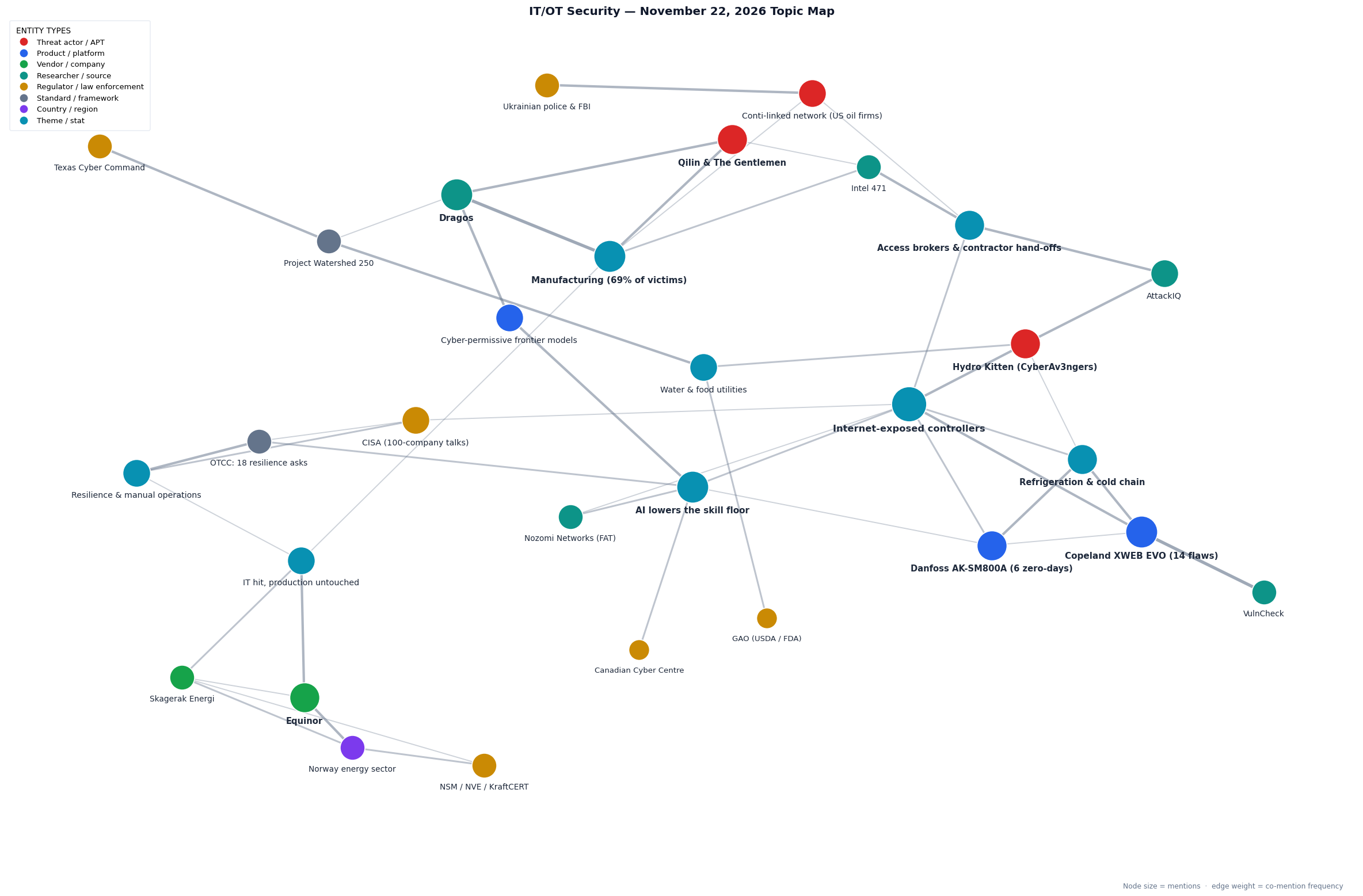
At right, internet-exposed controllers sit at the centre of the refrigeration story, linking Copeland XWEB EVO, VulnCheck and the Danfoss AK-SM800A to the cold chain, and to Hydro Kitten (CyberAv3ngers), which AttackIQ ties to access brokers and contractor hand-offs. At top, Dragos and Intel 471 connect Qilin and The Gentlemen to manufacturing, with the Conti-linked network and Ukrainian police and FBI above. In the middle, Dragos’ frontier-model tests, Nozomi and Canada’s Cyber Centre meet at AI lowering the skill floor, which OTCC links to CISA and resilience at left. At bottom left, Equinor, Skagerak Energi and Norway’s authorities cluster around IT-only intrusions; at top left, Texas Cyber Command and Project Watershed 250 lead to water and food utilities and GAO.
View interactive topic map →
Article index
Refrigeration and cold chain
Copeland XWEB EVO flaws probed within hours, six Danfoss zero-days found by hand, and Forescout’s count of exposed cold-chain systems.
Energy sector incidents
Two Norwegian energy companies contain IT intrusions, and Ukraine exposes a ransomware network that extorted US oil and energy firms.
Industrial ransomware and access brokers
Dragos’ Q3 industrial ransomware count and Intel 471’s view of access brokers selling into manufacturing.
Nation-state activity and the OT playbook
How Iranian groups share access, the OT attack pattern that keeps repeating, cyberwarfare reaching civilian infrastructure, and consumer devices on plant networks.
Water, food and sector policy
Texas’ water-utility pilot, GAO on food-sector gaps, CISA’s 100-company list and OTCC’s policy asks.
AI on both sides of OT
Frontier models tested on industrial ranges, AI-ready firmware tooling, and Canada’s advisory on AI-enabled attack tools.
Foundational reading
Zero trust limits in the OT standard, OT fundamentals, plants that cannot stop, long-lived IoT, smart-factory security, and engineering beyond NERC CIP.
Detailed write-ups
1. Copeland and Danfoss refrigeration controllers: scanned within hours, broken within an hour
SecurityWeek · The Register · Forescout · November 3-17, 2026
VulnCheck disclosed 14 vulnerabilities in Copeland’s XWEB EVO, a Dixell supervisory system now sold under the Copeland name, and researcher Valentin Lobstein says each one gave root on test systems. Nine affect only firmware older than a 2021 rewrite. The other five also affect current firmware: four come from predictable credentials, with the daily admin and root passwords derived from the device’s MAC address, which unauthenticated users can see, and the date, and the fifth is an authenticated command injection. Copeland ended software support for the XWEB EVO family on March 16, will not fix those five, and tells customers to move to XWEB Pro. Onyphe data cited by VulnCheck shows nearly 2,000 internet-exposed XWEB EVO hosts, against 108 for XWEB Pro.
The probing started fast. VulnCheck’s sensors saw exploitation attempts less than two hours after the CVE records were published on November 12: one address sent 125 requests overnight at CVE-2026-124014, an unauthenticated write to the system configuration file, and a second sent four probes on November 13 at CVE-2026-124010, unauthenticated root command execution. VulnCheck calls both opportunistic scanners, not the October campaign. “Operators who still run one should treat it as a device that must never touch the public internet,” Lobstein wrote.
A day later The Register reported that Carlo Meijer of Midnight Blue found six zero-days in Danfoss’s AK-SM800A, on firmware 5.3.2, in under an hour and without AI: five stack buffer overflows from unsafe strcpy() calls, and a pre-authentication memory corruption bug in the session-control layer that the product’s strict mode is meant to protect. The Centre for Cybersecurity Belgium warns the flaws could let attackers take control without credentials, keep access after resets, or disable controllers. Danfoss did not respond to The Register. Meijer called the vendor’s advice to rotate credentials, patch and enable strict session control insufficient: “We recommend against allocating scarce security resources to patching efforts and instead focus on reducing exposure.” CERT-FR has implicated Copeland, Dixell and Danfoss products in at least some of the European supermarket attacks.
Forescout’s cold-chain research puts the scale in context: 12,976 internet-exposed service observations across ten refrigeration and cold-chain product groups, on 6,017 public IP addresses in 99 countries, with Copeland/Dixell, Danfoss and CAREL among the vendors. It also notes the Pentagon’s open investigation into freezer failures at at least six military commissaries in August, and the November 5 joint fact sheet from CISA, FBI, HHS, USDA and DOT on hardening refrigeration and cold-chain monitoring systems.
Sources: SecurityWeek, The Register, Forescout
2. Equinor and Skagerak Energi contain IT intrusions; production untouched
The Record · Industrial Cyber · November 18-20, 2026
Equinor disclosed on the evening of November 17 that it had detected an ongoing attack on some IT systems. The company said oil and gas production was not disrupted, there was no sign of data theft, and the incident was not a virus attack, so there was no risk of it spreading. Spokesperson Ellen Maria Skjelsbæk told NTB that employees might have trouble reaching corporate applications and IT services; Reuters, citing a company source, reported that internal email was down. On November 19 Equinor said the attack was still under way, did not appear to target the company specifically, and had been reported to police. At 08:55 CET on November 20 it said the attack had been stopped, production was normal and there was no indication that data was stolen or altered. It has not described the attack, the systems involved or the actor.
Skagerak Energi, an eastern Norwegian power company, disclosed on November 18 that outsiders had broken into some of its IT systems. It said operations and production were unaffected and there was no sign of data leaking, and it notified the energy regulator NVE, the sector CERT KraftCERT and the National Security Authority, NSM. “Every day we have outsiders knocking on our digital door, but here someone has come a bit further, and we take that seriously,” spokesperson Kjell Løyland told Energiteknikk. Skagerak had not said its intrusion was stopped. Aker BP raised its emergency preparedness and monitoring and Statkraft said it was watching closely.
Nothing public links the two incidents, and both companies say the damage stayed in IT. That is the outcome every operator plans for, but the statements don’t say whether segmentation stopped an attacker who tried to go further or whether the intruders never got near operations. NSM had already raised Norway’s national cyber risk level in October.
Sources: The Record, Industrial Cyber
3. Dragos: industrial ransomware up 11% in Q3, manufacturing 69% of victims
Industrial Cyber · November 17-20, 2026
Dragos counted 1,266 ransomware incidents against industrial organizations in the third quarter of 2026, up 11% from 1,140 in the second quarter and 1,020 in the first. Manufacturing accounted for 876 incidents, or 69%, and its share has risen every quarter this year, from 62% to 65% to 69%. The number of distinct ransomware brands claiming industrial victims rose from 70 to 99. Qilin led for a sixth straight quarter with 195 claims, followed by The Gentlemen with 167, while Akira fell to 52 from 129.
The way in is familiar. Dragos says initial access came mostly from exploiting internet-facing edge devices and enterprise applications, often within days of disclosure, from stolen or brute-forced VPN credentials on devices without MFA, and from remote management tools. Data-theft-only extortion keeps growing relative to encryption. Dragos found no Q3 case in which a ransomware operator reached Stage 2 of the ICS Cyber Kill Chain; the operational impact reached plants through IT, ERP and virtualization systems.
Intel 471’s manufacturing report, covering January to October, points the same way. It counted 1,379 ransomware and extortion claims against manufacturers, 16.8% of all monitored victims, with Qilin, The Gentlemen and Akira the most active, and about 68% of claims involving firms with revenue under $50 million. Initial access brokers advertised footholds into 172 manufacturing entities, about a tenth of all offers it tracked; vulnerability exploitation explained 25% of the cases it could examine and brute force 16.3%, with VPN services the most common access type. Both counts come from leak sites and underground listings, not verified incidents.
Sources: Industrial Cyber, Industrial Cyber
4. Ukraine exposes a ransomware network that extorted US oil and energy firms
The Record · November 19, 2026
Ukrainian authorities, working with the FBI, arrested four suspected key members of an international ransomware network that had at least 27 members from Ukraine, Russia and Kazakhstan and links to more than 60 people across eight jurisdictions, including former Conti members. US law enforcement reportedly took part in the searches. Authorities did not name the group or the ransomware strain.
Prosecutors say the network extorted more than $40 million from at least 28 companies. Named victims include oil producer Warren Oil Company, which paid about $5 million in bitcoin; energy services firm Newpark Resources, which paid $1.5 million after an initial $10 million demand; tire maker Maxxis International-USA; and Quantum Health, which paid $5 million of a $15 million demand. Targets also included manufacturing, logistics, pharmaceutical, financial and critical infrastructure organizations. Police seized computers, phones, bank cards, about $370,000 in cash and €20,000, and suspects face up to 15 years in prison.
For energy and manufacturing operators, the case is a reminder that the groups hitting industrial firms are often established criminal crews with long histories, not new names, and that their payouts from oil and energy services companies run into the millions.
Sources: The Record
5. Iran’s ecosystem shares access, and the OT playbook keeps repeating
Industrial Cyber · Trellix · November 18-20, 2026
AttackIQ’s report on Iran’s state-sponsored cyber capability maps 20 groups, the government bodies they are tied to and the contractors that supply staff, tools and infrastructure, drawing on more than 200 references. Its central finding is a hand-off model: espionage groups establish and hold access, then pass it to destructive operators. It documents two cases, Helix Kitten (Scarred Manticore) to Banished Kitten (Void Manticore) and Static Kitten (Mango Sandstorm) to Storm-1084, and says destructive attacks are sometimes staged as ransomware or hacktivism. Several groups reach better-defended targets through subsidiaries, contractors and suppliers. For OT, the report describes Hydro Kitten, also known as CyberAv3ngers, as a sabotage group focused on internet-exposed ICS, HMIs and PLCs that has compromised Unitronics Vision PLCs using leased infrastructure and manufacturers’ own programming software. “Iran isn’t as technically sophisticated as China, Russia or North Korea, but what it lacks in sophistication it makes up for in cadence,” said Francis Guibernau of AttackIQ.
Trellix describes the pattern from the defender’s side. The same elements recur across sectors and regions: internet-exposed controllers with weak security, remote maintenance and third-party connections as a path into operations, techniques reused against new industries and equipment makers, and setpoint changes that cause spoilage, damage or safety risk. It cites the 2023 Unitronics attacks, France’s roughly 700 refrigeration sites, more than 30 Minnesota community water systems affected in July, and a refrigeration incident at an Israeli food plant in May. Its telemetry counts about 1,500 ransomware leak-site posts across five industrial sectors last quarter, up 50.8%.
LevelBlue SpiderLabs’ 90-page cyberwarfare report widens the lens: water utilities, European supermarket refrigeration, Jordan’s grain reserves, and false nuclear and chemical alerts pushed through emergency-warning apps in Ukraine and Russia on November 1-2. Its point is that the techniques are not new; phishing, credential theft and exposed systems are simply being used for bigger ends. All three are vendor syntheses rather than new incident disclosures, but they agree on the fix: know what is exposed, control third-party access, and plan to keep operating.
Sources: Industrial Cyber, Trellix, Industrial Cyber
6. Texas lines up 63 firms for water utilities; GAO finds gaps in food-sector support
Industrial Cyber · November 20, 2026
Texas Cyber Command announced that 63 technology and security companies have joined Project Watershed 250 and will provide assessments, technical assistance, tools and remediation at no cost to Texas water and wastewater utilities. The list includes OT specialists such as Dragos, Claroty Public Sector, Forescout, Industrial Defender and Xona Systems alongside Palo Alto Networks, Cisco, Cloudflare, Tenable, AWS, IBM, Deloitte and KPMG. The six-month pilot, launched in August by the White House Office of the National Cyber Director with the Texas governor’s office and TXCC, is aimed at smaller and rural providers that lack staff and money; Texas has more than 7,400 public water systems and 3,000 wastewater facilities. “Sixty-three companies raising their hands to help defend Texas water systems is a serious commitment from the private industry,” said TXCC chief TJ White. No enrollment numbers or results have been published yet, and the pilot is still accepting partners.
GAO reported on November 19 that USDA and FDA, the food and agriculture sector’s lead agencies, met most of their 16 cybersecurity responsibilities under the FY2021 NDAA but only partially met or missed five in information sharing and emergency preparedness, and have not run cyber emergency scenarios for the sector since 2024. Both cited limited resources and staff. GAO made five recommendations; HHS agreed and USDA disagreed. Food and Ag-ISAC counted 167 ransomware incidents in the sector in 2023, 206 in 2024 and 295 in 2025, and 227 through July 2026.
Sources: Industrial Cyber, Industrial Cyber
7. CISA picks about 100 companies for hardening talks; OTCC asks for resilience in AI security policy
CyberScoop · Industrial Cyber · November 17-18, 2026
CISA has identified about 100 critical infrastructure companies for an initial round of talks about hardening their systems, acting director Nick Andersen said at FedTalks. The list comes from overlaying two others: companies an intergovernmental Homeland Defense Working Group identified as providing the functions most important to the economy, public safety, national security and defense, and five to six years of intelligence on what adversaries seem to value, such as where they pre-position. Sector risk management agencies are involved. Andersen said the circle will widen because of interdependencies; a critical port, for example, brings in its energy and telecommunications providers, and he wants IT, OT and security providers in the room. The work ties to CISA’s 2030 strategy and its CI-Fortify assessments, which plan for isolation and recovery.
The Operational Technology Cybersecurity Coalition’s report, built from four summer roundtables with nearly 70 participants, makes 18 recommendations to put critical infrastructure resilience at the centre of AI security policy. They include a harmonized baseline built on CISA’s Cross-Sector Performance Goals, secure-by-design requirements, compensating controls for legacy systems that cannot be patched, money for under-resourced operators, an OT-specific AI governance framework that covers AI agents and other non-human identities, funding for the Cyber Response and Recovery Fund, reconstituting the Cyber Safety Review Board, and adopting CI-Fortify. It cites the SANS finding that only 15% of operators can sustain manual operations beyond 48 hours. “Congress and the Administration don’t need to start from scratch,” said OTCC policy director Michael Garcia. These are an industry coalition’s proposals, not requirements.
Sources: CyberScoop, Industrial Cyber
8. What frontier AI can do in OT: Dragos tests models on industrial ranges
Dragos · Nozomi Networks · Canadian Centre for Cyber Security · November 18-21, 2026
Dragos tested two cyber-permissive OpenAI models, GPT-5.5-Cyber and GPT-5.6 Sol, with safeguards relaxed for authorized testing, across seven assessments. Given only a subnet, a model classified a water pipeline range, built an asset inventory and wrote its own EtherNet/IP fingerprinting tool. It found two zero-days in software that manages protective relay data, rediscovered a known industrial router flaw in about ten minutes, and pulled HMI firmware from a vendor’s website, reverse-engineered it and exploited a live device. Twice the models disrupted equipment by accident: a PLC went offline and an HMI service crashed. Dragos assesses with moderate confidence that the models lower the barrier for less-skilled actors, mainly in reconnaissance and vulnerability research, while complex attacks still need human expertise. It did not test disruptive attacks and is not releasing tools. “The skill floor is dropping for the reconnaissance and vulnerability research needed before an attack,” said Rob T. Lee, Dragos’ chief AI officer. Its advice maps to the SANS ICS five critical controls: OT incident response plans, segmentation, monitoring for scans and malformed protocol traffic, retiring forgotten hosts and default credentials, and prioritizing exploitable flaws.
Nozomi Networks published its Firmware Archaeology Toolset, which mines Docker Hub and the Internet Archive for old SDKs and update packages. In one case it found a historical bridge package, reused the vendor’s own decryptor through targeted emulation, recovered encrypted firmware and apps, and reached a 0-click remote code execution chain on an unnamed IoT device; Nozomi is still working with the vendor. It released skills that let LLM agents extend and run the toolset.
Canada’s Cyber Centre warned on November 21 that attackers increasingly use automated and AI-enabled tools against internet-facing systems, led by ARTEX (about 46% of the tool infrastructure it identified), CyberStrikeAI and PentAGI. In some cases less than three hours passed between choosing a target and gaining privileged cloud access. The advisory is mostly about IT and cloud, but it points back to the Centre’s September warning about AI-assisted attacks on internet-exposed industrial controllers in manufacturing, energy, water, chemical and food.
Sources: Dragos, Nozomi Networks, Canadian Centre for Cyber Security
Calls to action
- Take refrigeration controllers off the internet. Find every Copeland XWEB EVO, Danfoss AK-SM800A and other refrigeration or building-management controller reachable from the internet or a contractor portal, remove direct exposure, and put remote access behind a gateway with MFA.
- Plan to replace XWEB EVO. Copeland will not fix five flaws in current firmware. Budget the move to supported hardware and, until then, isolate the units on their own segment.
- Review supplier and contractor access. AttackIQ and Intel 471 both point to contractors, integrators and VPNs as the way in. List every third-party connection into plant networks, remove standing access, and require named accounts with MFA.
- Check VPN and edge devices for MFA. Dragos says stolen or brute-forced VPN credentials on devices without MFA keep opening the door to industrial ransomware. Close any remaining gaps this week.
- Confirm IT incidents can’t reach operations. Use Norway as a prompt: test that your IT-OT boundary holds if corporate systems are compromised, and that plant staff know how to keep running without email and business applications.
- Hunt for forgotten hosts and default credentials. Dragos’ AI tests found leftover Linux hosts with default SSH credentials. Run the same sweep on your OT networks before someone else does.
- Apply for Watershed 250 help. Texas water and wastewater utilities, especially smaller ones, can request free assessments, tools and remediation from the pilot’s 63 partners.
|