This week at a glance
Ignite week turned the agentic SOC into a shipping product. Microsoft declared Perception generally available: a layer that coordinates red-team, blue-team and green-team agents through playbooks in a closed loop, with six agents (from alert triage to detection authoring) now GA and core ISOC capabilities in Defender out of preview. The 2026 Gartner Magic Quadrant for SIEM arrived the next day, and CrowdStrike used its Leader placement to pitch Falcon Next-Gen SIEM as the foundation for agents. Splunk brought Agent Mode to on-premises Splunk Enterprise by sending the LLM work to its cloud while raw logs stay local, and extended UEBA and Detection Studio to FedRAMP High customers. Startups kept pace: Exaforce lets any analyst build a personal team of agents, Corma raised $125 million at a $1 billion valuation to train defensive foundation models, and Fig Security’s partnership with Elastic traces upstream data changes to the detections they quietly break.
The people side is moving just as fast. In Strike48’s survey of 534 security and IT leaders, 74% now run agents in the SOC (up from 36% in May), 42% are retraining L1 analysts to supervise them and 38% are moving L1 staff into investigation. Gartner expects SOCs to employ 50% more engineers than analysts by 2028. Supervision is the weak point: Palo Alto Networks finds that 40% of organisations have been unable to reconstruct an agent’s actions, and 53% log agent activity under human identities or personal tokens. A CSO column names the result the benign true positive, a correct alert on an agent doing exactly what it was told.
Patch operations had a heavy week. Two critical NGINX HTTP/2 flaws, CVE-2026-123007 and CVE-2026-123633, were shown to give unauthenticated code execution in researcher demonstrations, with fixes in 1.30.7 and 1.31.9 and disabling HTTP/2 as the stopgap. F5 shipped out-of-band hotfixes for five critical BIG-IP flaws with no mitigation, Drupal fixed an installer RCE that anonymous users can reach, and SonicWall told Gen 6 owners to replace their firewalls because no further patches will come. Behind all of it, Google Project Zero is cutting its disclosure deadline to 60 days and then 30, Anthropic to 30 days for high and critical bugs, and Canonical is shipping AI-written Ubuntu patches to customers willing to test them before its engineers do.
On our watch list
- Exploitation of the NGINX HTTP/2 flaws. Wiz and Xint have demonstrated code execution and a container escape, but no attacks had been confirmed by November 19 and Wiz is withholding one proof of concept. Watch for a public exploit, a KEV listing, and fixed builds from official Docker images, OpenResty and ingress controllers. The archived kubernetes/ingress-nginx project will not get one.
- F5 BIG-IP after the hotfixes. F5 has not flagged the five critical APM and iRules flaws as exploited, but a September APM bug was used as a zero-day and Shadowserver sees more than 14,600 exposed APM fingerprints. Watch for exploitation reports and for F5 publishing fixed version numbers beyond the hotfix articles.
- Drupal’s “hours or days” warning. The Drupal Security Team said exploits for CVE-2026-132165 might appear within hours or days. Watch for public exploit code and scanning of /core/install.php.
- Perception’s preview agents and pricing. The Risk Reduction Agent, Web App Pen Test Agent, vulnerability shielding and the full SIEM capability set in Defender are still in preview, and Microsoft published no prices. Watch for GA dates, the cost estimator’s real numbers and the January 2027 AI Readiness preview.
- The shorter disclosure clock. Project Zero moves to 60 days in February and Anthropic to 30 days for high and critical bugs in January. Watch for other research teams and bug bounty programmes following, and for disclosures that land before a vendor fix exists.
- Ubuntu’s Edge archive in practice. Canonical’s AI-written userspace patches reach Ubuntu Pro users before human review. Watch for regression reports, the share of Edge patches later changed by Canonical’s engineers, and whether other distributions offer a similar channel.
- Agent audit trails. With 40% unable to retrace agent actions and 53% logging them under human identities, watch for SIEM and identity vendors shipping per-agent identities and replayable agent logs as standard features rather than add-ons.
- Whether the L1 retraining sticks. Strike48 found 42% retraining L1 analysts to supervise agents. Watch the next round of SOC hiring data for entry-level roles, and Gartner’s guidance on building entry paths before triage volume falls.
- SonicWall Gen 6 at the edge. No more patches will come for Gen 6 and 6.5 appliances. Watch for the first new SonicOS 6 vulnerability disclosed after end of support, which will stay open permanently on those devices.
- Copycat outage lures. The Microsoft 365 outage phishing campaign used fake service-health notices. Watch for the same template after the next large SaaS or cloud outage, aimed at other providers’ customers.
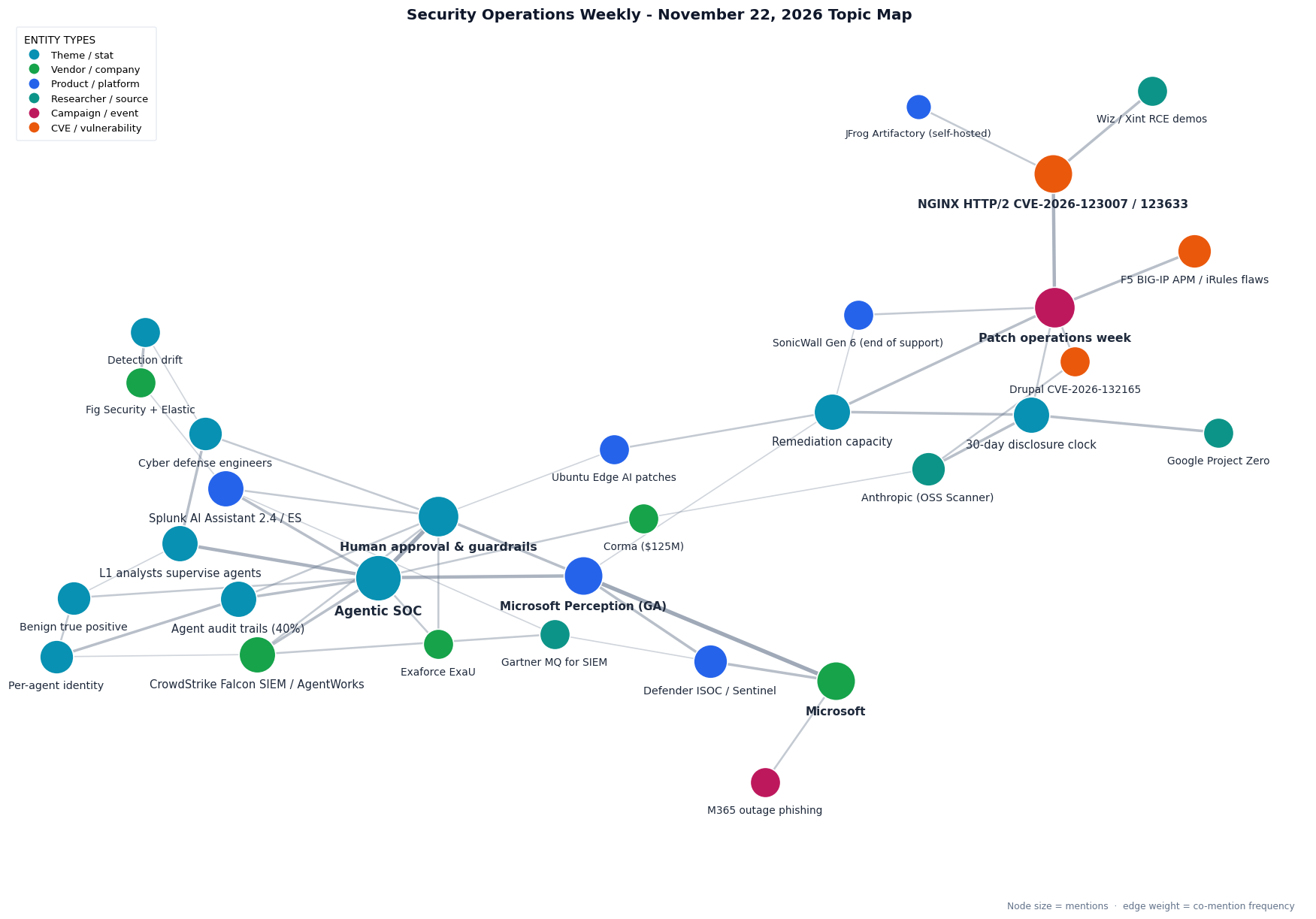
This week’s topic map: Microsoft Perception and the SIEM vendors’ agent push (Gartner MQ, CrowdStrike, Splunk), AI SOC startups (Exaforce, Corma, Fig and Elastic), the patch-operations cluster (NGINX HTTP/2, F5 BIG-IP, Drupal, SonicWall Gen 6), the shrinking disclosure clock and AI-written patches, supervising agents (audit trails, benign true positives) and the changing L1 role.
View interactive topic map →
Article index
Agentic SOC platforms and SIEM
Microsoft took Perception to general availability at Ignite, the 2026 Gartner Magic Quadrant for SIEM landed, and Splunk pushed agent features to self-managed and FedRAMP High customers. All five items are vendor-published.
AI SOC startups and funding
Personal agent teams for every analyst, a unicorn round for defensive foundation models, and a partnership that traces data changes to the detections they break.
Patch operations
Two critical NGINX HTTP/2 flaws (covered by BleepingComputer as NGINX2Root and by JFrog as Nginx2Shell), emergency F5 BIG-IP hotfixes, a Drupal installer RCE and SonicWall’s end-of-support warning for Gen 6 firewalls. The JFrog post is vendor research.
The disclosure clock and remediation capacity
Disclosure deadlines are shrinking, AI-written patches are shipping before human review, and two opinion pieces argue the constraint is now fixing, not finding.
Supervising AI agents
Whether you can reconstruct what an agent did, how to handle correct alerts on legitimate agent activity, and what builders learned from a SOC agent hackathon. The survey is Palo Alto Networks’, the CSO piece is a contributed column, and the CrowdStrike post is a vendor blog.
SOC roles and skills
L1 analysts are being retrained to supervise agents, Gartner expects engineers to outnumber analysts, and a vendor argues the three classic SOC roles are merging. The Gartner write-up is sponsored and the Vega post is vendor content.
Outages and resilience
Attackers used the Microsoft 365 outage as a phishing lure, and a survey finds that confidence in containment outruns the ability to reach equipment when the main network is down.
Detailed write-ups
1. Microsoft Perception goes GA: red, blue and green agents in one loop
Microsoft Security Blog · November 17, 2026
Microsoft’s Ignite announcement, written by Microsoft Security president and chief architect Aleš Holeček, declares Perception “now generally available”. Perception sits on top of Microsoft’s security stack and coordinates three kinds of agents through playbooks in a closed loop: red-team agents simulate attacks before a breach, blue-team agents detect and investigate, and green-team agents remediate. People set the guardrails and approve high-impact actions. Six agents are generally available: Posture Prioritization, Recon, Alert Triage, Attack Investigation, Detection Authoring and Threat Intelligence. The Risk Reduction Agent is in public preview, and a Web App Pen Test Agent, vulnerability shielding and an expanded preview of Codename MDASH, which analyses repositories of up to 5 GB, are also in preview.
For SOC teams the SIEM detail matters most. Microsoft says the Integrated Security Operations Center (ISOC) in Defender is now generally available for its core capabilities (SIEM, UEBA, threat intelligence and threat protection), and eligible Defender Suite, Microsoft 365 E5 and E7 customers get Sentinel SIEM features, though the complete SIEM capability set is still in preview. Default retention for Defender data is 90 days. Microsoft claims more than 165 trillion signals a day and more than 500 connectors, and has extended agent discovery by 35 local agent types to 60. The post gives no prices, pointing instead to cost-management dashboards and a cost estimator for AI usage.
Microsoft frames the launch against vulnerability volume: more than 96,000 CVEs published in 2026 against about 40,000 in 2024, and roughly 29 million internet-facing PHP services still vulnerable nearly two weeks after disclosure. “The more agency we give AI, the more transparency we should expect in return,” Holeček writes. All capability and scale figures are Microsoft’s own claims, and teams should check which agents their licence includes before planning around them.
Sources: Microsoft Security Blog (Security for the agentic era, powered by Microsoft Perception)
2. SIEM vendors reposition around agents: the Gartner quadrant and Splunk’s on-prem push
CrowdStrike · Splunk · November 18–20, 2026
Gartner published its 2026 Magic Quadrant for SIEM on November 18, and CrowdStrike says Falcon Next-Gen SIEM is a Leader. Its post is a pitch for the SIEM as the agent’s data layer: native Falcon endpoint, cloud, identity and exposure data with no added ingest cost, third-party pipelines on Falcon Onum that filter noise at ingestion, custom agents built in the no-code Charlotte AI AgentWorks workspace, and Charlotte Agentic SOAR with human approval for significant actions. CrowdStrike projects “up to 50%” lower storage costs and notes that results will vary. “The agentic SOC starts with SIEM,” it writes.
Splunk spent the week extending agents to customers who do not run its cloud. Splunk AI Assistant 2.4 adds a Cloud Connected mode for on-premises Splunk Enterprise: raw logs stay local, the LLM processing runs in Splunk-managed services, and no local GPUs are needed. Agent Mode breaks a question into steps, proposes searches for the analyst to approve, and summarises results. It needs only outbound HTTPS, but Cloud Connected deployments need a fresh install rather than an upgrade. The assistant is FedRAMP High authorised in AWS GovCloud (US), and since November 16 FedRAMP High Enterprise Security customers can also use UEBA (a separate entitlement), Threat Intelligence Management and Detection Studio (both included with ES Essentials). A third post describes Entity Profile in ES 8.8, which assigns profile levels and tags to assets and users from posture gaps or discovery filters and feeds those levels into the entity risk score.
All four items are vendor posts. The practical point for SOC leaders is the same as last week: SIEM selection is turning into a choice about where agent reasoning runs and what it costs, so ask for agent pricing and data-residency terms alongside ingest pricing.
Sources: CrowdStrike (CrowdStrike Named a Leader in the 2026 Gartner Magic Quadrant for SIEM) · Splunk (Bridging the Gap: Splunk AI Assistant 2.4 Brings Agentic AI to Every Deployment) · Splunk (New Expanded Capabilities Are Now Available for Splunk Enterprise Security FedRAMP High Customers) · Splunk (Entity Profile: Identify Contextual Risk Affecting Entities)
3. AI SOC startups: Exaforce’s personal agents, Corma’s $125 million, Fig and Elastic
SiliconANGLE · SecurityWeek · November 16–19, 2026
Exaforce’s ExaU lets any member of a security team create agents by describing the job in plain language or starting from a template. The agents remember decisions, exceptions and past instructions, work out what to do next from what the user is responsible for, and can be shared, so a CISO’s briefing agent can collect status from every team’s agents. ExaU runs inside Exaforce on the customer’s existing identity, cloud and telemetry connections, so no new tokens are minted. Agents investigate on their own, but any action affecting employees, systems or communications needs prior approval, and every step goes to the audit log. It is available now; Exaforce gave no pricing.
Corma raised a $125 million Series A at a $1 billion valuation, led by NEA with Sequoia Capital, Khosla Ventures and Coatue, bringing its total to $185 million. Founded in 2025 in Tel Aviv and San Francisco, it trains frontier foundation models for defence and deploys them as agents that work alongside existing tools. “Cybersecurity is now a battle of intelligence against intelligence, and Black October made that impossible to ignore,” said co-founder and CEO Alon Pluda.
Fig Security’s partnership with Elastic addresses a quieter failure. Detection rules depend on data arriving in an expected shape, and when a tool outside the security team changes that shape, rules stay enabled but stop matching. Fig’s Data Lineage, connected through a read-only API key, maps Elastic sources, pipelines, mappings and fields to the rules that use them, flags affected detections when something changes and suggests a fix, which teams can test against their own data and ship through CI/CD with rollback. It also checks translated rules before a SIEM migration cutover. “Elastic gives security teams control over their data, and Fig gives them control over the engineering around it,” said Fig CEO Gal Shafir. None of the three companies has published independent results.
Sources: SiliconANGLE (Exaforce's ExaU lets security staff spin up a personal team of AI agents) · SecurityWeek (Corma Receives $125 Million to Train Foundation Models for Defensive Cybersecurity) · SiliconANGLE (Exclusive: Fig Security partners with Elastic to show how data changes affect detection coverage)
4. Patch operations: NGINX HTTP/2, F5 BIG-IP, Drupal and SonicWall Gen 6
BleepingComputer · JFrog Security Research · Help Net Security · November 18–20, 2026
BleepingComputer’s “NGINX2Root” and JFrog’s “Nginx2Shell” describe the same pair of critical HTTP/2 flaws. CVE-2026-123007 is an integer underflow in HTTP/2 flow control that leads to an out-of-bounds copy (NGINX 1.9.5 to 1.31.8). CVE-2026-123633 is a use-after-free that needs NGINX to be proxying to a backend and running low on connection slots (1.19.7 to 1.31.8). JFrog rates both 9.2 under CVSS v4. Wiz demonstrated unauthenticated code execution on a server serving only static files over HTTP/2 and TLS, and Xint chained CVE-2026-123007 with a Linux kernel SCTP flaw to escape a Docker container as root. No attacks had been confirmed. Censys counts about 8.8 million services potentially exposed to the first flaw. Fixes are in NGINX 1.30.7 and 1.31.9 and NGINX Plus 37.0.8.1 or 37.3.0.1, which also address four lesser flaws. Until then, turn HTTP/2 off, reload, and confirm the old workers have exited. Official Docker images, OpenResty and ingress controllers stay affected until they ship updates, and the archived kubernetes/ingress-nginx project will not be fixed. JFrog says Artifactory SaaS customers need do nothing, while self-hosted customers should check every NGINX instance in front of Artifactory and disable HTTP/2 until a permanent patch ships.
F5 released out-of-band hotfixes for five critical BIG-IP flaws, stack overflows in Access Policy Manager and iRules, plus a high-severity APM SAML bug. They let an unauthenticated attacker crash the Traffic Management Microkernel or run code on vulnerable configurations. F5 says “there is no control plane exposure; this is a data plane issue only”, offers no mitigation, and has not flagged exploitation. Shadowserver tracks more than 177,000 exposed BIG-IP instances and over 14,600 APM fingerprints.
Drupal’s SA-CORE-2026-017 fixes CVE-2026-132165, an installer RCE that anonymous users can exploit to reinstall a site, found by Anthropic’s OSS Scanner, plus a moderately critical gadget chain. Upgrade to 10.6.22, 11.3.22 or 11.4.13. If you cannot, block /core/install.php, and note that a settings.php the web server cannot write to closes some paths. The team had warned that exploits “might be developed within hours or days”. SonicWall, meanwhile, told owners of every Gen 6 and 6.5 appliance on SonicOS 6.x to replace them now: they are past end of support, and “any new flaw, even a Critical one, stays open permanently on Gen 6.” Until replacement, disable WAN management and SSL VPN, enforce MFA and watch the logs.
Sources: BleepingComputer (Critical NGINX 'NGINX2Root' bugs let attackers hijack servers) · JFrog Security Research (Nginx2Shell: All You Need to Know About CVE-2026-123007 and CVE-2026-123633) · BleepingComputer (F5 releases emergency patches for critical BIG-IP RCE flaws) · BleepingComputer (Drupal patches critical RCE flaw, warns exploits may surface quickly) · Help Net Security (SonicWall urges customers to replace Gen 6 firewalls now)
5. The disclosure clock shrinks, and fixing becomes the bottleneck
CSO Online · Help Net Security · Infosecurity Magazine · November 17–19, 2026
Google Project Zero will cut its disclosure deadline from 90 days to 60 in February and to 30 in January 2028. The 30-day grace period after a patch ends immediately, severity will no longer change the timing, and the team will stop checking that a vendor’s patch works before publishing. Anthropic moves to 30 days for high and critical issues and 45 for the rest from January. “A vulnerability reported today presents a much higher immediate risk to users than one reported last year,” said Project Zero’s Natalie Silvanovich. The CSO report adds two numbers that explain the worry: in XOR’s benchmark the best models fully fixed only about a third of flaws, and VulnCheck counts 217 fixes among 7,349 public findings from Anthropic’s Glasswing programme.
Canonical is trying to close that gap with AI. Its opt-in Edge archive for Ubuntu Pro delivers userspace patches written by Surge, a pipeline in which one agent triages vulnerability feeds, another pulls the upstream fix, several models compete to write the backport and a panel of judge models must agree, with a human taking over on deadlock. Patches still pass Ubuntu’s deterministic tests, but they arrive before Canonical’s engineers have reviewed them, so turning Edge on makes the customer responsible for deciding whether a patch is safe for production. Kernel fixes are excluded. “We need to fight AI with AI,” Canonical says.
Two opinion pieces argue that faster patching alone will not keep up. An Infosecurity column cites DARPA’s AI Cyber Challenge, where autonomous systems found 54 of 63 planted bugs and patched 43 in an average of 45 minutes, and argues for runtime hardening of compiled binaries on systems that cannot be patched in time, measuring whether a flaw can be exploited rather than how fast a patch ships. In CSO, Corix Partners’ JC Gaillard says remediation is a management problem: build an operating model with clear owners for shared-platform fixes, emergency changes and risk acceptance, and measure verified exposure reduction rather than ticket closure.
Sources: CSO Online (Google and Anthropic push for faster patches as AI collapses bug discovery timelines) · Help Net Security (Ubuntu AI security patches are here, if you're willing to test them yourself) · Infosecurity Magazine (AI Now Finds the Bugs Faster Than We Can Fix Them, Stop Racing It) · CSO Online (Vulnerability management: The cybersecurity industry is still solving the wrong problem)
6. Supervising agents: audit trails, benign true positives and hackathon lessons
Help Net Security · CSO Online · CrowdStrike · November 2–17, 2026
Palo Alto Networks’ State of Cloud Security Report 2026 puts numbers on the oversight gap. Forty percent of organisations have been unable to reconstruct what an AI agent did (46% in financial services). Almost all use agents for autonomous or semi-autonomous actions in development pipelines, nearly three-quarters let them modify code, CI/CD configuration or production, and 53% log agent actions under human identities or personal access tokens. In the past year, 43% found agents or automated workflows running without security approval. Only 36% can monitor AI behaviour in production, and rotating compromised credentials takes 2.5 days on average.
In a CSO column, 7AI CEO Lior Div names the alert that follows: the benign true positive, a correct detection triggered by an authorised agent doing its job. Agents gather context broadly, work in parallel and move between systems at machine speed, which looks like reconnaissance, credential access or lateral movement. He wants each agent to have a named owner, scoped credentials and a place in an inventory, with no shared service accounts. He also argues for treating benign true positives as their own category and testing controls against real agent workflows, and he warns that broad suppression rules create blind spots attackers can use. “Trusted machines will increasingly look like attackers.”
CrowdStrike’s write-up of its AgentWorks hackathon, which drew nearly 100 nominations from more than 50 countries, turns that into build rules: point agents at work that never gets done, use the model only where judgment is needed and deterministic tools for queries and routing, cap tool calls and spend, and require a named human to approve consequential actions. Entries found 1,710 hosts running unapproved MCP servers and more than 25,000 hosts holding USB exemptions with no active approval, cut an MFA-reset investigation from 20 to 30 minutes to about 70 seconds, and cut one triage agent’s cost about eightfold by trimming its tools from 17 to 5. The survey and the hackathon post are vendor content.
Sources: Help Net Security (40% of organizations struggle to retrace AI agents' actions) · CSO Online (The benign true positive: When trusted AI agents look like attackers) · CrowdStrike (What Makes a Good Security Agent? 5 Lessons from the AgentWorks Hackathon)
7. The L1 role is being rewritten
Infosecurity Magazine · BleepingComputer · Vega · November 3–18, 2026
Strike48 surveyed 534 security and IT leaders at organisations with more than 200 employees in the UK, Canada and the US. Eighty-seven percent are redesigning their SOC because of agents, and 74% have agents deployed, up from 36% in May. Forty-two percent are retraining L1 analysts to supervise agents, 38% are moving L1 staff into investigation, 49% are hiring for skills such as AI detection engineering, and 30% are still adding entry-level analysts. Thirty percent give agents high or full autonomy. “I’d argue the models are mature enough. What’s immature is how most teams use them,” said Strike48 co-founder Tim Leehealy.
A Gartner report on the roles needed for an AI-enabled SOC, summarised in a sponsored BleepingComputer article, predicts SOCs will have 50% more engineers than analysts by 2028 and says “the SOC will not shrink by 2030.” Its advice is to move analysts to end-to-end case ownership, add prompt design, AI output validation and rollback to detection engineering job descriptions, run the SOC on case and decision metrics rather than alert counts, make exposure management a standing function, and build entry-level paths before triage volume drops.
Vega’s Orion Cassetto argues that the analyst, detection engineer and threat hunter roles are merging into a cyber defense engineer who owns the loop from deciding what to catch to reviewing the verdicts agents produce. In this model the engineer writes the skills that tell agents which sources to check and supplies business context, and agents cannot change production: new detections are saved as drafts and tuning changes as suggestions until a person approves them. Vega is a vendor and the post promotes its platform, but the approval pattern is worth copying whatever tools you run.
Sources: Infosecurity Magazine (Most SecOps Leaders Are Changing the L1 Role as Agent Use Grows) · BleepingComputer (Gartner Predicts SOCs Will Have 50% More Engineers Than Analysts by 2028) · Vega (The Rise of the Cyber Defense Engineer)
8. Outages as attack windows: Microsoft 365 phishing and the out-of-band gap
CSO Online · Help Net Security · November 17–20, 2026
Microsoft Threat Intelligence found a high-volume campaign that impersonated Microsoft 365 service-health notices after the recent outage, referring to the November 12 Exchange Online disruption. The emails said messages held during the outage would be deleted within 24 hours unless the recipient clicked “RESTORE MESSAGES”, which led through recipient-specific tracking links to a non-Microsoft domain. Randomised subject lines and a hidden fake conversation in the body helped evade filters. Indicators include the sender domains moments-notice[.]com, planetmaison[.]com and newbooker[.]com, subjects beginning “Outage” followed by a random string, and the landing domain reallifeaccounting[.]com. “We assess that the activity was likely credential phishing,” wrote Microsoft researcher Jeremiah Jasmin. Microsoft found no confirmed credential capture, and Defender for Office 365 blocked or quarantined the messages it caught.
An Opengear survey of 514 CIOs and CISOs shows why outages are hard for the SOC as well as for users. Among the better-prepared group, 93% were confident they could isolate compromised systems during an incident while keeping access to everything else, but only 15% could get secure management access straight away if the primary network failed. Fewer than a third had secure remote access and recovery in place before new systems went live, and about one in six do not formally test network resilience. Opengear sells out-of-band management, so read the findings as a vendor survey, but the gap between containment plans and the ability to reach the equipment is worth testing for yourself.
Sources: CSO Online (Hackers exploit Microsoft 365 outage to launch credential phishing campaign) · Help Net Security (Most CIOs and CISOs expect to contain attacks, though few can reach their gear right away)
Calls to action
- Find every NGINX that speaks HTTP/2. Include containers, OpenResty, ingress controllers and appliances that bundle NGINX. Upgrade to 1.30.7 or 1.31.9 (or the fixed NGINX Plus builds), or set http2 off and remove http2 from listen directives, reload, and confirm the old workers have exited. If you self-host JFrog Artifactory behind NGINX, follow JFrog’s guidance to disable HTTP/2 until the permanent patch ships.
- Install the F5 BIG-IP hotfixes. There is no mitigation for the five critical APM and iRules flaws, so apply the out-of-band hotfixes (K000164239, K000164058) to internet-facing BIG-IP first.
- Patch Drupal or block the installer today. Upgrade to 10.6.22, 11.3.22 or 11.4.13. Where you cannot, block /core/install.php at the web server and make settings.php read-only for the web server user.
- Retire SonicWall Gen 6 at the edge. Inventory every Gen 6 and 6.5 unit, including spares and branch devices, plan replacement, and until then turn off WAN management and SSL VPN and enforce MFA on remote and admin access.
- Hunt for the Microsoft 365 outage lure. Search mail telemetry for the sender domains and “Outage” subject pattern, find anyone who clicked through to reallifeaccounting[.]com, and for them revoke sessions, check MFA registrations, OAuth consents and new inbox or forwarding rules.
- Give every agent its own identity. Replace agent activity logged under human accounts or personal tokens with per-agent identities, a named owner and scoped credentials, so you can reconstruct any agent run end to end.
- Create a benign-true-positive disposition. Add a separate close code for correct alerts on authorised agent activity, review those cases weekly, and resist broad suppression rules for agent behaviour.
- Plan for 30-day disclosures. Shorten your internal SLA for critical internet-facing flaws, and write down the interim mitigations (feature disablement, WAF rules, isolation) you will use when details are public before a fix exists.
- Map your detections to their data. Pick your top 20 detections, list the fields and pipelines each depends on, and add a check that alerts when one of those fields stops arriving.
- Test out-of-band access. Run one exercise this month in which the primary network is unavailable, and confirm responders can still reach and isolate critical equipment.
|